




With more first-time buyers committing to a new yacht — often with less experience — what do you need to consider to make the biggest purchase of your life a pleasure?
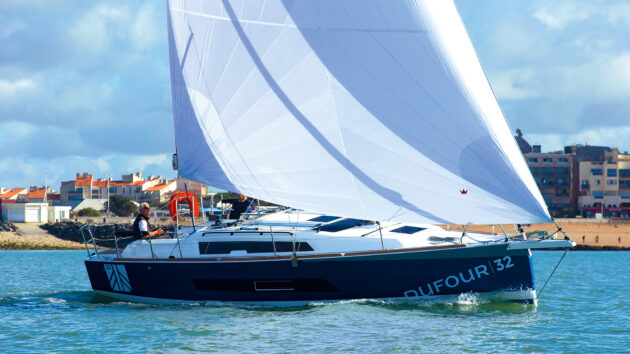
Mention that you’re buying your first yacht, and plenty of helpful advisors will warn you of the perils. Buying is an act of commitment with inevitable complications. Rigging, after a time, will demand the expertise of a rigger. The engine, that of an engineer. The electronics, likely a marine electrician. By committing to buy, you’re taking on considerable responsibility in exchange for the intangible pleasure of ownership.
The payback is experiential – going about buying your first yacht in the right way can help ensure this rite of passage is a positive experience from the outset.
An act of commitment
For a first-time buyer, it’s tempting to think the moment of commitment happens when you sign on the dotted line at the dealer. In practice, it starts when you decide to buy a yacht – and that’s the point you should begin thinking carefully about the ownership experience you actually want.
Ordering processes are better orchestrated than they used to be, but the reality of what arrives is still hand-built, at a relatively small scale compared to a car, for example.
Ben Nichols is sales director of Clipper Marine, the UK dealer for Bavaria, and he spends his working life meeting buyers at the point where excitement turns into decisions. He’s clear that new yachts are brilliant, but they are not perfect objects delivered into a perfect world. “A boat is hand assembled,” he points out. “The sea is a difficult environment. It will not be perfect – right from the beginning. And you’ve got to go into it understanding that.”
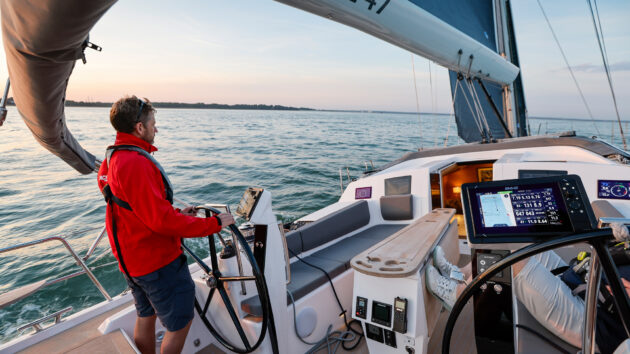
Consider how you plan to use your yacht, how much time you have, and where you’ll be based. Photo: Paul Wyeth
Part of that expectation reset is financial. “A £300,000 boat doesn’t buy you a Rolls-Royce, even though it’s the same price as one,” he says. “People do need to understand that’s the reality. If they’re looking for a Rolls-Royce experience, then the spend equivalent is quite easily going to be £1.5 million for the same length of boat.”
Yet the conclusion, for Nichols, isn’t that production yachts are somehow inferior – it’s that buyers should understand what the category has become.
“The gap between a production-built boat and something truly ‘bespoke’ is significant,” he says. “But the important point is that builders like Bavaria have got to a point where the quality of the production build is really, really good. We offer a great experience in owning a new boat, and it will be a real pleasure because we’re well-versed in what we do.”
Ignore pub ‘experts’
There’s always a chorus of opinion when you tell people you’re buying your first yacht. Some are helpful, some are romantic, and some are simply someone else’s decisions repackaged as universal truth. Nichols sees the same pattern repeatedly: buyers being pushed by other people’s compromises.
“There’s always that archetypal bloke down the pub,” he says.
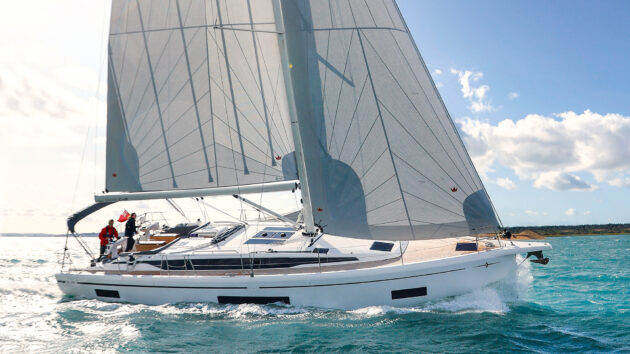
If buying new, consider service/dealer locations for any support or warranty follow-up. Photo: Paul Wyeth
“He’ll tell you you shouldn’t do it, you shouldn’t buy that, you should buy something else. And quite often, he’s coming from a position of his own experience. Perhaps he’s got a 40-year-old Moody with a shaft drive and that’s his reference point. It doesn’t mean he’s wrong, it just means it’s a compromise that he has made. You need to figure out what your objectives really are. That should always be your starting point.”
If you start by identifying your own objectives, the rest of the choices begin to organise themselves. Will you be primarily day sailing or cruising further afield? Sailing with two people or a crowd? Keeping the boat close to home or four hours away?
Those objectives might evolve, and the experience of owning a yacht will teach you plenty – but that is what a first yacht should do: build confidence, rather than frustration.
Warranty over brand
First-time buyers spend a lot of energy comparing models and layouts, but the biggest swing factor in early ownership can be logistics: how close the yacht is, what support exists locally, and whether a breakdown will steal the whole weekend.
“If you’re local to your boat, and you’re half mechanical, then sure, you can buy something older,” says Nichols. “You can chip away at it, you can learn, and get people in when you need them, and it can still be rewarding.
Article continues below…
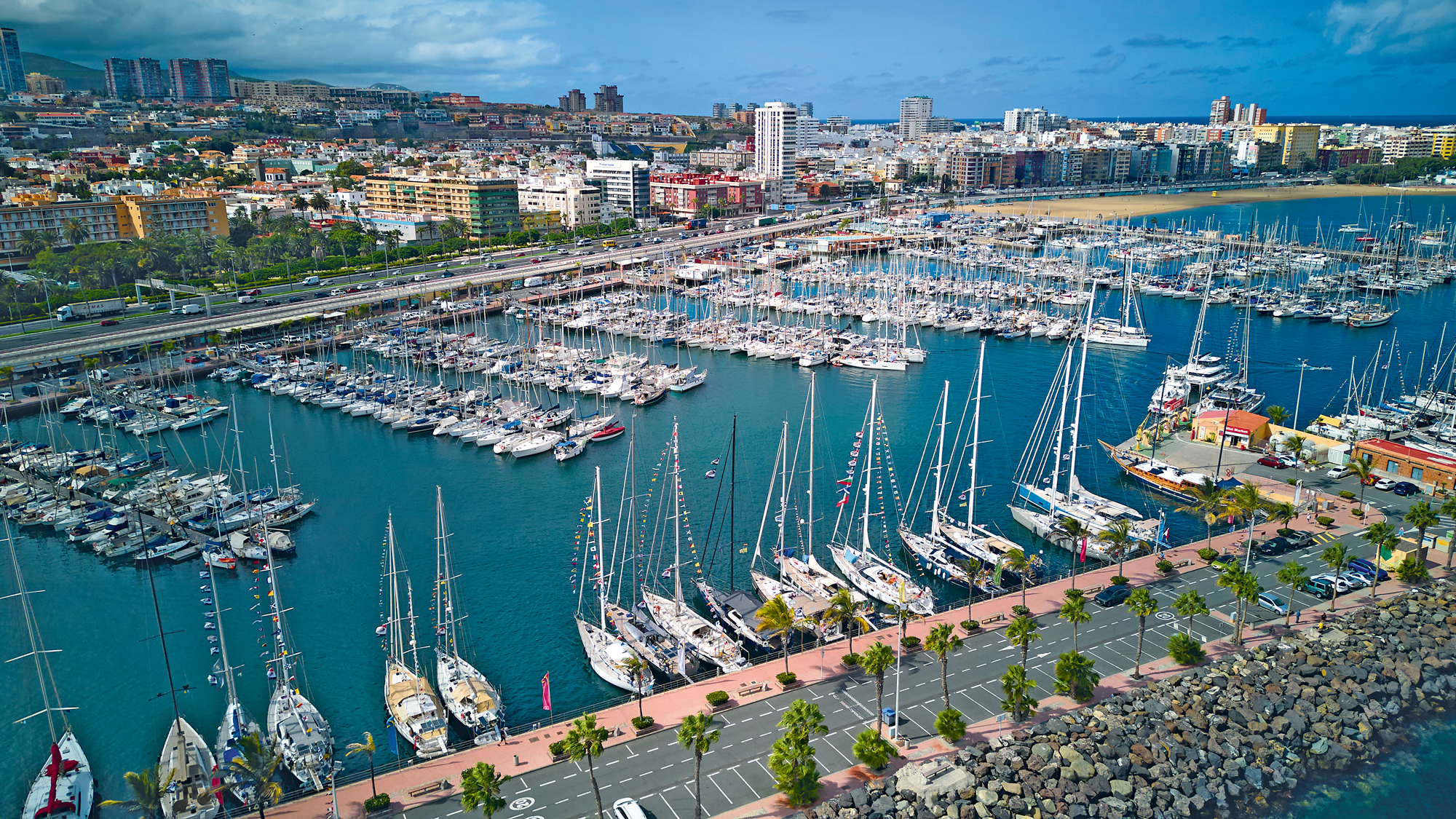
Is now a good time to buy (or sell) a used boat?
When activity levels drop, assumptions tend to fill the space. A softer economy should mean softer prices; fewer listings but…
“But if you’re travelling for four hours to go sailing at the weekend and something doesn’t work, you’re not going to get an engineer at the weekend easily. They’re going to be expensive, and you and your family are going to be frustrated. That’s when buying a new yacht with a warranty can really make a lot more sense.”
That isn’t about dismissing older yachts – a well maintained, well proven model can be a great first buy. It’s about matching the yacht to the reality of your time. A warranty can be less about ‘peace of mind’, and more about keeping your first season intact.
Stock boat appeal
When buying a brand new yacht there can be an additional risk: the gap between paying a substantial sum of money and receiving the yacht – and how exposing that can feel to a first-time buyers. One solution can be to buy an ‘ex-display’ model closer to home.
“A stock boat can remove the financial risk that comes with paying a deposit and then waiting,” says Nichols.
“People don’t always think about it. With a stock boat, you have legal ownership immediately, and physical delivery soon. If you’re nervous, if you want to protect yourself,
a stock boat can make a lot more sense.”
It also gets around the many assumptions novice buyers can make about unrealistic time frames. “People can wake up in April and want a boat to spec for May,” he says. “And it’s not going to happen.”
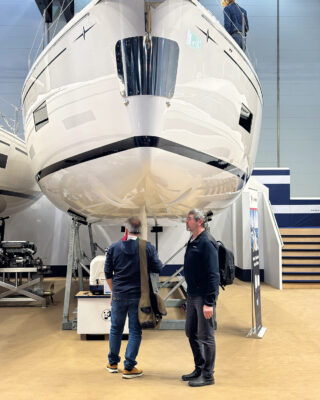
Ordering from a show might be appealing to get the exact specification you’re looking for, but a stock boat will be available much more quickly. Photo: Will Bruton
The last phase of delivery can compress quickly: suppliers, commissioning, snagging, scheduling, handover. Nichols recalls one buyer during the Covid period who made plans based on optimistic handover timing.
“We sold a boat in October for May delivery,” he says. “The customer made plans and ignored me. We ended up with about six weeks to handover. Generator, air con, watermaker, the whole lot – and it was three and a half weeks late. Coming out of Covid, that was actually pretty good.”
The detail matters because first-time buyers can think delays are a sign of something wrong. Often, they are simply a sign of how many moving parts there are in the process between ‘ordered’ and ‘ready to leave the dock’.
New yacht buying can make you feel as though you must decide everything up front. In reality, over-specifying is one of the easiest ways to spend money solving the wrong problem. It’s also one of the most common first-time buyer traps: spec’ing up for the ARC, but actually spending the next three seasons sailing locally.
“If you add a genset later on a modern boat, it’s generally easy,” says Nichols. “So, if you’re spec’ing with a view to doing the ARC three years later – fitting a watermaker, that sort of thing – do it later and get the right equipment.”
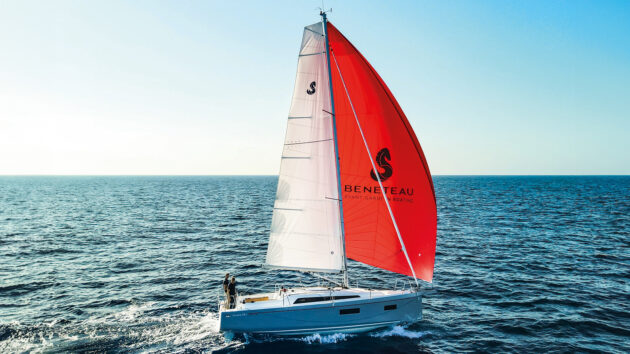
The Beneteau Oceanis 34.1 is a compact cruiser for anyone considering buying new for their first yacht.
Later doesn’t have to mean an afterthought. “You can even decide when you’re buying the boat that you’re going to add certain things later,” Nichols says, “so that the yard can put provisions in place – cabling routes, space, access etc – so it’s easy to fit the stuff properly when the time comes. But don’t be rushed into over-specifying the boat when you’re not going to use it in the way that you would use it on an ocean crossing.”
The aim is not to under-equip the yacht, it’s to keep the first season simple enough that you actually sail, and to keep budget in reserve for upgrades you’ll choose with real knowledge rather than imagined necessity.
Handover and support
The first year of ownership can be a steady build of confidence, or a sequence of avoidable frustrations. Which outcome you experience often comes down to the basics: proximity, documentation, and the relationship with whoever supplied the yacht.
“Keep it close to your supplying dealer,” Nichols advises. “If something goes wrong, call them in the first year of ownership. Don’t disappear off into the sunset and then get angry when you’re in a difficult spot.”
When sailing away, he adds: “Don’t go too adventurous at the beginning. Look at where the dealers are and where the support is before venturing too far away from them. Build your confidence, then extend your range.”
Whatever you do, it’s important to enjoy the process. “Above all, it should be fun,” says Nichols. “Don’t think that across the industry everyone is trying to lift money out of your pocket! Most dealers really don’t want the aggravation of selling people extras they don’t need.
“They’d much rather get a great result, and you be happy so you come back in the future.
“What you should focus on is what do you want to achieve? How’s the boat going to be used? Buy it really sincerely for you to have your very own experience.”
 If you enjoyed this….
Yachting World is the world’s leading magazine for bluewater cruisers and offshore sailors. Every month we have inspirational adventures and practical features to help you realise your sailing dreams.Build your knowledge with a subscription delivered to your door. See our latest offers and save at least 30% off the cover price.
Note: We may earn a commission when you buy through links on our site, at no extra cost to you. This doesn’t affect our editorial independence.