


Jochen Rieker explores the Pure 42, a German-built marvel that blends bulletproof aluminium with the lightweight soul of a performance racer
Pure 42 review: Why this alloy cruiser is the new benchmark for bluewater cruising

It has got busy lately in the explorer segment. While some of the traditional brands like Ovni, Garcia and Bestevaer are still trucking along steadily, new ones have complemented this special part of the market. Pure Yachts of Germany is the youngest, by far. Despite its rustic premises that once housed a commercial shipyard north of Kiel Canal, Pure is a startup. Only, it doesn’t feel that way. The company, now employing 20 gifted builders, was founded just a couple of years ago by three enthusiasts.
The trio originally met over a custom fit-out project. When they teamed up during long weekends, not only chips and sparks were flying, but also ideas. By the time the 49ft fit-out yacht was finished, they couldn’t imagine stopping there. So over a few beers they decided to keep going, this time in earnest.
The aluminium hull they completed was for Matthias Schernikau, now CEO of Pure Yachts and main shareholder. He’s the kind of guy you’ll more likely find in the workshop, a welding gun in hand, than in his office – a metalworker through and through, with great character and even greater ambition, as grounded and likeable as he is a natural born entrepreneur. Before he took to professional boatbuilding, which he swears he never planned to do, he had successfully started a highly specialised company for elevators, which he sold when its headcount reached 170.
“I wanted to slow down, manage less, spend more time with my family”, he says – only to find himself head-on in this new venture. Judging from what he and his fellow founders have achieved already, they are in for something big. And quickly too.
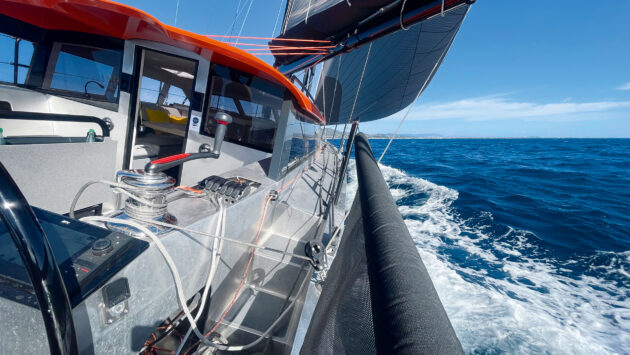
Walk-around cockpit with easy access to the side deck. Photo: Irk Boockhoff
Fervent approach
In the first year they revamped the yard, turning the first of two run-down construction halls into a glass-walled wonderland for high-end boatbuilding, complete with a five-axis milling machine, industry-grade CAD laser cutter, bending press, veneer press, a three-storey-high automated parts storage, and a huge paint box worthy of a classic car restoration clinic that can also be used as a chamber to temper complex GRP parts at up to 110°C.
It’s the kind of machinery you’d expect from the most established brands like Nautor, Baltic, Solaris, but hardly from a company yet to make any significant turnover, much less profit. And they are not even remotely done yet; last year, they started repurposing the second hall in a similar style. To call their mindset ‘aspirational’ would be an understatement.
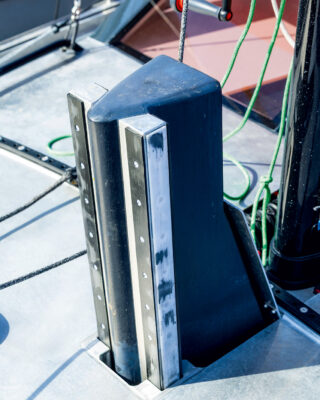
When raised, the top of the hydraulic keel protrudes from the deck forward of the mast. Photo: Irk Boockhoff
Pure Yachts is clearly set up to transform the trade. Schernikau, the CEO, who prefers a wool sweater over business attire, has taken a long-term view. “We want to do something new, something special. I wouldn’t be interested in becoming yet another builder of sturdy bluewater cruisers.”
And of course, it helps when you don’t need banks to invest. Having the liberty to buy or do what you think will be best is a rare privilege. The immediate rationale was “precision in everything we build”, says Urs Kohler, another of the founders. It’s reflected in the brand’s slogan ‘Think Exceptional!’ Yet it also proved an asset in recruiting.
While most yards are struggling to attract or retain skilled workers, Pure has become a magnet for the most talented. Take Till Manderscheid, a master boatbuilder who swapped a career at Sirius Yachts for a job at America’s Cup syndicate American Magic, and has since become a foreman at Pure. “For me it’s a jackpot”, he says, “being part of an all-new team with all those high-tech machines and possibilities, having the chance to create the perfect boatyard.”
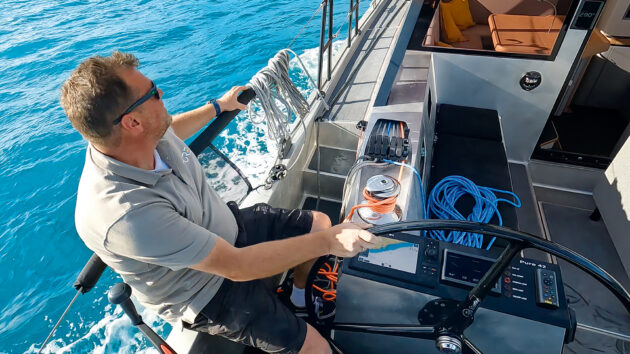
The helmsman can sit on the coaming with an adjustable guardwire and netting to lean against. Photo: Irk Boockhoff
This approach shows in the Pure 42, a boat engineered and built with fanatical attention to detail that opens an exciting new niche in aluminium go-anywhere-yachts, adding some proper performance to the list of so far mainly sturdy long-distance cruisers. She is Pure’s first production boat, and will be followed by a 52ft sistership later this year.
While the yard wants to maintain capacity for aluminium one-offs as well – after all, that’s what got it started in the first place – the 42ft deck saloon yacht will be its backbone: small enough to be handled by a couple, big and safe enough for months-long passages to the most remote places on the planet.
Pure tasked Martin Menzner, head of Berckemeyer Yacht Design, with the lines. He is a uniquely gifted naval architect: well-versed in aluminium boats of which he designed more than two dozen, but also a keen and successful J/80 racer.
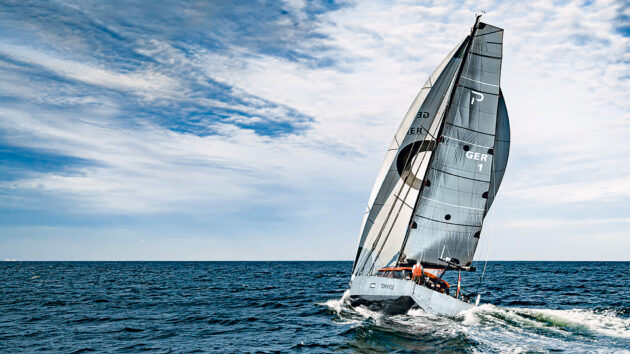
Powerful shape: the test boat also has an optional carbon mast and square-top mainsail. ‘Tom Kyle’ is an old German term for fjord, from which Kiel was derived – home to the Pure yard. Photo: Irk Boockhoff
42ft of pure quality
Little surprise, then, that the 42 sports a round-bilge hull forward of the mast and amidships.
While it requires more effort and man-hours to build than using straight sheet metal, it avoids turbulence along the edges, providing improved speed (and looks, too). Only in the aft part does the hull widen enough to require a hard chine, a typical feature on most contemporary hull shapes.
The design also differs from the swing keel or daggerboard arrangements many aluminium yachts offer, either as standard or as an option to a fixed keel. Instead, the Pure features a hydraulic lift T-keel with an exceptionally wide span between minimum draught (1.20m) and maximum (3.00m). It’s push-button operated from the helm station and, when fully up, the tapered top-end of the fin protrudes through the deck forward of the mast by half a metre.
Underneath, the Pure 42 carries a torpedo-shaped lead bulb weighing 3.3 tonnes – a third of the boat’s total displacement. When fully lifted it can, together with the twin rudders, support the yacht’s weight, allowing the crew to beach in shallow waters or to dry-out at low tide without additional supports. Rudder bearings sit in solid aluminium tubes welded into the hull and stiffened inside the watertight aft lockers by four massive knees each.
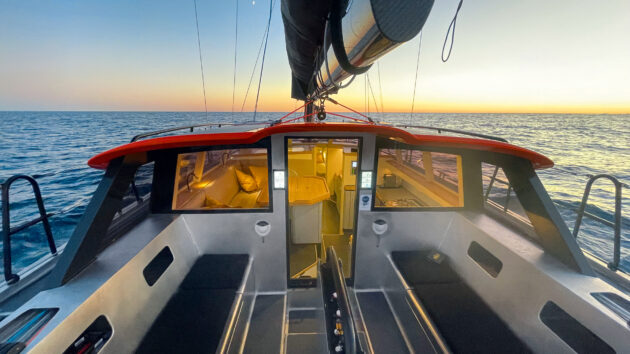
Well protected and connected: the overhang of the coachroof keeps rain and spray from the deep cockpit. Photo: Pure Yachts
This kind of fail-safe robustness guides all of the design. Saildrive and folding prop, for example, are protected by a skeg. Frames, stringers and plates have been generously dimensioned; all are laser-cut and machine-bent, high-strength, sea-water-resistant aluminium (AlMg 4.5 Mn). Hull panels measure up to 15mm thick in the underwater sections, 6mm and 5mm higher up, supported by massive T-frames every 80cm and longitudinals at less than 30cm intervals.
While Pure Yachts is ready to do the whole production in-house once the second hall is fully operational, the first five hulls are built in the Netherlands by Yachtbouw Folmer, a well-respected specialist for aluminium boats. When hull number one was delivered, the team in Kiel checked the construction by 3D-measuring it. No less than 85% of the thousands of data points obtained were within or below a tolerance of 1mm – precision unknown in GRP serial production.
It’s hard not to marvel at the technical prowess of the 42, which runs down to the smallest details. The rudders, for example, have recesses for the zinc anodes to be mounted flush, without compromising the flow of the water and thus the efficiency of the steering. Or take the thermal insulation: Pure is using Armaflex, a water-repellent material that is glued to the inside of the hull.
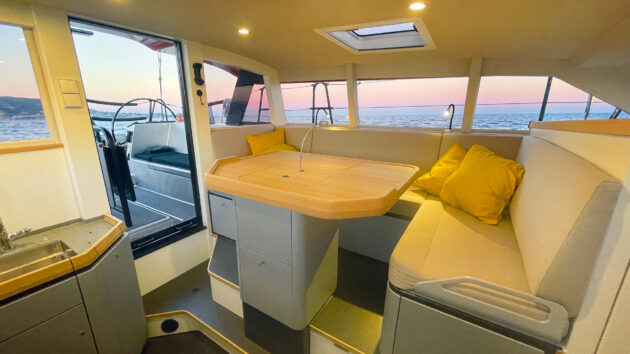
Full panoramic views from the deck saloon and galley. Photo: Andreas Lindlahr/EYOTY
To protect its soft surface, each panel is covered by an additional layer of glued-on PVC – even behind the furniture or cladding, where it will hardly ever be exposed. Equally impressive is that all composite seacocks are mounted above the waterline on welded standpipes; they can be exchanged at any time without lifting the boat or needing to dry-out. And the list of obsessive quality features goes on.
You can even feel it blindfolded. When the hull arrives in Kiel it has the roughness of 40-grit. Many aluminium yards sand it down to a 180 or 240 grit; Pure is going the extra mile to arrive at 320 – which is not just pleasant to the touch but also helps with aesthetics as it’s not easily compromised by fender marks.
Article continues below…

Buying a ‘Bulletproof’ Yacht: New and Used Adventure Boat Advice
Those planning to sail to inhospitable places tend to have a strong vision of what is needed from the craft…

Ovni 430 review: new interpretation of a successful concept
The concept of rugged aluminium centreboard boats is well proven, but can a boat displacing 14 tonnes when loaded sail…
£424,823.00
A new performance
And what about the sailing? This, in fact, is the raison d’etre of the brand, its USP. Pure is advocating a new type of long-distance cruiser by emphasising performance. All the usual properties of an alloy yacht – the high tensile strength of the hull and its elasticity in case of an impact with floating debris – are a given.
What sets the 42 apart is that she is supposed to deliver speed as well as robustness, even in marginal conditions. At 9.8t (9.7t with the performance package we sailed, including a carbon mast), she is more than 2t lighter than an Ovni 430 and still weighs 1.3t below a Grand Soleil 42 Long Cruise or 1.2t less than the smaller Hallberg-Rassy 40C, the latter two built in GRP. Most of the weight savings come from the light sandwich interior. Performance is also related to the efficiency of the deep, lift keel with its exceptionally low centre of gravity.
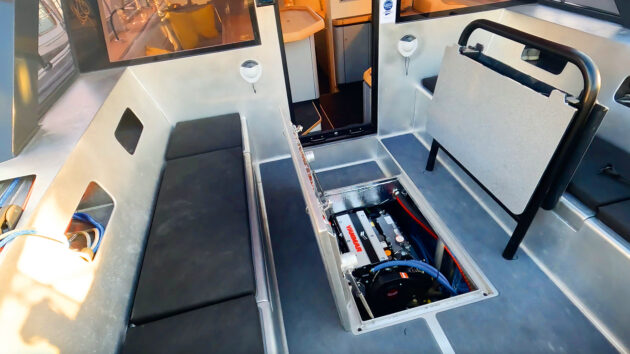
Cockpit benches open to vast lockers and engine access is excellent – from the cockpit sole hatch and lockers both sides. Photo: Andreas Lindlahr/EYOTY
At the same time, she is properly canvassed. Even in the standard version with aluminium mast and pinhead main, the Pure’s sail area to displacement ratio of 22 remains 10-20% higher than that of both the HR40 and the Ovni, matching the Grand Soleil’s. With carbon rig and square-top main, she indeed sits solidly in performance cruiser territory, above the X-Yachts 43, for instance.
But the bonus in power comes with the added complexity of running backstays. We sailed the boat in very different conditions: first, mid-October in Port Ginesta, off the Catalan coast, during European Yacht of the Year sea trials, which proved sporty. And again in November, in near-freezing but light conditions in the Baltic Sea. The Pure 42 handled both with ease.
Most surprising was her temperament in 6-10 knots of variable breeze in her home waters. Exploration-type yachts hardly come to life in such light stuff. This boat, however, doesn’t even require a Code 0 to get going. The 49m2 genoa and full main are enough to induce a light heel upwind and generate an easy 4.5-6 knots of speed at tacking angles clearly inside of 100°, nearing 90° in the upper wind range.
It’s an eerie experience on such a yacht, offering all the protection, all the safety and liveaboard comfort you can wish for, without ever feeling dull. She’s so balanced you can leave the helm for a minute to trim sails or check for traffic in the busy fjord without having to activate the autopilot. Visibility from the pedestal is excellent: because the coachroof sits low, it doesn’t obstruct the view forward or of the sails.
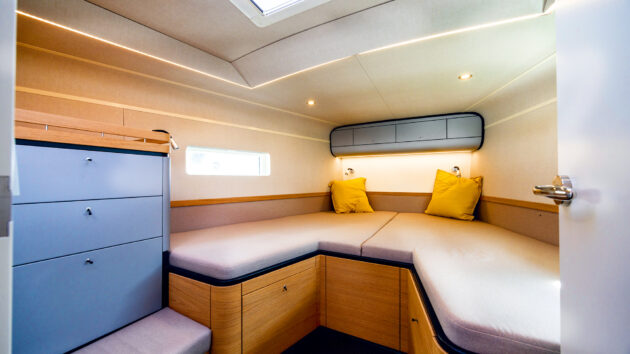
contemporary cosiness: the owners’ cabin forward has a wide berth and plenty of easily accessible stowage space. Photo: Andreas Lindlahr/EYOTY
And with the cockpit floor extending to the lowered side decks there are several positions for standing or sitting at the wheels. The low autumn sun, however, shining from the stern, turned the deck saloon windows into mirrors, blocking almost all vision through them. The yard will change from Plexi to ESG glass from hull number two, hopefully with less glare.
Headsail halyards are tensioned at the mast, on a dedicated winch; sheets and main halyard lead aft to the pedestals, where there are two Andersen winches on either side, one of each electric as standard. This can get a bit busy with the backstays, but it’s a simple and easy layout with good ergonomics, leaving the deep and comfortable crew cockpit uncluttered.
You find wide benches here, plus protection from the cuddy-like overhangs of the coachroof; so two crew can stay almost fully protected while outside. In the Med, wind and sea state were much more testing than in Kiel, with 17-22 knots of breeze and steep, disorderly waves of a metre or more. Upwind, the Pure could carry full main and the 24m2 staysail, averaging 7.2 knots boat speed – testimony to her impressive stability.
However, she needed a much firmer hand and some focus because of her rather direct rudder gear ratio. We should probably have put in the first reef, but since she didn’t need it, we kept ploughing through the Spanish sea to windward at 42-45° true. This is where you would clearly distance all the other alloy competition. The Pure’s potential offers more than just fun; it can also help get you out of trouble on a lee shore when the fuel level runs low.
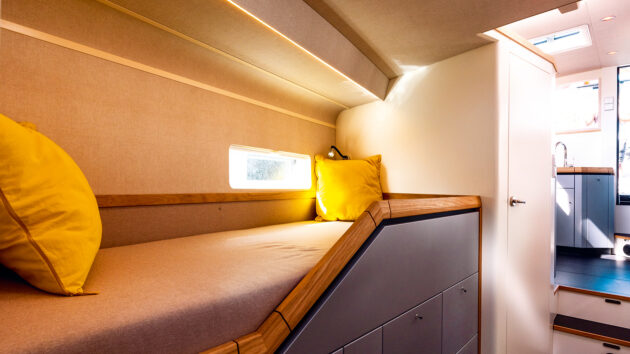
Amidships to starboard a pilot berth is one of many options. Photo: Andreas Lindlahr/EYOTY
Downwind, the asymmetric spinnaker boosted performance another notch. The Pure 42 easily reached and slightly exceeded her hull speed, clocking 9 knots on average with the occasional surfs at 11-12 knots. When the wind peaked at 25 knots she briefly lifted her bow and got onto short planes at up to 15 knots, leaving a flat sea in her wake. But you have to muscle her into this kind of sailing; it doesn’t come easy, at least not without proper ocean swells to help her accelerate downhill.
Still, you can rack up the miles in a way very untypical of the usual explorer yachts that don’t even lure you into helming yourself. To be brutally honest: the contrast between an Ovni or Garcia couldn’t be starker. And even one of the latest, very capable Boreals or Bestevaers doesn’t offer such joy in as wide a range of conditions as the Pure 42.
Contemporary luxury
Her accommodation also exceeds expectations. It looks and feels subtly luxurious and comfortably contemporary. Seated in the deck saloon or standing in the spacious, well-organised galley, the crew enjoys near unobstructed 360° vision. A couple of steps down, you find a day heads, ventilated by a side window as well as a fan. Forward, there is a space that can be an office, a workbench, a berth for the off-watch, even a settee with two comfortable chairs.
It’s where owners can pretty much choose what they like, thanks to the low-volume, semi-custom nature of the Pure 42. Crew quarters are amidships and in the forward cabin, both featuring comfortably sized berths as well as ample stowage. The owner’s bathroom with a separate shower stall is outright huge; originally it was also meant to be equipped with a heads, but that would have taken away most of its striking generosity. The yard believes the boat will be mainly sailed by a couple, only occasionally with kids or guests, thus the arrangement.
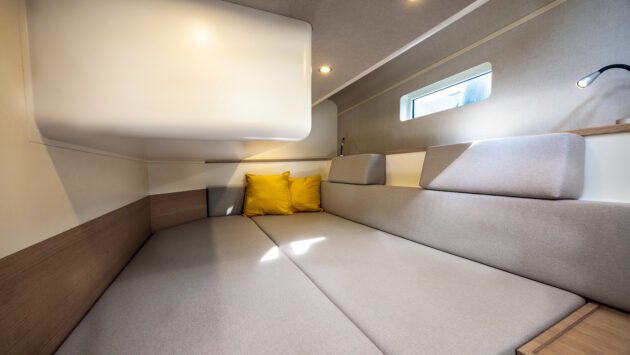
Large double berth for guests below the deck saloon. Photo: Andreas Lindlahr/EYOTY
Build number one is finished to such perfection that you need to spend some time finding the slightest imperfections – of which there were fewer than half a dozen, none of them crucial, all of them already on the yard’s snagging list. Extra grabrails near the companionway will be needed. The heating vent in the wet hanging locker was not yet installed, nor were the rubber seals below the lids to the aft lockers.
Underneath the harmoniously contrasted wood veneers and painted surfaces, almost everything of the 42’s furniture is foam-cored, even the floorboards. Except for a few edge bands, you’ll hardly find any solid or marine plywood – not in the kitchen modules which use aluminium structures, nor in the sole of the deck saloon, which, like the coachroof, is of sandwich GRP construction.
Very few performance cruisers are built this way. It is laborious and thus expensive, but it is an integral part of Pure’s ambition to keep displacement low. “We are saving close to 1.5 tonnes that way”, says Urs Kohler. Light weight doesn’t mean flimsiness: each of the drawers can take up to 80kg of load, for instance.
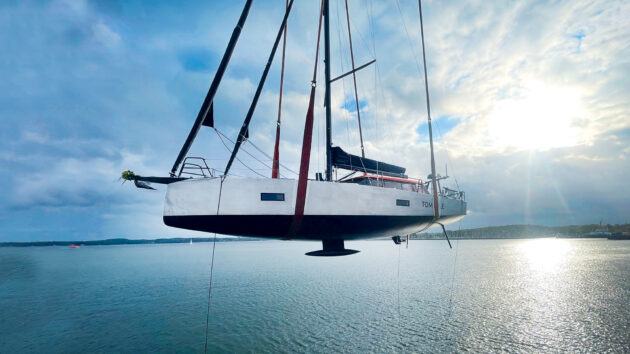
With keel lifted, the Pure can dry-out on its bulb and twin rudders. Photo: Andreas Lindlahr/EYOTY
Pure 42 specifications
LOA: 13.80m 45ft 3in
LWL: 12.30m 40ft 4in
Beam: 4.20m 13ft 8in
Draught: 1.2m to 3.00m 3ft 11in to 9ft 10in
Displacement: 9,800kg 21,600lb
Ballast: 3,300kg 7,275lb
Sail area: 99m2 1,065ft2
Water: 300lt 65gal
Fuel: 2x 200lt 2x44gal
Sail area/displacement ratio: 22.1 (Performance 23.8)
Displacement/LWL ratio: 147
Price as tested: €1,316,750
Design: Berckemeyer Yacht Design/M Menzner
 If you enjoyed this….
Yachting World is the world’s leading magazine for bluewater cruisers and offshore sailors. Every month we have inspirational adventures and practical features to help you realise your sailing dreams.Build your knowledge with a subscription delivered to your door. See our latest offers and save at least 30% off the cover price.
Note: We may earn a commission when you buy through links on our site, at no extra cost to you. This doesn’t affect our editorial independence.
Verdict
The claim to technological leadership makes the Pure 42 an expensive tool. Even considering the class and scope of her unrivalled standard equipment she sits clearly above her competition, with 2026 prices setting you back well over €1m (ex VAT) sail-ready. The performance package adds another €83,000. But if you want to go far, fast, in safety and in style, there’s hardly any better yacht to choose. Should you be in any doubt, pay the Pure yard a visit. And better yet, go sailing with one of the guys who run it. This 42 offers a new level of pure cruising indeed.