



The latest JPK, the JPK 1050 is pushing boundaries. A scow-inspired shape, with exhilarating performance that has led it to dominate IRC, in and well above its class. What makes it so outstanding? Jochen Rieker reports
JPK 1050 review: Absolute top-performing offshore monohull

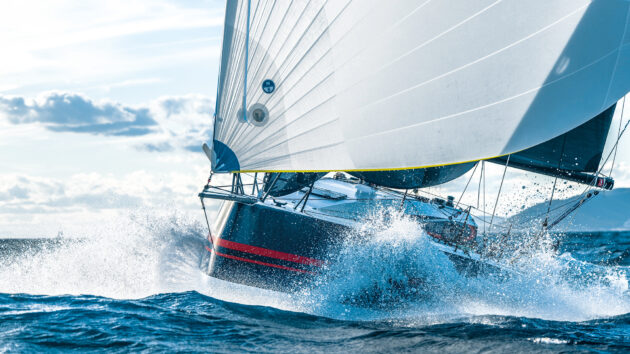
There are not many production shipyards that specify the weight difference of individual options compared to that of the standard equipment. Fewer still would list single-digit deviations with accounting precision as JPK does.
If you order the mast for the new JPK 1050 in higher-modulus carbon than the already light standard Axxon profile, for instance, you can save 5kg for an additional charge of €3,700. If you choose the boom in carbon instead of aluminium, you lighten your boat by 8kg and your bank account by €5,300.
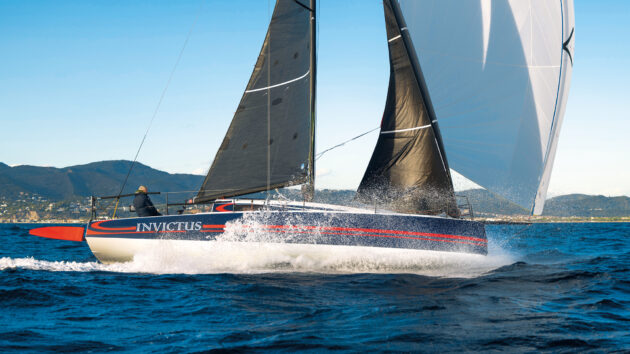
In full planing mode the 1050 is merely skimming along the leeward side of her powerful hull. The slightly
concave aft section helps get the bow up quickly even when the boat outpaces the waves. Photos: Andreas Lindlahr/EYOTY
The most efficient option would be to switch from the standard Yanmar diesel to the 20hp Lombardini with shaft drive: minus 25kg for a mere €3,200 surcharge.
Weight, or rather the avoidance of it, has always been one of the virtues of the shipyard that has made a name in competitive offshore racing. The company, operating from Larmor-Plage, opposite Lorient, the Mecca of the French sailing elite, has had a soft spot for asceticism from the very beginning. With its latest design, however, JPK is taking this another step further.
Looking at the total displacement, the 1050 does not appear to be extremely light at first glance: the 34ft distance racer weighs 3.48 tonnes. However, 44% of that is in the keel, which is an unusually high proportion of the total displacement by today’s standards.
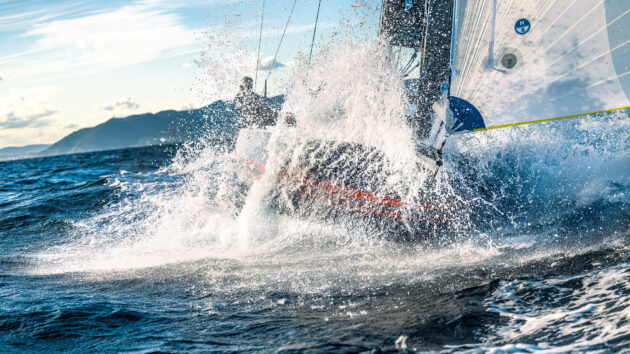
Photos: Andreas Lindlahr/EYOTY
In addition, the fin and lead bulb reach very deep at 2.22m. This lowers the centre of gravity and increases stability considerably. Excluding the ballast, the JPK weighs less than two tonnes. By comparison, its predecessor, the 1030, displaces 2.2 tons – despite its significantly less voluminous hull.
In fact, the differences are even greater than mere figures suggest. The JPK 1050 is by far the more modern and more radical yacht, a thoroughbred racer rather than a racer/cruiser. “We developed two variants at the beginning of the design process,” explains CEO and founder Jean-Pierre Kelbert: “One was more evolutionary, the other broke with our previous philosophy.” Both were conceived by the renowned Jacques Valer, probably the last architect who still draws his designs by hand, on paper.
JPK chose the revolutionary path. “In principle, she’s a small Class 40,” says Kelbert. That’s quite an accurate framing, even if the lines don’t look quite so extreme. While not an outright scow-bow design, the JPK 1050’s fore-section still looks beefy.
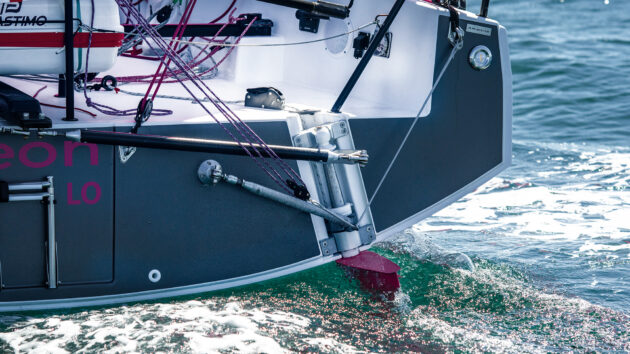
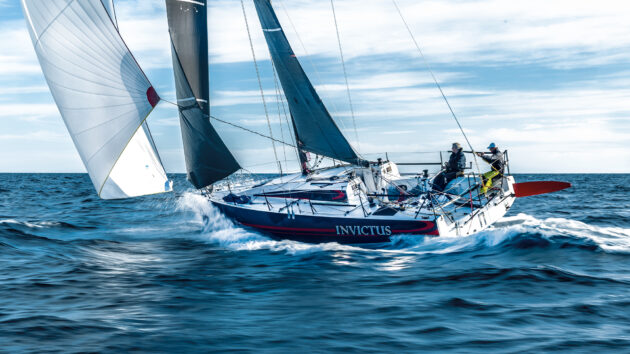
The twin transom-hung rudders are derived from Class 40 racers and can be lifted or locked easily using a purchase system. Photo: Côme de Préville
Her waterline begins a good metre behind the stem and remains very narrow. Aft, the hull runs very flat, with a slightly concave shape in the last third to keep drag as low as possible.
A sailing revelation
During testing for the European Yacht of the Year Award in mid-October, she had to perform in a wide wind range: from a gentle 5-8 knots to a brisk 20-25 knots. She proved a revelation throughout.
From the very first moment the boat seems to embrace you like an old friend: there is an immediate sense of intuitive trust. In the cockpit, littered with ropes, you quickly feel at home. Seating position, overview, line management: nearly perfect. So is the handling.
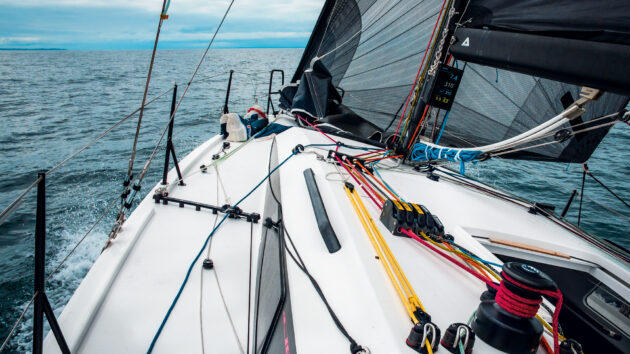
To facilitate single-handing, sheets and traveller control lines are led directly to the helm’s position, while 3D jib leads and other tweakers are quickly adjusted near the companionway. Photos: Côme de Préville / JPK Composites
The mainsail is sheeted in via coarse and fine adjustment on a central console, with the traveller line right at hand on the coaming. The backstays run to dedicated winches aft of the helmsman.
The genoa sheet is on winches just forward of the helmsman and can be led to windward – all within easy reach. It’s a layout JPK has honed and perfected over several model generations.
When underway, the crew will appreciate the footrest mounted in the centre of the forward part of the cockpit; it’s high enough to provide good support. Further aft, there are also GRP footrests either side, positioned a little too close to the coaming, however. You can securely brace yourself against them, but tall people will feel too much load on their thighs over time. On request, the shipyard therefore also offers fold-down U-shaped brackets that can be adjusted.
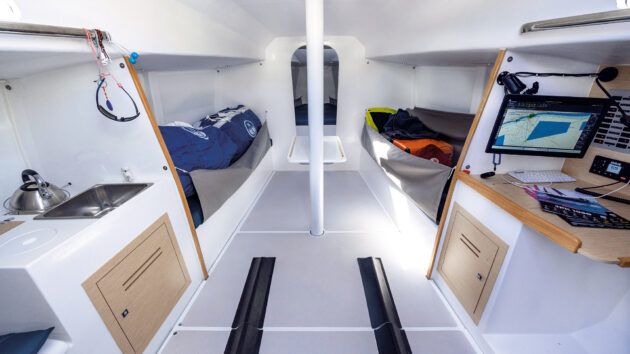
JPK’s raceboats have never been particularly cozy, but the 1050 feels even more basic – a result of the lightweight hull construction. Photos: Andreas Lindlahr/EYOTY
Otherwise everything’s fine, apart from the slightly high loads on the mainsheet. If you leave the sail unreefed in 16- to 20-knot winds, tightening it becomes an exercise, even with the fine adjustment. And in case you’re wondering, the JPK can indeed carry full mainsail even upwind in such conditions. This is made possible by the stability that both the keel and hull shape provide. As narrow as the waterline is at zero trim, its form stability increases rapidly when heeling.
With the traveller slightly eased, the mainsail can remain tightly sheeted without the JPK developing much windward tendency in a Force 5. The tiller remains light and super precise. The boat easily makes around 7 knots at a tacking angle of just under 90° true, quite good considering the wave pattern and hull shape. In flat water she points at 40-42° true. Because she is relatively light, she sails more over the waves than through them, thus remaining fairly dry. However, the 1050 requires concentration at the tiller because the rudders are long, with a high aspect ratio and thus provide loads of grip.
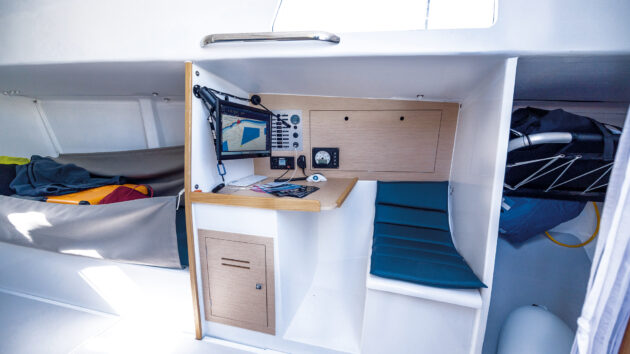
Headroom above the nav and galley seats was minimal on the test boat, something the yard will redesign. Photos: Andreas Lindlahr/EYOTY
Born to plane
After a few tacks, Kelbert prepares the A2, a 125m2 asymmetric spinnaker. In gusts, the wind is now well above 20 knots. Wouldn’t the smaller A5 do the job just as well? It still measures 102m2, certainly enough.
But as soon as the A2 is up, it becomes clear the bold choice was just right. Before the mighty bubble is properly trimmed, the 1050 already races forward like a greyhound: 12, 13, 14 knots… all this practically from a standing start and under autopilot, which has no difficulty whatsoever with the increase in power.
When steered by hand during the test, an effortless 14-15 knots was possible on average, with a top speed of 20 knots, all this without much help of the waves in a disorderly sea. The boat can be briefly brought up to 110° true to gain momentum in a lull, without even showing any signs of broaching. It’s precisely this combination of maximum agility and stability that makes the JPK 1050 so superior.
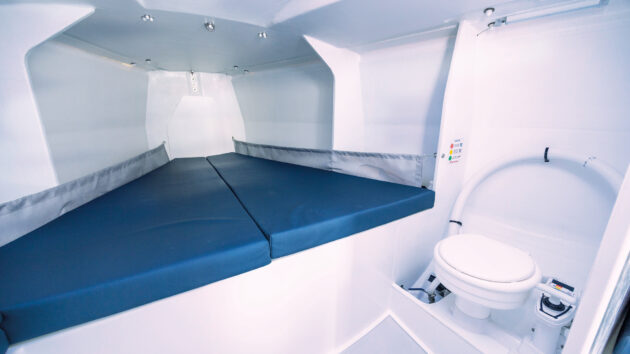
In the open forward cabin ringframes limit the V-berth’s width, and the seawater toilet comes without a holding tank. Photos: Andreas Lindlahr/EYOTY
And it’s not her only forte. She is equally impressive upwind, with the sheets cracked open just a bit. Here she remains virtually unrivalled. At 60° true she goes a steady 9-10 knots, almost as if on rails. No wake, just the right amount of pressure on the tiller. That’s sailing in the ‘wow!’ zone.
The ease with which she delivers – this ‘not having to force it’ performance – is perhaps the most astonishing of her talents. It wasn’t like that from launch; it did require a bit of fine-tuning. The shipyard changed several sizes of bearings on the lifting rudders. JPK also extended the blades to almost 1.50m – a reason for that impressive balance and control.
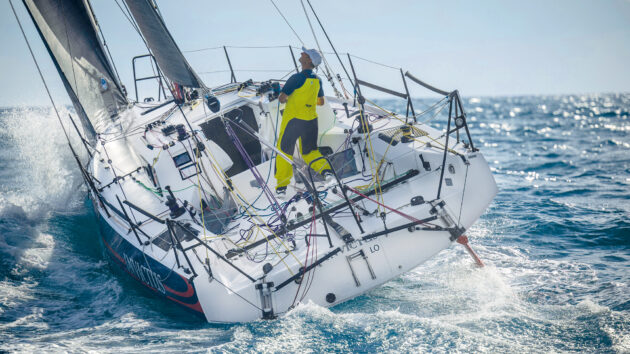
Master and commander: Jean-Pierre Kelbert enjoying and tweaking his new model. Photos: Andreas Lindlahr/EYOTY
The price of lightweight
Cabin layout and cruising comforts are not the strengths of the 1050, as would be expected for a pure raceboat.
In the depths of the cave-like aft cabins there is at best a double berth or a pipe cot covered with mesh fabric.
While the open forward ‘cabin’ offers more space and light, it does so only if the toilet is moved aft, which in turn makes one of the aft quarters quite cramped. And there is simply not enough headroom at the nav station, not even when seated (JPK says it is addressing this).
The yard does offer some more cruising-friendly interior options on request, like a galley module on the port side and some basic open shelves in the saloon, all of which is built from foam-cored GRP to keep displacement low. Even so, the JPK remains a thoroughbred sailing machine.
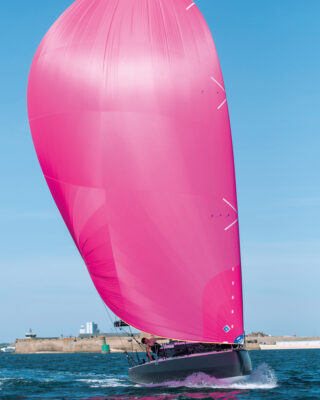
Photo: Côme de Préville / JPK Composites
Unfortunately, it is also pretty pricey. For the same money you could order two First 30s, which have similar hull lines, a more comfortable interior, and also quite considerable performance potential. But that’s like comparing a Volkswagen Golf R with a Porsche 911 Carrera GTS: both are fascinatingly fast – but the Golf is not in the same league as the Porsche.
The JPK 1050 undoubtedly represents the pinnacle of development in the series production of monohull offshore yachts her size right now. Not only did she win Spi Ouest and the Rolex Fastnet Race overall in her first Season, she then repeated her Spi Ouest victory this April in dominant fashion.
Due to this success, Jean-Pierre Kelbert even threw his resolution overboard to not sail any more transatlantic regattas above the age of 60. As we went to press, he was competing in the Cap Martinique transatlantic race, solo.
Why? “It’s just so much fun to sail this boat.”
Photos: Andreas Lindlahr/EYOTY
JPK 1050 specifications
LOA: 12.15m 39ft 9in
LWL: 8.10m 26ft 6in
Beam: 3.54m 11ft 6in
Draught: 2.22m 7ft 3in
Displacement (lightship): 3,480kg 7,672lb
Ballast: 1,520kg 3,351lb
Sail area upwind: 73.0m2 785.8ft2
Sail area downwind: 167m2 1,767.6ft2
Engine: Yanmar 21hp 15kW
Sail area:/disp ratio: 32.3
Disp/LWL ratio: 182.5
Price: €331,484 ex VAT – price of sail-ready, including carbon rig and sails test boat in full race trim
Design: Jacques Valer/Jean-Baptiste Dejeanty
 If you enjoyed this….

Yachting World is the world’s leading magazine for bluewater cruisers and offshore sailors. Every month we have inspirational adventures and practical features to help you realise your sailing dreams.Build your knowledge with a subscription delivered to your door. See our latest offers and save at least 30% off the cover price.
Note: We may earn a commission when you buy through links on our site, at no extra cost to you. This doesn’t affect our editorial independence.