


A report by the UK Marine Accident Investigation Branch has found that the skipper and crew of the Bayesian did not have access to key information on the yacht's stability when motoring or anchoring. It also found weather forecasts did not give the crew sufficient warning of potential hurricane-force winds.
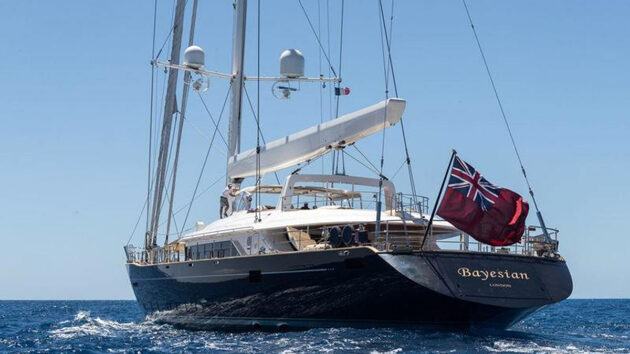
The UK Marine Accident Investigation Branch (MAIB) has released its full report into the sinking of the Bayesian superyacht in 2024. The sinking led to the deaths of six guests and one crew member, who drowned when the 184ft (56m) Perini Navi superyacht capsized off Sicily.
The report’s key conclusions are that there was no information in the yacht’s Stability Information Book regarding its vulnerability to knockdown while at anchor or motoring, only for under sail. The crew, therefore, were ‘unaware of a critical risk to the vessel’.
The MAIB report also found that the extreme winds on the night of the capsize were most likely the result of a violent downburst of hurricane-force winds. But it found that weather information available before the night of the tragedy was not sufficiently detailed to suggest the winds would be this powerful. No weather warning was issued for the Lipari Sea.
Chief Inspector of Marine Accidents, Rob Loder, said: “This accident developed with extraordinary speed. In just 14 minutes, calm conditions had given way to winds of at least 68 knots, which in less than 15 seconds pushed the yacht onto its side. Fifteen survivors escaped from the yacht and recovered to a liferaft that had been launched by a crew member.
“Our investigation found that Bayesian had a vulnerability to high winds that was not recognised, because the yacht had never been assessed at anchor with its sails down. The extreme winds that night were also not explicitly forecast, so the crew had no warning of the risk.”
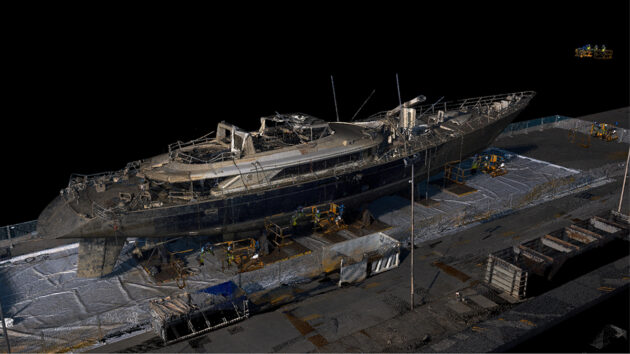
This photo: the salvaged Bayesian, image supplied by MAIB. Top image: photo by Shutterstock
In-depth investigation
Following an interim report issued in May 2025, the MAIB today issued a 137-page in-depth report into the events of the sinking, including the weather, the crew’s actions, and the condition of the yacht itself on the night of the capsize, 19 August 2024.
The report follows a thorough investigation, including stability testing by experts at Southampton’s Wolfson Unit, and weather analysis. The Wolfson Unit investigation considered the impact of the yachts’ 72m mast, furled sails, points of downflooding, tankage, and many more factors.
The report states: ‘The investigation found that, with no sails set, Bayesian’s windage and stability characteristics left it vulnerable to knockdown in severe winds. This vulnerability was affected by its loading condition, apparent wind angle and the position of the centreboard, but had not been identified in the originally approved stability information available to the crew.”
On the night of the tragedy, the yacht was at anchor. During salvage, it was identified that the centreboard was raised, and its external hull shell door closed.
According to the MAIB report, the yacht’s Stability Information Book (SIB) detailed information for the master and crew on operating under sail, including critical heel angle. However ‘the SIB did not include any information on [the effect of heeling motion] in the motoring condition with the centreboard raised and no sails set.’
The report also highlights the fact that ‘Bayesian had a propensity to yaw at anchor when the centreboard was lowered. This increased snatching on the anchor cable and the consequential dragging risk.’
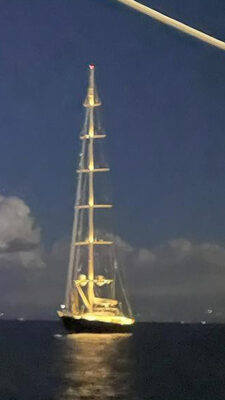
The Bayesian at anchor on the night of the sinking, photographed by Captain Karsten Borner of the neighbouring yacht Sir Robert Baden Powell. Image supplied by MAIB
Due to these factors, and the uncomfortable motion onboard caused by excessive yaw, the centreboard was rarely lowered when Bayesian was at anchor.
The report continues: ‘without knowledge of the vulnerability of Bayesian to extreme weather, no actions to mitigate the risk of knockdown in the motoring condition had been identified and included in the SIB for the guidance of the crew.
‘The vulnerability of Bayesian to wind heeling moments while in the motoring condition had never been assessed, resulting in the crew being unaware of a critical risk to the vessel and unable to take account of it in their operations.’
Not sufficient warning
The report also concludes that weather forecasts before the night of the capsize did not give the crew sufficient warning of the likelihood of such extreme weather.
It states: ‘Information contained in guidance provided to mariners did not provide sufficient detail of the impact of possible weather conditions to support decision-making. The weather forecast for the area, while predominantly correct, did not indicate the risk of downbursts from the thunderstorms predicted.’
Italian prosecutors suggest crew at fault
The MAIB report’s findings are in stark contrast to claims made in separate legal proceedings. The MAIB is investigating the incident as the Bayesian was a UK-flagged vessel. Its report is not intended to determine liability or apportion blame.
Separately, Italian public prosecutors have been conducting their own investigation into the sinking. According to findings released to Italian media yesterday, the Bayesian sank due to ‘crew error’, rather than design faults of the yacht.
The Italian investigation also found that the 70-knot winds amounted to ‘little more than a squall’, and that the crew should have been able to react to the change in conditions.
The MAIB report identified that at the point of knockdown, Bayesian took less than 15 seconds to go from 10°-20° of heel to lying flat in the water.
Three members of the Bayesian crew – skipper James Cutfield, chief engineer Tim Parker Eaton, and crew member Matthew Griffith, who was on watch that evening – are under investigation by Italian authorities for their part in the tragedy. No criminal charges have been issued.
Counter-claims in High Court
In a complex chain of legal proceedings, Perini Navi’s parent company, The Italian Sea Group also filed a €456 million claim in Italy against Angela Bacares, the widow of British technology entrepreneur Mike Lynch and owner of the Bayesian, for reputational and financial damage following the high profile sinking.
TISG initially insisted that the Bayesian was ‘unsinkable’. Bacares lost both her husband, and 18-year-old daughter Hannah in the tragedy.
A case has also been lodged in the UK High Court by Revtom – the Isle of Man company which officially owned the yacht – and Camper & Nicholson to cap potential payouts for personal injury claims made by survivors.
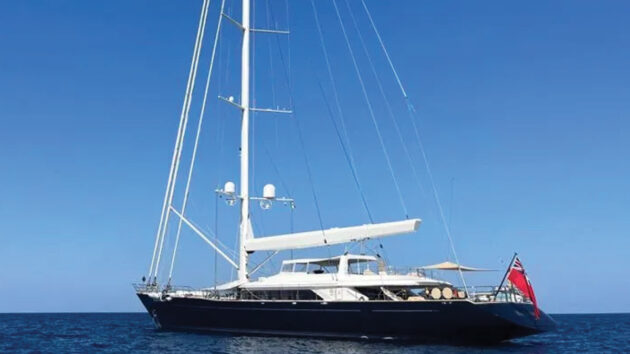
The Bayesian at anchor on a previous date. Image: Attilio Taranto/Marine Traffic, supplied by MAIB
This has been challenged by survivors including guests Charlotte Golunski and James Emslie, who escaped the Bayesian with their infant daughter. The family claimed the crew were ‘reckless’ and left guests to ‘scramble to safety on their own with very limited assistance’. They also called into question whether liferafts were deployed promptly.
The MAIB report details how the chief officer and master evacuated Becares, and three guests, from the saloon to the flying bridge through cascading water. It states that three crew were trapped in a diminishing airpocket in the wheelhouse, behind a closed door, and were assisted by a guest outside to escape.
The MAIB report recounts how the crew administered first aid to survivors in the water, and how two crew members swam back to the capsized Bayesian to try to release a liferaft from its stowage. None of the Bayesian’s liferafts automatically deployed during the capsize.
The report notes that ‘The safety of those crew and guests able to leave Bayesian following the accident relied heavily on the training, experience and initiative of individual crew members.’
Both the Italian prosecution and UK Admiralty cases are yet to be heard in court.