


Is it a boat or a revolution? Palanad 4 scales the scow-bow concept to 50ft, defying IRC norms with a blunt nose and raw power. Louay Habib reports
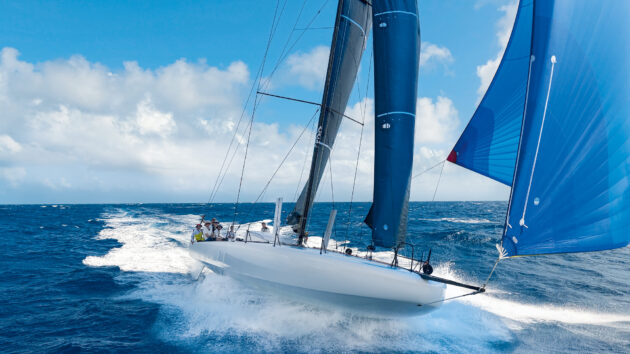
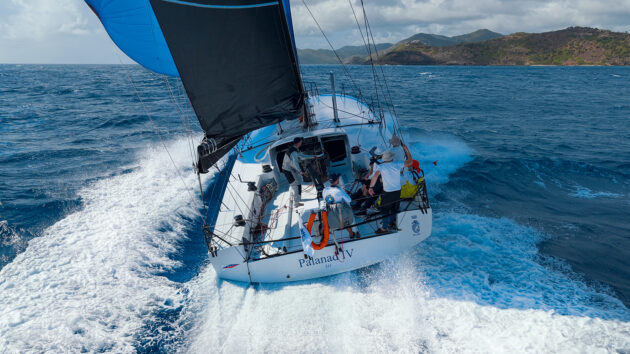
At first glance, the Mach 50 Palanad 4 looks as if it has arrived from a different discipline entirely when compared to her rivals in recent offshore races. The bow is wide and blunt, the sections powerful and unapologetic, the design is reminiscent of a Mini Transat rather than a conventional 50-footer built to race under IRC.
Yet this is no conceptual flight of fancy. Palanad 4 is designed to sail at high consistent average speeds across long distances – including the demanding miles of a transatlantic crossing – and to win under IRC.
The project is the latest evolution in a design journey shared by French skipper Antoine Magre and designer Sam Manuard, a collaboration rooted over multiple seasons of Class 40 racing and a growing conviction that the scow-bow concept could scale far beyond its origins.
Designer Manuard has long been acclaimed for his innovative blunt-nosed designs, which have been hugely influential in everything from the Mini 6.50 to IMOCA 60 class. In the Class 40 fleet his boats have dominated for many seasons. Among them was Palanad 3, which Magre sailed to win the 2021 RORC Transatlantic Race overall – the first Class 40 to do so – as well as class in the Rolex Fastnet Race the same year.
Palanad 4 is the next step. An idea made real: a custom offshore racer conceived with an unusually open design brief, freed from strict class constraints, and driven by a desire to explore where performance gains might still be found without resorting to foils.
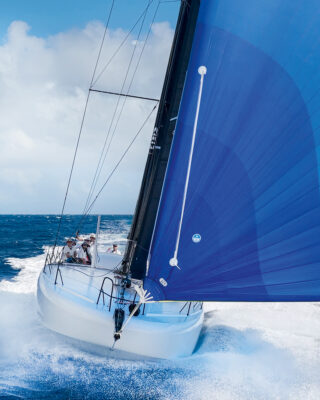
Palanad 4 averaged 17.68 knots over the 3,500-mile Transatlantic race. Photo: Roddy AcquaFilms/RORC
Scaling up
“The concept of Palanad 4 is basically a 50ft Mini Transat prototype,” explains Manuard. “A true scow-bow, twin daggerboards and a canting keel – but applied at a scale and under an IRC rule that allows much more freedom than a Class 40.”
That freedom is key. Unlike Palanad 3, which was shaped tightly around the Class 40 rule, Palanad 4 was drawn with much greater design freedom. The hull form is a pure scow, without the compromises sometimes imposed by box rules. Meanwhile the appendage package – a canting keel combined with twin daggerboards – is central to the boat’s power and control.
Unlike Class 40s, the rudders are not transom hung. Mainsail track across the transom and transverse jib tracks next to the mast base. Photo: Roddy AcquaFilms/RORC
Where compromises do exist, they are largely driven by the IRC handicap rule. “Most of the IRC tweaks are within the rig design and sail wardrobe,” says Manuard. “Without IRC we would probably have done a different rig, but the hull and appendages are exactly where we wanted them to be.”
For skipper Magre, the idea of scaling up the scow concept had been simmering since the launch of Palanad 3. “Even back in 2020, when we launched the Class 40, we were already thinking about what a bigger boat could look like,” he recalls. “A full-scale scow, no restrictions, where you can really play the game without class rule limitations.”

Photo: James Mitchell/RORC
That opportunity came when his father, Olivier Magre, committed to the project alongside Manuard. For Antoine, the transition from a Class 40 to a 50-footer was both familiar and entirely new. “Some of the sensations are similar,” he says, “but then you add the canting keel, the extra power upwind, and everything changes.”
The bow is characteristically beamy and full. “You could almost roller-skate on the foredeck,” jokes Manuard. But unlike the Class 40s, the Mach 50 carries a canting keel and twin daggerboards.
Downwind, the boat is notably dry. “At 20-25 knots of boat speed there is barely any water on deck,” Manuard notes.
“That’s not just performance – it’s comfort… and comfort is performance.”
But one of the biggest surprises has been just how effective the boat is to windward thanks to the effects of the chines when heeled. While scow-bows are often associated with reaching and downwind dominance, Palanad 4 has shown impressive upwind ability, delivering speed without the slamming traditionally associated with fuller forward sections, and without water ballast. Manuard noted: “The boat needs to sail above a minimum heel angle of around 18-20° in order to improve its hull drag as well as reducing the slamming impact through the waves.”

Photo: Arthur Daniel/RORC
Micro-movements
The boat’s early racing programme underlined both its potential and the scale of the learning curve ahead. After being launched in July last summer, the 2025 Rolex Fastnet Race was only its third proper outing.
“We were learning how to sail the boat while racing,” admits Antoine. “There were moments when we realised, just hours too late, that a small adjustment like lifting a daggerboard by just a few centimetres, unlocked another gear.” That early experience shaped a far more structured training programme through the autumn of 2025, focusing on polars, trim modes, and the subtle decisions that define offshore success.
“VMG angles are the hardest to master,” says Manuard. “Do you go higher and faster, or lower and slower? Small choices make huge differences, and we’re still learning.”
One key decision was whether to choose a wheel or tiller – they opted for a tiller. “The good thing about the tiller is that you really get a feel for the boat, and especially downwind, it is micro-movements sometimes to go nicely through the waves,” explains Manuard.

The scow-bow creates early planing, with the flat bottom generating lift and the wide bow power. The chine assists upwind performance when the boat is heeled. Photo: James Mitchell/RORC
“Having a scow-bow means there’s a lot less resistance at the tiller, which means helming is easier,” adds Magre. The main compromise he notes is that the tiller position has the helmsman sitting laterally, rather than standing up with a clear view forwards. “So it’s still within debate. But in terms of feeling, you really feel like you’re steering your Laser.”

Manuard and Magre stand by the daggerboard for scale. The cockpit has a central tunnel with all lines led through it – as per many Class 40s. Photo: James Mitchell/RORC
At night the helming experience steps up a gear. “At night, in the surfs, when the boat just takes off, you feel like you’re driving a dinghy but you don’t know where you’re going, so you’re just watching the numbers, following your angles. “The boat just keeps riding the waves and going and going!”
Transat ready
The 2026 RORC Transatlantic Race provided the first true test of the boat’s offshore credentials. Over thousands of miles – on what was very much a VMG race – Palanad 4 was sailed at a high intensity, and delivered what Magre describes as “a very strong first proof of concept”.
“Having the right boat is not enough,” he says. “Preparation and teamwork are everything. For this race we had time to train properly, and the difference was clear.”

Two-spreader rig with aero-optimised spreaders. Multiple deflectors assist in gybing the mainsail. Photo: James Mitchell/RORC
On a human level, the campaign has its own distinctive dynamic. Olivier Magre races aboard as owner and crew, but the hierarchy is clear. “I am always the father,” he laughs, “but on board Antoine is the boss. He makes the decisions, and the crew follows.”
Designer Manuard also points to the advantage of a smaller crew: “Palanad 4 does not require a huge number of crew onboard since the hull form stability is huge. So compared to a more traditional slender hull, we sail with maybe 30-50% less crew. This is cutting down the sailing weight and the owner’s nightmares!”
The blend of family, friendship and high-level competition is part of what gives the project its energy and its pressure. Expectations are high, not least because the design is already being measured against some of the fastest offshore monohulls afloat (in the Transatlantic, Palanad 4 finished less than a day and a half behind the 111ft foil-assisted superyacht Raven).
With a 2026 season of major offshore races ahead, including courses that will test the boat across a wider range of angles, the team remains focused on experimentation. “We have to sail our own race,” says Magre. “We’re so different from the other boats that trying to match them doesn’t make sense. We’re still finding gears.”
For Manuard, success is not defined solely by results. “We come out of the RORC Transatlantic with a better understanding of VMG sailing, of how to unlock performance in these shapes, that’s a big win on top of the overall trophy.”
Palanad 4 is not trying to be a universal solution. But it does ask an important question: how much untapped potential still exists in offshore monohull design, if you are willing to challenge assumptions?
 If you enjoyed this….

Yachting World is the world’s leading magazine for bluewater cruisers and offshore sailors. Every month we have inspirational adventures and practical features to help you realise your sailing dreams.Build your knowledge with a subscription delivered to your door. See our latest offers and save at least 30% off the cover price.
Note: We may earn a commission when you buy through links on our site, at no extra cost to you. This doesn’t affect our editorial independence.