



NGO Skippers talk to Yachting World about doing search and rescue under sail, and the obstacles facing humanitarian vessels in the Central Mediterranean. Plus, what to do if you encounter a migrant boat at sea.
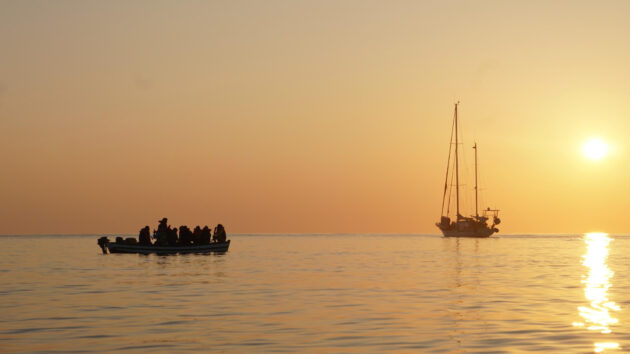
‘I read in the newspaper about people drowning in the Central Med and I asked myself whether I needed to do something,’ says Johannes, a one-time Tall Ships Skipper.
He is now a Skipper on NADIR, the 18m steel-hull ketch run by the NGO RESQSHIP, which conducts monitoring activities to help refugees in the Central Mediterranean.
Since its founding in 2019, RESQSHIP alone has assisted more than 13,000 people. Every year, its operational vessel hosts 70 volunteers across 10 rotations.
Some, like Johannes and Lauren, who’ll set off for her first turn at the helm in September, come directly from the maritime world. Others have no prior sailing experience.
As Johannes and Lauren share their close-up view of a NADIR’s operations, they shed light on the knots and loopholes in Europe’s immigration systems and how civilian efforts have been working to untangle them.
Sailing yacht or search and rescue boat?
In many ways, NADIR is just like any other sailing yacht.
It’s classed as a pleasure craft, rigged for cruising, and crewed by civilians. It prepares for a mission as for any small crossing: repairs, resupplies, routine checks.
Yet, ‘It’s a different kind of psychological thinking and mental preparation,’ Johannes says, when you set off knowing you may have to jump into an emergency situation.
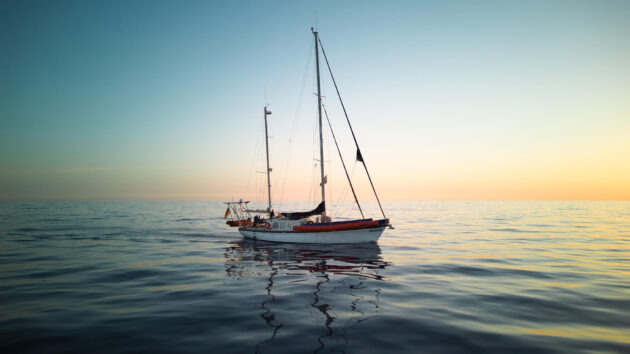
S/Y NADIR is an 18m steel-hull k etch conducting monitoring activities in the Central Mediterranean. Photo: Leon Salner / RESQSHIP.
When passage planning, NADIR’s skippers aren’t just concerned with keeping their own crew safe, says Lauren.
They’re also considering ‘who might be out there in an overcrowded boat, facing those conditions.’
Training for search and rescue
Roles onboard NADIR are multi-function, but every 7-person crew has a qualified Skipper, Co-Skipper, Officer of Watch, RHIB driver, and an onboard paramedic.
Many volunteers come without prior sailing knowledge, and undergo specialised training.
‘In the end, the doctors that might not have been sailing before, they might even end up knowing more than other sailors,’ Lauren says.
The crew drills skills most sailors might only try a few times until they’re second nature: setting out the tender in minimum time; coming alongside; performing man overboard recoveries in any conditions, with the target both conscious and unconscious; throwing lines accurately even over a crowded deck.
They establish clear procedures for recovering people from the water and guiding them to the right place to sit.
‘There are these very small steps that sound quite obvious when you speak about them, but in a rescue you don’t have the time to think about it,’ Johannes says. ‘All these procedures have to be trained and agreed on before.’
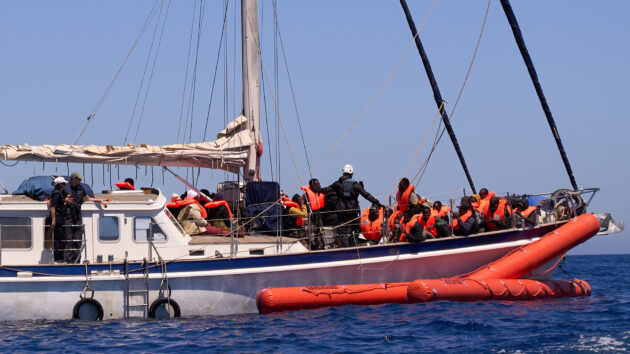
S/Y NADIR is an 18m steel-hull k etch conducting monitoring activities in the Central Mediterranean. Photo: Leon Salner / RESQSHIP.
Incoming crews also receive a thorough technical and mental preparation, as well as professional legal briefings and psychological support to help manage the emotional toll.
‘Mass casualty we face very often, so we prepare for this,’ Johannes says.
Sailing’s double standard
According to the International Organization for Migration, 2024 was the deadliest year on record for migrants.
8,938 people died on migration routes worldwide.
2,452 of these were in the Mediterranean, where the IOM says adequate search and rescue systems and safe and regular migration routes are urgently needed.
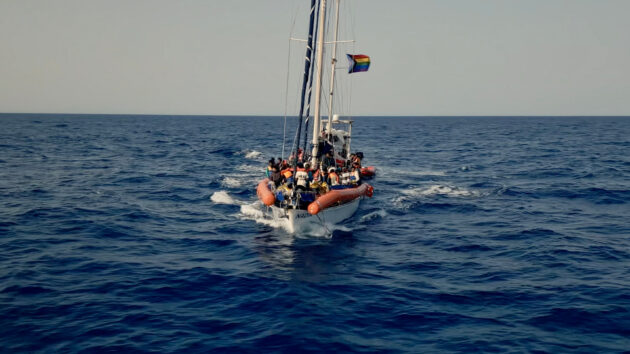
Every member of crew volunteering on NADIR undergoes extensive preparation ahead of each operation Photo: Leon Salner / RESQSHIP.
It can seem, ‘A bit crazy, this closeness of the sailing sport and money and us trying to do something,’ says Johannes.
The races that clip past the Island of Lampedusa, NADIR’s closest Port of Safety, ‘probably spend millions on the regatta sailing yachts, and 30 miles South there’s a rescue operation.’
He’s quick to point out another double standard between leisure cruising and maritime rescue.
‘One year ago, there was a luxury sailing yacht, Bayesian, sinking close to Sicily, and there was probably assistance there in 20 minutes. That got coverage.
Of course it’s very sad that people drowned there, but the public media attention it got was so much bigger than the boats with many more refugees sinking.’
Untapped potential
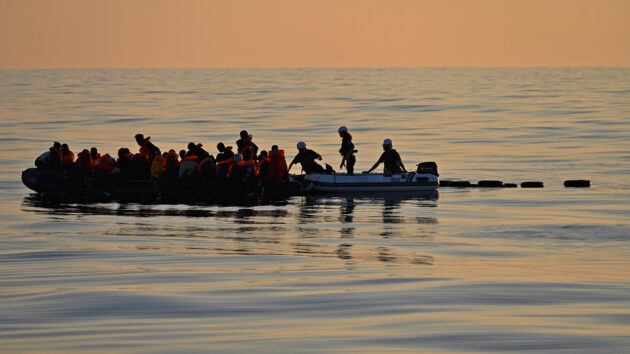
S/Y NADIR conducts monitoring activities in the Central Mediterranean. Photo: Friedhold Ulonska / RESQSHIP.
Johannes sees a lot of untapped potential in the cruising community.
‘I always walk through ports in the islands, and there are so many sailing boats just sitting there. There’s so much capacity, even if the states don’t act, to have a massive civil action.’
Besides NADIR, only a few other sailboats currently operate in the Central Med alongside search and rescue boats run by larger NGOs like SeaWatch, Mediterranea, and SOSMediterranee.
‘We speak of a “Civil Fleet,” but it’s just a euphemism. It’s still just a couple of boats out there, and not enough of them.’
The benefits of search and rescue under sail
When it comes to search and rescue operations, small sailing boats have unique advantages over larger motor vessels, both skippers maintain. First and foremost, their low cost.
‘We can do a three week rotation with 8,000 euro,’ says Johannes. ‘For the bigger ships, this doesn’t even cover one day of fuel.’
As a sporty motor-sailer, NADIR can both travel significant distances under engine and move by sail.
The sails offer greater stability and give NADIR the option of heaving-to while patrolling (instead of having to zig-zag back and forth), saving time, money, and fuel.
Heaving-to also offers extra comfort during sleep rotations, ensuring crews get enough rest to operate safely, which Johannes says is crucial to keep crews from making mistakes during operations.
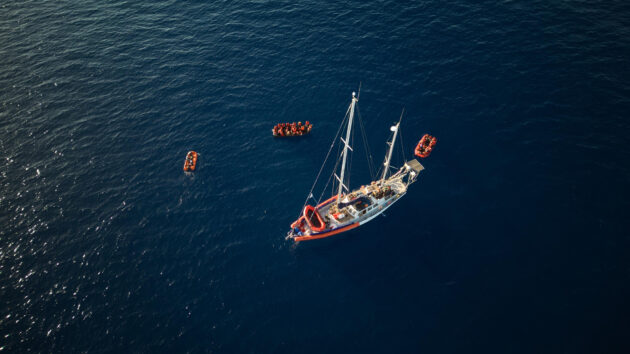
S/Y NADIR conducts monitoring activities in the Central Mediterranean. Photo: Leon Salner.
NADIR has a surprising capacity to store equipment and take on several passengers.
‘Lots of people probably can’t imagine having 100 people on a small vessel,’ Lauren laughs. ‘But you can take a lot before your own stability becomes a problem.’
It’s also small enough to dock next to the other yachts in Lampedusa, and to easily anchor in any one of the island’s sheltered bays.
This means it can reach the rescue zone more quickly than the bigger NGOs, whose larger search and rescue boats are regularly sent to the mainland under the controversial “Distant Ports” practice, through which Italian authorities have been regularly instructing NGO ships in the Central Med to disembark passengers in far-off ports in Central and Northern Italy.
What really happens on a search and rescue boat?
‘It’s a very different mental space you’re in on a search and rescue vessel instead of on a sailing yacht,’ Lauren says. ‘You’re in alert mode, in tune the whole time. It’s not a holiday.’
On a leisure cruise, ‘You wouldn’t expect a Mayday Relay, and it may take you a while to realise what’s actually happening. But when I’m on NADIR, it’s something I’m expecting.’
NADIR operates within its rights as a civilian vessel to monitor areas with a high concentration of distress cases, documenting and stabilising the situation.
‘This direct accountability is very effective,’ Johannes explains. ‘It already makes a difference when we are on scene.
Sometimes the authorities get alerted about a distress case, but the responsible MRCC does not take over coordination,’ or at least not immediately.
‘But once a German sailing vessel is on scene with cameras, they feel more obliged to. Then it will not be just a silent drowning in the night.’
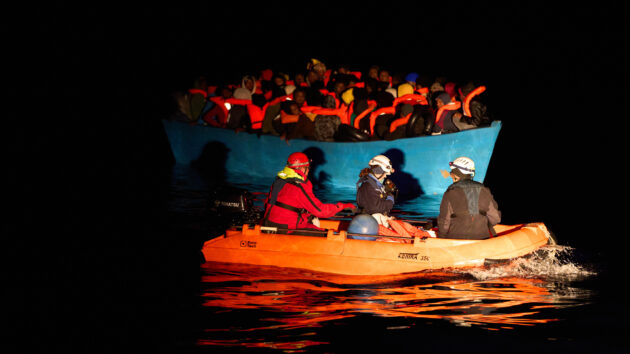
In addition to its monitoring activities, if it encounters vessels at risk of capsizing or carrying medical emergencies S/Y NADIR also performs rescues. Photo: Leon Salner / RESQSHIP.
If there is immediate risk of capsizing, if water enters the boat or there are severe medical cases amongst the survivors, as often turns out to be the case, the crew has to perform rescues.
Most of their interventions entail primary care measures like distributing lifejackets, which the Italian Coast Guard does not always provide.
Rescued people might have wounds, or just need to go to the toilet. Often they’ve been left sitting in their own vomit and urine.
The crew gives them dry clothes, or at least emergency blankets, and distributes water and crackers.
If urgent medical care is needed, NADIR’s saloon has the equipment of a small emergency room, with bench extensions for a table, monitors, and oxygen.
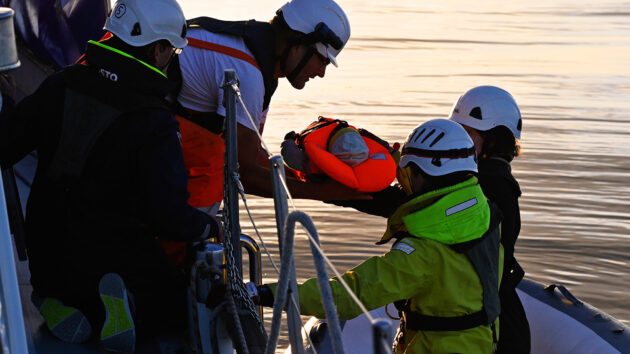
The refugee vessels encountered by S/Y NADIR are often carrying children onboard. Photo: Friedhold Ulonska / RESQSHIP.
Johannes describes an operation that took place just days before our interview.
NADIR answered a Mayday Relay issued by a rescue plane that had spotted a migrant boat. It had been at sea for four to six days without supplies, and there were several babies on board.
NADIR made its way onsite, where crew were informed some refugees had jumped into the water when the boat’s engine gave out, hoping to push it forward.
Waves had quickly separated them from the boat.
NADIR was able to find most– though not all – of the shipwrecked people on the way back to Lampedusa. No one they picked up had been spotted by the patrolling planes.
And this, Johannes stresses, is just the most recent example.
‘The people being criminalised are the people who need rescue’: Misconceptions about migrant boat encounters
‘People are afraid of people who are in distress, but if you were in that situation you would just be so relieved to see anybody at all on the horizon,’ says Lauren.
‘The worst thing a sailor– or anybody– can imagine, is that you’re out there and nobody knows. There’s nobody to come for you.
Having a vessel there that is saying, we don’t want to drown you, we want to help, we’ll stay here and try to call for help, is really important on a mental and physical level for the people in that situation.’
For anyone worried about criminal repercussions for offering assistance, ‘It’s really the other way around,’ Johannes says firmly. ‘The people being criminalised are the people who need rescue.’
He cautions against taking any photos or video of the boat or the people onboard, as identifying visual details can be used by authorities to arbitrarily target specific individuals for arrest on arrival.
What to do if you encounter a migrant boat while sailing
Any civilian yacht that comes across an unseaworthy boat is legally obligated to make a distress case alert on VHF16 under the (IMO) Safety of Life at Sea (SOLAS) convention (Chapter V, Regulation 33).
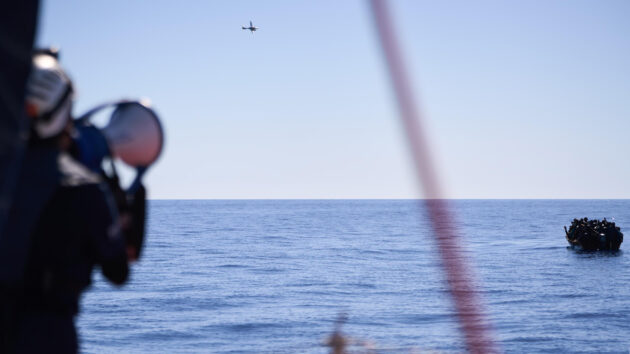
A civilian yacht encountering a distress case at sea is legally obligated to call for assistance. Photo: Leon Salner / RESQSHIP.
Should you find yourself facing a distress case, after alerting the authorities Johannes recommends keeping a distance and monitoring its progress.
To avoid making the situation more unstable, keep a distance of a couple hundred meters so people don’t try to swim to your vessel.
In case of a capsize, you will still be close enough to throw out a life-raft and anything else you might have on board that can help them survive until a bigger vessel approaches.
Should the other boat still have a working engine, it can help to continue on course and show them the way so that support is readily available until the relevant Coast Guard arrives.
It’s important to remember that people on the move are often unequipped to call for help, while almost every sailing vessel has a VHF. Even if you’re not prepared to help, you can still activate the process by sending a Mayday Relay.
While the civilian yacht should then receive immediate assistance and guidance from authorities, ‘This is really not the case that we are experiencing out there.’
Johannes wavers between resignation, exasperated amusement, and latent rage as he explains that when it comes to migrant boats, things suddenly get more complicated.
Bureaucratic runarounds
International law stipulates that once an MRCC (Maritime Rescue Coordination Centre) has been alerted, the communication gets forwarded until one MRCC takes over coordination.
This process should be almost immediate. Instead,
‘We are calling, and they say, “Ah, no, we are not responsible. You have to call the other one,”‘ Johannes says.

Search and rescue activities in the central Mediterranean often require careful coordination with between the MRCC, humanitarian vessels, and local authorities. Photo: Paula Gaess.
As it frequently operates in overlapping areas of MRCC jurisdiction, NADIR might be required to alert Italy, Malta, Libya, Tunisia. As a registered German vessel, it also always informs German authorities.
This spread leaves plenty of room for communicative delays and procedural ambiguity, often resulting in missed or delayed action.
NADIR may be instructed to wait hours next to an unseaworthy boat.
Authorities aren’t immune to this kind of procedural paralysis, either.
‘They want to assist and help,’ Johannes says of the Italian Coast Guard, which he describes as a generally “reliable partner”.
‘But they get some orders from the MRCC, which falls under the authority of the Ministry of the Interior in Rome, and then their hands are bound.’ (The Italian Coast Guard and the Italian Ministry of Interior did not respond to a request for comment).
‘The other side, the so-called “Libyan Coast Guard,” there are no words for, because they are not a real coast guard. They are not acting in a legal frame.’
Open fire against humanitarian vessels
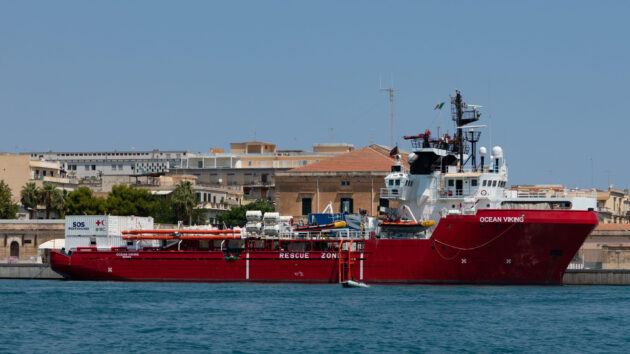
The Ocean Viking, chartered by NGO SOS Mediterranee to conduct search and rescue activities in the central Mediterranean. Photo: James Grady / Alamy.
Humanitarian vessels and search and rescue boats are often asked to cooperate with authorities that aren’t authorities at all, leaving them – quite literally – exposed to open fire.
On 24 August, the rescue vessel Ocean Viking was shot at by the Libyan Coast Guard while in international waters. There were 87 survivors on board in addition to the humanitarian crew.
While the crew searched the surrounding waters for people in distress, a Libyan patrol vessel approached Ocean Viking and demanded the ship leave the area. Ocean Viking informed them they would comply.
Then, two men aboard the patrol vessel opened fire for at least 20 minutes of assault gunfire, deliberately targeting crew members on the bridge, states a press release from SOS Mediterranee.
Though no one was physically wounded, the attack caused extensive damage to the ship, its RHIBs, rescue equipment.
Ocean Viking issued a Mayday and alerted NATO1, seeking protection and assistance. They were referred to the closest NATO asset — an Italian navy ship, which they said did not answer.
The episode was far from an isolated incident.
Armed attacks and “pull backs”, in which migrating peoples are captured at sea by Libyan militias operating on EU-gifted motor-vessels and taken to detention centres in Libya, are part of what has been called a “shadow immigration system”.
Out of sight, out of mind
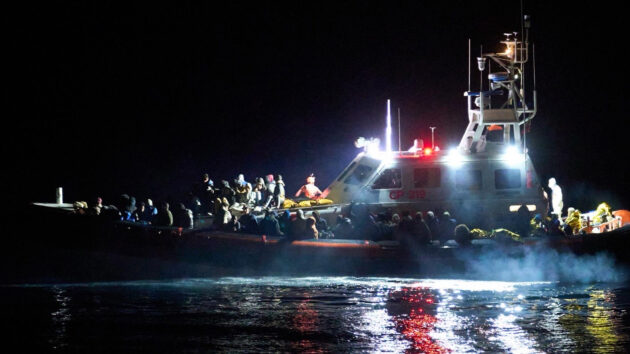
Search and rescue activities in the central Mediterranean often require careful coordination with between the MRCC, humanitarian vessels, and local authorities. Photo: Leon Salner / RESQSHIP.
Since 2017, the EU has contributed €42,223,900 in funding to the first phase of the “Support to Integrated border and migration management in Libya” project.
The project has the stated aims of enhancing Libyan authorities operational capacity in responding to border crossings, both at sea and in the desert.
Yet both the plan and its effects have been the subject of extensive investigative reporting, according to which migrant captives are held and often tortured while their relatives are extorted for money.
To make a long, bloodcurdling story short, paying these militias to keep refugees from European waters allows the EU to externalise its handling of migration flow, shifting responsibility for the fleeing people and keeping the matter out of sight, Johannes explains.
‘The policy of giving money to Tunisia and Libya, so basically to failed states, and paying them to pull back the people,’ means that, ‘In the public media there are no images of drowning people.’
Legal Labyrinths
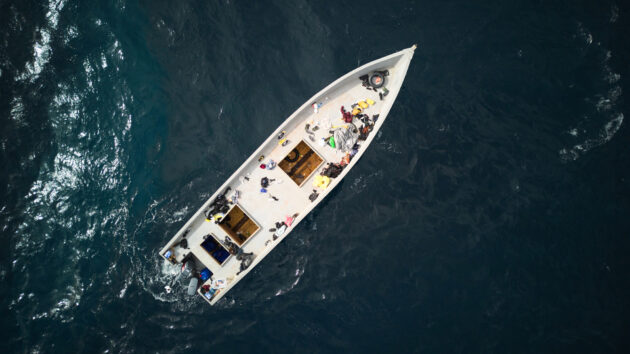
The shooting of humanitarian vessel Ocean Viking resulted led to an open letter to the EU Commission signed by dozens of NGOs and human rights organisations. Photo: Leon Salner / RESQSHIP.
On paper, “pull-backs” of refugee boats and shootings of humanitarian vessels shouldn’t be happening.
In June 2024, Crotone Civil Court in Italy ruled: ‘Interceptions at sea conducted by the Libyan Coast Guard cannot legally qualify as rescue operations since the Libyan authorities are systematically armed, fire gunshots to intimidate civil society actors and migrants, and create an overall situation of danger.’
The CCC also ruled that, ‘Libya cannot be considered a safe place for disembarkation due to its serious and systematic violations of human rights and the fact that it has never ratified the Geneva Convention.’
This means that pull-backs likely fall into something called “refoulment”, the act of returning refugees or asylum seekers to places or countries where they might face persecution.
The search and rescue ‘Catch-22’
In order to defend their right to operate, intervene, and disobey illegitimate orders, humanitarian organisations regularly have to play a game of legal and procedural whack-a-mole.
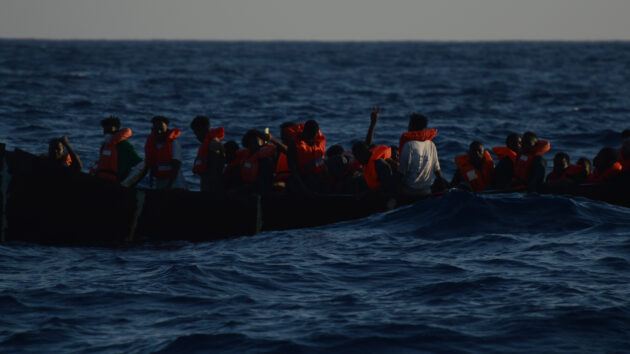
Photo: Paula Gaess / RESQSHIP.
Refoulment is overtly prohibited by EU and international law, and leaves all those involved liable.
Yet the Libyan Coast Guard regularly demands that humanitarian and search and rescue boats surrender rescued migrating people and leave the scene.
Other state authorities instruct them to comply, leaving humanitarian crews in a difficult double bind.
‘On the one hand, if you alert an authority and you know that they will bring people back to torture, you are making yourself accountable to criminal law for bringing people back to a country where they aren’t safe,’ Johannes explains. ‘On the other hand, we have to comply with what the Italian authorities ask of us.’
He stresses that the organisation’s very survival, its ability to keep helping refugees, is at stake.
‘We have to be hyper-perfect if we want to stay in operation.’
SAR boats detained under the Piantedosi Decree
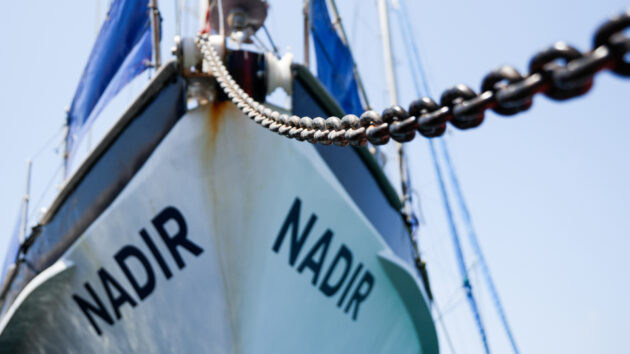
S/Y NADIR was detained twice this summer, marking the first ever time a sailing yacht was detained in conjunction to search and rescue activities. Photo: Paula Gaess / RESQSHIP.
In recent months, this emphasis on compliance still hasn’t been enough to keep organisations like RESQSHIP in operation.
Over the summer, NADIR was detained twice by Italian authorities. Its first seizure on 8 June was the first ever time a sailing yacht had been detained in conjunction with search and rescue activities.
Its crew had just evacuated 112 people from an unseaworthy wooden boat in international waters off the coast of Libya, approximately a 12 hour sail from Lampedusa.
Under the controversial Piantedosi Decree, RESQSHIP was accused of (1) not communicating with the Libyan authorities, and (2) not following orders regarding its assigned Port of Safety.
Video footage circulated in the meantime shows NADIR being surrounded by Frontex, Coast Guard and Guardia di Finanza and receiving verbal permission from the local Harbour Master over the radio to access the Port of Lampedusa, the last Port of Safety agreed upon in written form with the MRCC.
What is the Piantedosi Decree?
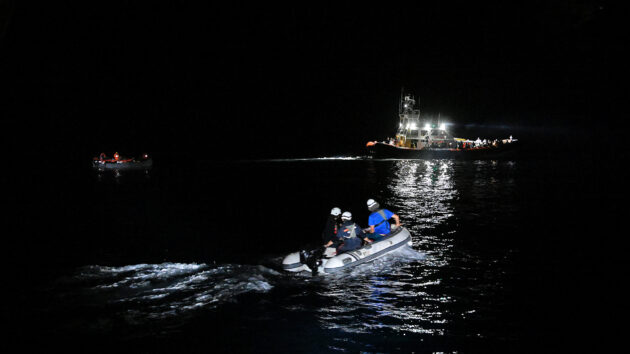
S/Y NADIR conducts monitoring activities in the Central Mediterranean. Photo: Friedhold Ulonska / RESQSHIP.
Many other boats in the “Civil Fleet,” as well as SeaWatch’s rescue plane SeaBird 1, have met a similar fate under the Piantedosi Decree.
The decree introduces additional requirements for NGO search and rescue boats, and legitimises the “Distant Ports” practice.
It gives Italian authorities the right to fine and detain rescue ships on various grounds, including alleged failure to abide by instructions from the so-called Libyan Coast Guard.
Italy’s Interior Minister Matteo Piantedosi maintains that the practice is designed to reduce strain on reception systems in the regions surrounding the Central Mediterranean, Sicily and Calabria, and to more evenly distribute refugee arrivals among various ports.
Yet like the recent detentions, ‘The intention behind the practice – and indeed, the only notable consequence of its introduction – appears to be to keep NGO rescue vessels far away from the areas where boats carrying refugees and migrants are most often in distress,’ writes Amnesty International.
Is the Piantedosi Decree legal?
The Decree itself was under consideration in the Italian Constitutional Court from 21 May 2025 after interventions from Human Rights Watch and the European Center for Constitutional and Human Rights.
A challenge to its legality had been previously raised by NGO SOS Mediterranee following the detainment of its ship Ocean Viking, the same vessel affected by the 24 August shoot-out.
While the challenge was dismissed on 8 July 2025, the ICC’s ruling did recognise the Piantedosi Decree’s overtly punitive nature.
It acknowledged its intent to dissuade search and rescue activities, and reiterated the legal requirement that rescue operations end in a port of demonstrable safety; where fundamental human rights of the rescued persons are guaranteed; in the shortest amount of time possible; and without undue burden on the vessel’s captain.
These stipulations directly contrast “Distant Ports” orders, Human Rights Watch has said.
The ICC also established humanitarian vessels’ right to not comply with unlawful orders (those which contradict the SAR Convention and International Maritime Organisation’s Guidelines), and to disregard any order which conflicts with the fundamental duty to save a human life.
This includes those which may be issued by the Libyan “Coast Guard”.
What does this mean for humanitarian vessels?
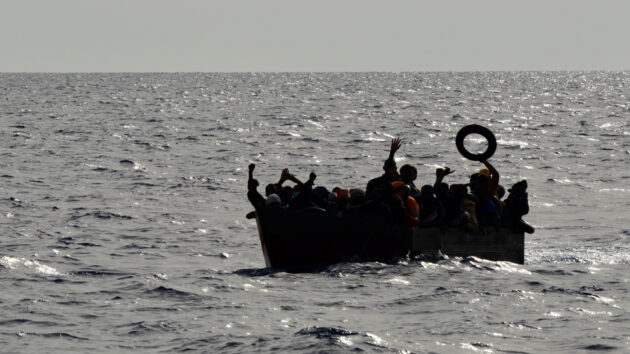
S/Y NADIR conducts monitoring activities in the Central Mediterranean. Photo: Paula Gaess / RESQSHIP.
Johannes says that currently, between the Italian and the European courts, there are 10 ongoing “Distant Port” related legal hearings underway.
A single detention can rack up thousands of euros in fines and take search and rescue boats out of operation for at least 20 days at a time, impacting two full rotations.
Whatever the case’ outcome, by the time it hits the courtroom it’s already too late. They have lost valuable time, with a likely cost of human lives.
‘Even if they end up losing the legal battle, they won,’ Johannes says. ‘All it does is keep us away from the sea.’
‘They want to silence us and not have any public out there,’ he adds. ‘But we do not want to shift our fight from being out at sea and helping people into legal battles in front of courts.’
Like many NGOs, RESQSHIP maintains the route will only get more dangerous under the current European policy.
‘Our biggest demand is that there’s a state actor getting active again, and that responsibility is not shifting.
As long as there are reasons for the people to go on such a journey […] they will not stop trying,’ Johannes says. The danger lies in ‘thinking this is somehow a phenomenon that can be controlled.’
In response to a request for comment, a Commission Spokesperson for the EU stated:
The EU adopts a comprehensive approach to migration governance in its relationship with partner countries. This includes advocating for and promoting the protection of the rights of migrants, asylum seekers and refugees, fostering legal migration, addressing the root causes of irregular migration, combating smuggling of migrants and trafficking of human beings.
At the same time, we also work with partners on reinforcing their border management capacities, and ensuring assisted voluntary, safe and dignified returns, and support to sustainable reintegration in the countries of origin.
This has been the core of our work in our comprehensive partnerships and in our bilateral relations with partner countries in the region. In all these cases, the respect for human rights and human dignity of all migrants, refugees and asylum seekers has been central. They are the fundamental principles of migration management, in line with obligations under International Law. The EU expects its partners to fulfil these international obligations, including the right to non-refoulement.
The Commission does not have competences on search and rescue, which ultimately falls under EU Member States’ remits. All parties in a Search and Rescue operation need to operate with the required diligence and in full respect of international law and international maritime law.
The European Commission encourages all actors, competent authorities as well as private stakeholders, to improve cooperation in search and rescue operations. We remain open and interested in continuing our dialogue with NGOs, including those active at sea. ✦
The 2025 operational season is coming to an end. Crewing for next year will be available on the website in October/November. RESQSHIP also welcomes donations and material contributions, in particular of safe and working medical supplies.
 If you enjoyed this article about search and rescue under sail and what to do if youn encounter a migrant boat….

Yachting World is the world’s leading magazine for bluewater cruisers and offshore sailors. Every month we have inspirational adventures and practical features to help you realise your sailing dreams.Build your knowledge with a subscription delivered to your door. See our latest offers and save at least 30% off the cover price.
Note: We may earn a commission when you buy through links on our site, at no extra cost to you. This doesn’t affect our editorial independence.