


Solo ocean racing is a high-stakes game. Ollie Heer talks to Helen Fretter about why it’s worth the gamble
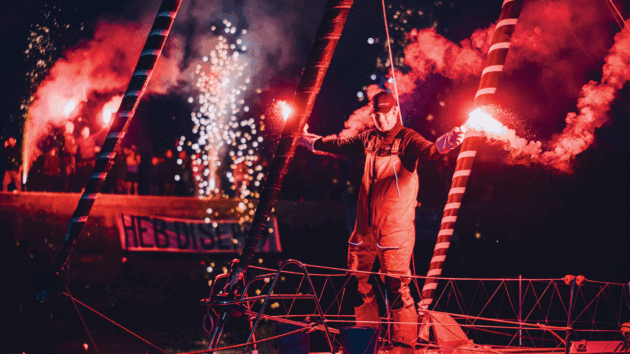
It takes a certain type of person to become a solo ocean racing skipper. The pontoons of Lorient and Les Sables d’Olonne are filled with French racers who have grown up with salt in their veins, whose appetite for risk was honed during formative years spent racing Mini 6.50s and Figaros, aiming for the craziest challenge of all in the Vendée Globe.
IMOCA campaigns are now big budget, data heavy, complex projects. To succeed in this world requires other skillsets. But it also still demands a no-holds-barred commitment to the cause that most would flinch from.
So how did a sailor from landlocked Switzerland – a country renowned for its risk aversion – end up running an ambitious Vendée Globe campaign out of England?
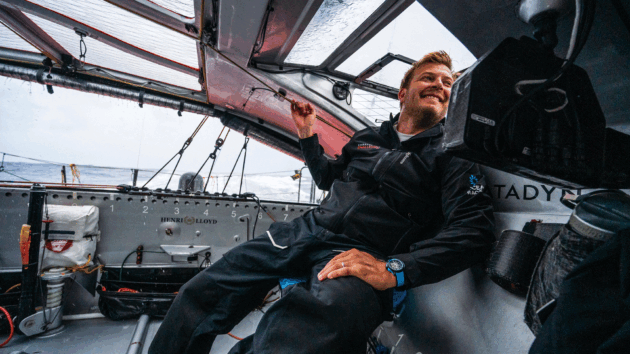
Heer enjoying his foiling IMOCA’s performance. Photo: PKC Media/Ollie Heer Racing
Change of course
Ollie Heer’s life could have followed a very different path. Growing up in the German-speaking region of Switzerland, he started sailing aged five in a little Optimist dinghy on Lake Zurich and progressed through the Laser, 420, and 29er, as well as some small keelboat and 49er sailing. But Heer never considered the sport as anything more than a hobby.
“My mom is a teacher, so school and education was always quite important – not just to her, for me as well. I was always a very ambitious student,” he recalls.
The academic pathway took Heer to Singapore, Hong Kong and Taiwan, where he studied international business and Mandarin. While in Asia he raced in the TP52 fleet, which opened his eyes to professional yachting as a career.
“But then my time in Asia came to an end. I had to go back to Zurich. I got my degree. I started working in the private sector. Sailing moved into the background, and I had the corporate goggles on fully,” Heer recalls.
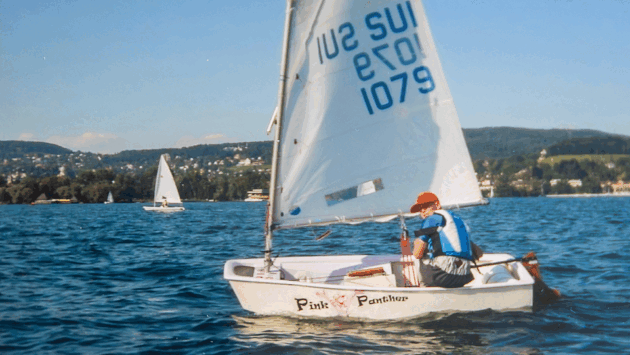
Optimist sailing as a young boy in Switzerland. Photo: PKC Media/Heer family
“And then in February 2014, my father passed away very suddenly. A cardiac arrest in our living room on a Sunday evening. I was convinced that he passed away due to overwork and too much stress. And I realised that subconsciously I’d chosen exactly the same career path as he did.” His father was just 52.
“Then you ask yourself the question: is it worth spending 60 hours a week in front of a computer working on a spreadsheet that you don’t really care about? And once you ask yourself this, it’s almost self-explanatory. So I handed my notice in, put my suit in the wardrobe, got my sailing kit out, and drove my 60-year-old campervan from Switzerland to Hamble.”
Fast track
It was a big gamble, and Heer, then 26, ended up living out of his vintage van for around eight months, with no running water or electricity, working to get his Yachtmaster ticket. But the decision felt natural. “I was always just happy on the boat. And my dad was a very, very passionate sailor – he always wanted to do the Atlantic again, but it got pushed in his very busy diary. So I said, you know what, f**k it, I’ll go after it.”
Heer completed his Yachtmaster Fastrack with Sailing Logic out of Hamble, also meeting his now-wife Theresa on the course. He worked for the race training and charter company at events like the ARC and Rolex Fastnet Race.
Allie Smith, who founded Sailing Logic and is now rallies director at Oyster Yachts, recalls: “From the outset, Ollie was an exceptionally quick learner. He spent much of his spare time helping with the yachts and immersed himself completely in life at the marina.”
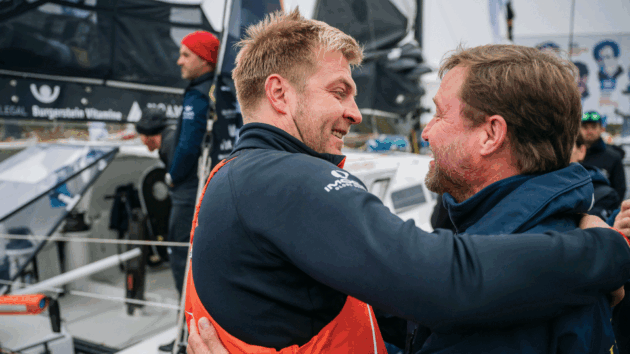
With former boss and mentor Alex Thomson ahead of the 2024 Vendée Globe start. Photo: Jean-Louis Carli/Alea
His first job as a Sailing Logic skipper came unexpectedly, when the booked skipper was unwell. Heer was first mate, but stepped up.
“I remember asking him on the dock whether he wanted to give it a go? Ten minutes later, he was delivering the safety briefing to the day’s clients. Leaving the berth during a spring ebb provided an immediate test – there may have been a few choice words and strategically placed fenders, but Ollie remained composed and completed the manoeuvre safely!”
Next he was asked to run Giles Redpath’s Lombard 46 Pata Negra for the 2018 Sevenstar Round Britain and Ireland Race. The young team turned out to be quite the crack crew, including Will Harris, now IMOCA co-skipper; and Antoine Magre, skipper of Palanad 4. They raced Pata Negra hard and won overall. It was Heer’s first real taste of big boat success.
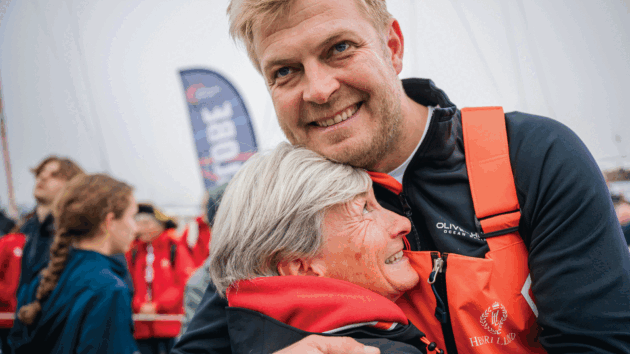
Emotional farewells at the start of his first Vendée Globe in 2024. Photo: Jean-Louis Carli/Alea
“But afterwards I was a little bit lost because I felt in the pro-am kind of sailing I had reached quite a high level in quite a short period of time. I only did my Yachtmaster three and a half years earlier. So it was [a question of], where should I go? And I’m quite ambitious.”
Heer was based in Hamble, Britain’s epicentre of offshore racing, but he had arrived with few contacts.
“I never consider myself as one of those Hamble guys because it’s quite a close-knit group. The whole Fast 40 and now Cape 31 scene – I’ve never sailed on any of these boats. But I think with a good attitude and a good work ethic, you can achieve a lot.
“And with every job, it didn’t matter if it was a Reflex 38 at Sailing Logic or Hugo Boss #7, I always told myself, ‘Ollie, you’re the first one on the boat and you’re the last one off the boat.’ And if you do give your best and you do a good job, it’s noticed.”
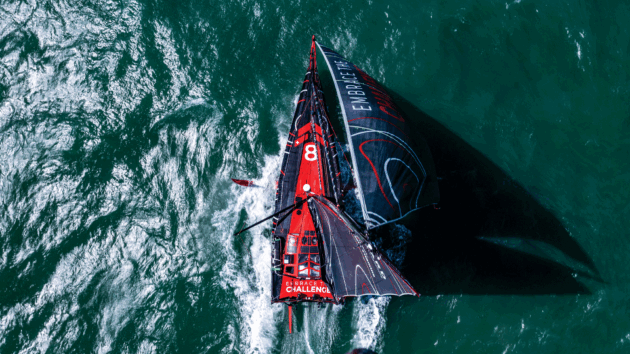
Full bore: Heer’s IMOCA Embrace The Challenge. Photo: PKC Media/Ollie Heer Racing
From boss to skipper
That ethic was tested when he was introduced to Hugo Boss skipper Alex Thomson, who was about to launch a new IMOCA for the 2020 Vendée. “He said, ‘Yeah, Ollie, I’ll give you a job. But then you’re in the pro league, and you start at the very bottom again.’”
Heer joined Thomson’s team as junior boat crew, and worked his way up. “From there I became the boat captain, then co-skipper for races like the Fastnet. I did lots of corporate sailing whenever Alex wasn’t around, or I delivered the boat. That was my intro to the IMOCA class.
“I started on Hugo Boss #6 so I was involved in the full cycle – from designing to building the boat, commissioning, activating it, racing it, breaking it, fixing it again. You learn a lot.
“Alex is not the easiest of people, but if he trusts you and respects you, he’s a great guy. I sailed well over 50,000 miles with Alex. And I was very fortunate that in the Boss campaigns senior team I sailed with guys like Neal MacDonald, Andrew Cape. When you sail with these legends, as a young Swiss kid, you just shut up and learn.”
However, Heer had no dreams of taking the helm himself. “I never considered my own campaign until Alex had to retire from the Vendée Globe 2020. I was on a skiing holiday, on a chairlift in Klosters when Ross Daniel, the technical director, called me and said ‘Alex has a snapped rudder. I need you in Cape Town in two days’ time’.
So I took the next downhill run pretty fast!
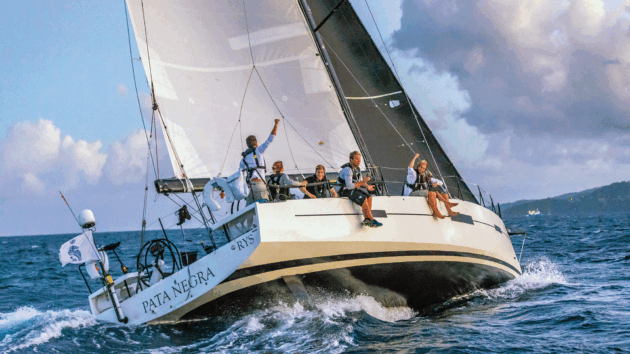
The Lombard 46 Pata Negra had a successful offshore campaign. Photo: Arthur Daniel/RORC
“In Cape Town we fixed the boat for a few weeks, then I sailed home with Alex. During the delivery, he hinted that he’s not doing it anymore, he was unsure. There was also a big change in Hugo Boss, it looked like the sponsorship might not be renewed, and it all came to a natural end.
“But then he said, ‘Ollie, I think you should do it. You’re in the perfect place. If you ever want to do it, you have to do it now, otherwise you never will.’
Heer had never imagined the possibility. “Before then it had seemed quite far-fetched, almost arrogant. Maybe it took someone like Alex to say: ‘Ollie, I think you can do it. You’ve got the abilities to sail around the world, you’ve got the commercial sense to manage a campaign, you’ve got the communication skills to get the funding.’
“Thank God he told me this in the South Atlantic, so I had another 10 days to think about it!” After making the decision with his wife, Theresa – now his team manager – Heer set himself a goal of entering the 2024 Vendée Globe.
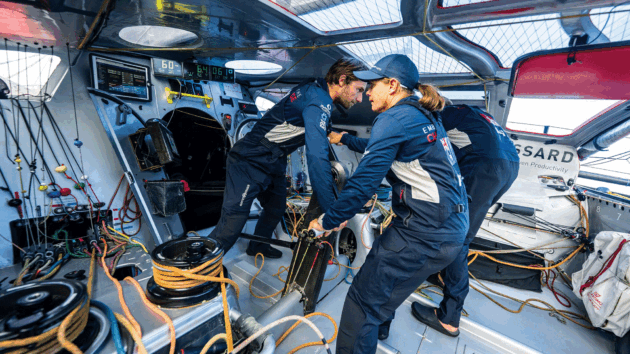
The busy cockpit sailing fully crewed (four sailors plus one OBR) in The Ocean Race Atlantic. Photo: PKC Media/Ollie Heer Racing
Reality bites
It quickly became evident that his campaign would look very different from the glossy 5 West team he’d worked for. “We knew that, looking at Alex’s budget, we’d need at least $2.5 million to run a campaign. I had about $500,000. I had to do it my own way. And if I failed, I wanted to fail my way.”
He secured a 2007 IMOCA, a daggerboard Farr design, but the first years of his Tut Gut campaign were brutal. His boat was damaged in a port-starboard incident on the start of the Route du Rhum, and though Heer was not at fault it was a huge setback.
Then he lost the forestay a day into the Transat Jacques Vabre, and during the Transat CIC an autopilot left Tut Gut knocked down flat in 40-knot winds, causing major damage and an electronics blackout, with Heer forced to hand steer solo across the Atlantic. At times just getting the boat across the line in one piece seemed insurmountable, but he managed to secure enough qualification miles to be awarded the 40th and final entry to the 2024 Vendée.
“It was kind of a wake-up call in those qualifying races: that you just cannot push the boat. For us the objective was always getting to the finish. I had to keep that in my head at every moment of the Vendée. Whether I’m 29th or 23rd, it doesn’t matter, it’s the story you tell on the way that counts. But I had a great experience in the Vendée Globe. And before I even crossed the finish line, we already kind of decided that we want to do it again.’
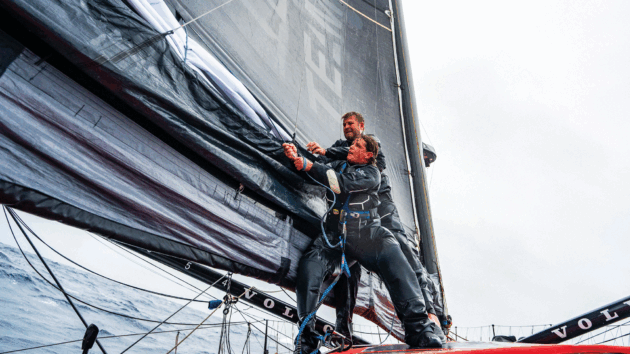
Wrestling mainsail repairs with Liz Wardley mid-Atlantic. Photo: PKC Media/Ollie Heer Racing
Heer finished 29th. One of his key partners, Burgerstein Vitamine, came straight back on board as a sponsor and Heer was off again, planning his second assault on the world’s toughest race. Has he ever doubted himself?
“No, I was a little bit like a dog who’s got a bone in his mouth. The more people want to take the bone, the more I just bite onto it.”
But despite having worked inside an IMOCA campaign previously, the realities of heading his own were daunting. “My wife and I had moments where we just didn’t have any cash. Zero. We had a tin of baked beans at home and we managed to buy a baguette for 90p, and that was our dinner. A lot of people have this very romantic idea of being a professional sailor. It’s not easy at all. It’s hard work and long days and a lot of stress.
“But for me there’s nothing more fulfilling than overcoming a difficulty or a challenge.”
Article continues below…
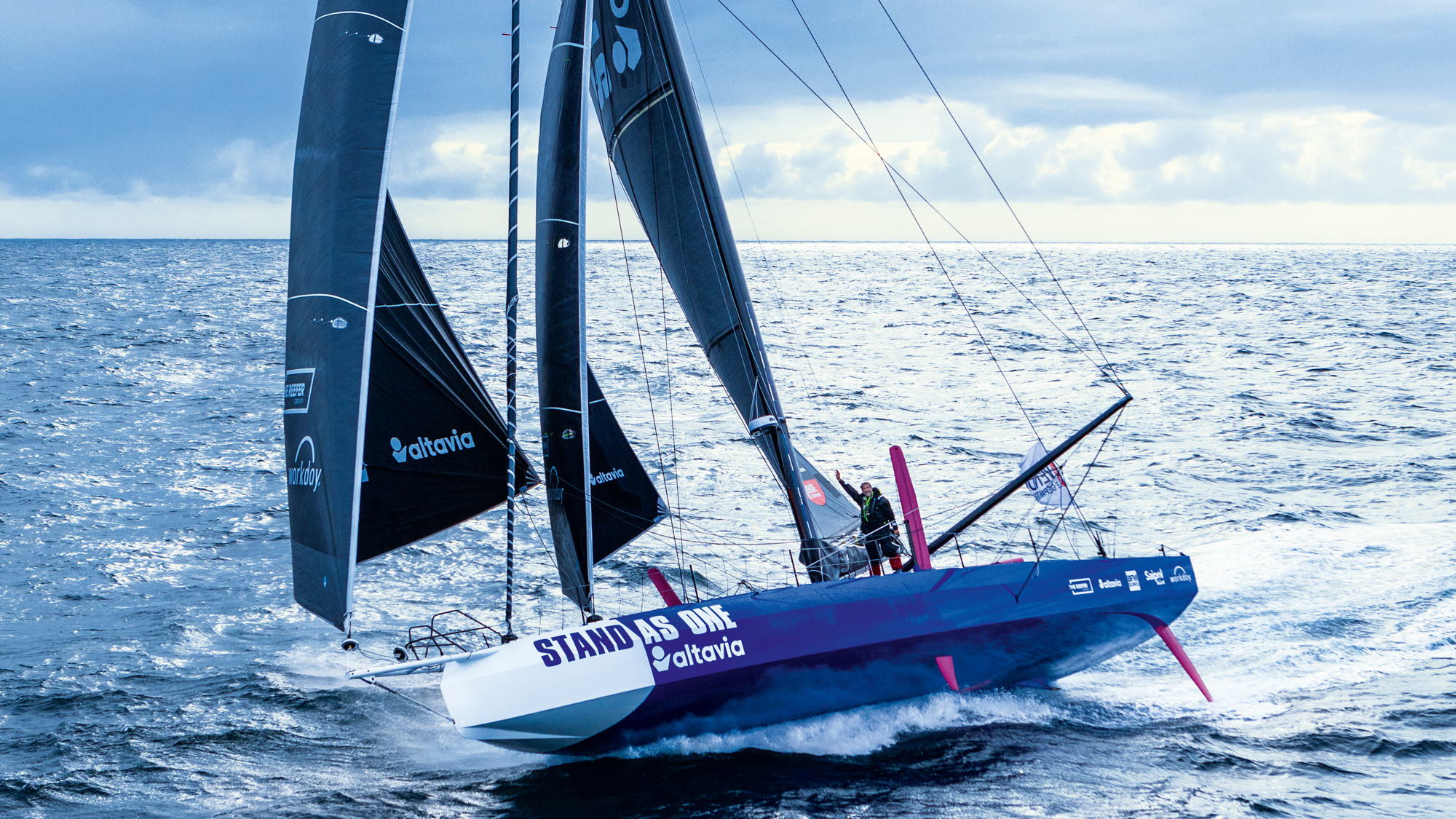
Non-foiling IMOCA: Can the latest non-foilers compete at the front of the fleet
Despite their lack of foils, Eric Bellion’s and Jean Le Cam’s Raison-designed Non-foiling IMOCA sisterships (Stand as One Altavia and…
How Alexis Loison won the Solitaire du Figaro after 19 attempts: ‘In solo racing you have to be good at everything’
Most sailors would have simply given up, but Alexis Loison kept coming back. For 19 editions of La Solitaire du…
GBR team base
Funding to get his second project off the ground finally came together in December last year, leaving Heer with three months to raise over €2 million. It’s a level of financial risk few people would be comfortable with, and a hard sales target. But having sailed with Thomson on hundreds of Hugo Boss corporate days, Heer is comfortable pitching to decision makers.
“I also think from my previous university and business experience, I know how these people think. I can talk to them on the right level so they can take me seriously.”
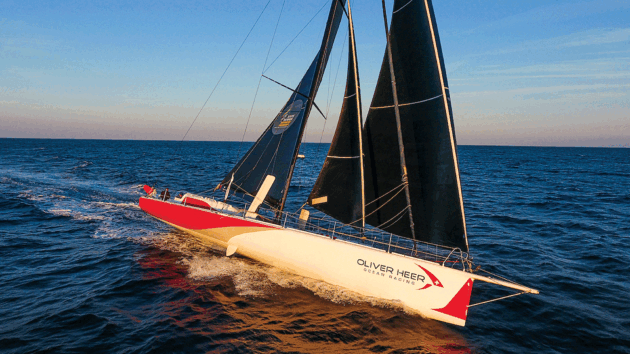
The 2007 daggerboard IMOCA Tut Gut. Photo: Ollie Heer/Défi Azimut/Lorient Agglomération
They bought a 2018 VPLP-designed foiling IMOCA, Justine Mettraux’s Teamwork SNEF, formerly Jérémié Beyou’s first Charal, and refitted it together with Mettraux’s team in France. “I wanted to have a very proven platform. One that I know is rock solid, and Justine is a madwoman! The way she sailed this boat, I know I will not be able to overload it,” Heer reflects. “She sailed it to the absolute limit. And so did Jérémie beforehand.”
Heer was also keen to purchase the intellectual property of the boat. “All the drawings, all polars, pilot settings, the wind tables, all of this data saves us so much time if we don’t have to go back to square one. We know Justine’s polars. And if we can sail this boat up to 95% within the first year of owning it, we know we’re sailing it fast.”
Heer now has 15 people working for him and the ‘Embrace the Challenge’ team is ensconced in Endeavour Quay out of Gosport, a shift from his first campaign out of Port la Foret in France. So is it a Swiss team or an English campaign? “My wife calls it Swinglish. There’s definitely a Swissness to it, and I’m very proud to be Swiss. But with the mentality and the people that work on it and all the suppliers we work with, it is a British campaign.”
His first big test in the new boat was the crewed Ocean Race Atlantic, a new 3,000-mile sprint from New York to Lorient this September. They finished fifth, after badly ripping the mainsail in strong winds early in the race. But for his first crewed IMOCA race, in a new boat, Heer was happy with the lessons learned.
Next will be The Ocean Race, which begins in January 2027 with a monster opening stage of 14,000 miles non-stop from Alicante to Auckland – effectively half a Vendée Globe. Then the IMOCA calendar shifts towards double-handed racing for the 2027 Transat Cafe L’Or, before a season of solo transatlantics ahead of the 2028 Vendée Globe.
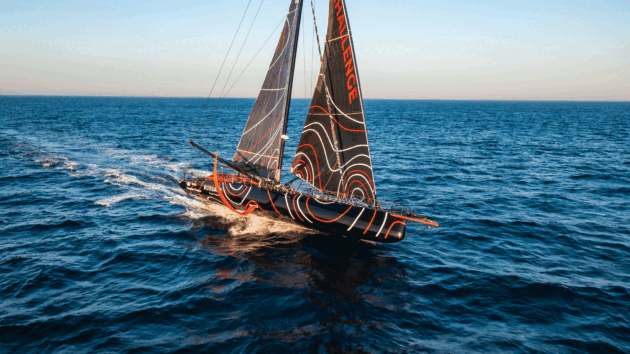
Ollie Heer is now campaigning the IMOCA Embrace The Challenge. Photo: PKC Media
What are his goals? It all comes back to Heer’s balance between cool, data-driven analytical sailing, and knowing when to raise the stakes. “I think this campaign will be the most difficult one because in the first I just took it super easy. If you build a new boat and you want to sail at the very front, you risk it all. But if you aim for a top 15 result, the risk management will be really hard and very stressful for me.
I have to start to accept that I might not make it to the finish.
“On my old boat, I was the limiting factor. Now the boat is the limiting factor. We’re already playing with setting alarms at the right threshold, so the boat will tell me when I’m in the right zone. So I know if I have to push harder, or have to slow down. It can’t be just me and my gut feeling anymore.”
Follow at www.oliverheer.com
 If you enjoyed this….
Yachting World is the world’s leading magazine for bluewater cruisers and offshore sailors. Every month we have inspirational adventures and practical features to help you realise your sailing dreams.Build your knowledge with a subscription delivered to your door. See our latest offers and save at least 30% off the cover price.
Note: We may earn a commission when you buy through links on our site, at no extra cost to you. This doesn’t affect our editorial independence.