


The Q Class was designed 100 years ago by the designers of the J Class. This new Q7 is built on those original long-keel classic lines, with modern additions and exquisite fit-outs
Q Class: All the soul of a J Class, without the super-sized crew

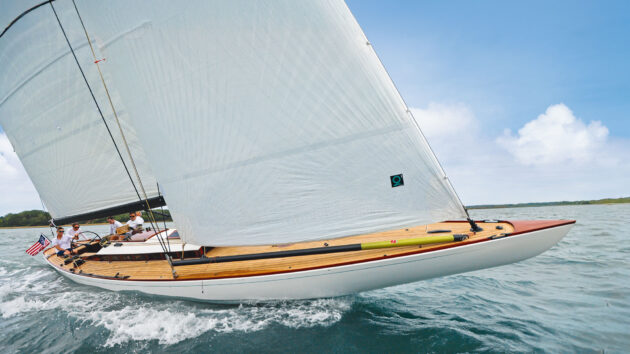
Glance down past the gunwales while sailing at full pace, and there’s that distinct, mesmerising vacuum left by the midbow wake, as if the very sea below is being sucked away.
That’s long-keel displacement yacht sailing. We could well be aboard a J Class – in this case, she has the same lines drawn by the same eminent designers.
But imagine a J you could take out with your partner or friends, race or cruise, and still turn heads anywhere you sail.
Welcome aboard Victoria, the first new Q Class this side of World War II. This is a centenary tribute to the 1926 classic Q-Class yacht Falcon, re-imagined and now offered as a limited series of bespoke builds. She uses the hull geometry, displacement, and sail plan of the original, but has modern construction, such as a cold-moulded wooden hull, carbon spars and a high-tech sail wardrobe to make the yacht easier and more versatile to sail.
In some senses, her story is unusual: the owner of an original classic wanting to create a new version. Consider the astonishing resurgence of the J Class over our lifetime.
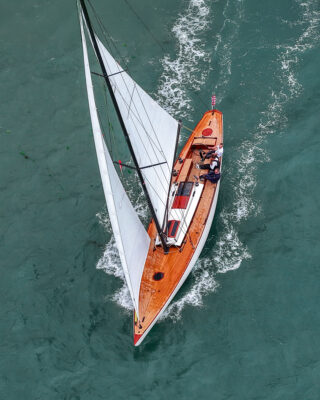
Traditional hull shape and large sail area controlled by modern means for sporty or pure pleasure sailing. Photo: Paul Wyeth
On the other hand, there are many other ‘letter’ classes that have failed to pique the broader interest or the extensive necessary funds (even this Q class has had several attempts to create a revival class).
But when a new hull launched from Spirit Yachts in Ipswich, it presented an irresistible chance to not only find out how she sails, but the backstory behind this yacht and class, and what revival really entails.
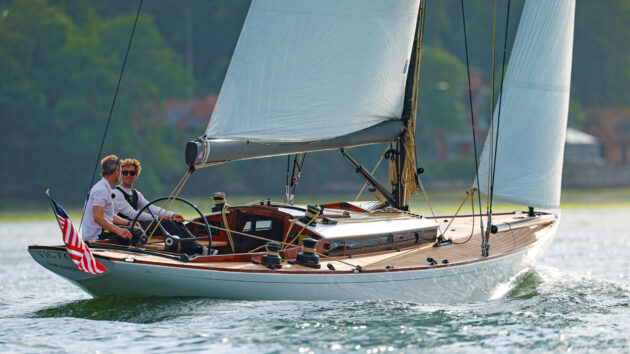
‘We glided elegantly over glassy river sections’. Photo: Paul Wyeth
Ranger’s cousin
The Q Class should arguably be more of a household name. What these lack compared to the subsequent J Class is the fame and the grandeur of the America’s Cup, plus that added majesty their super-size brings.
Referred to as mini Js, the Q Class is around one third the length (45-50ft LOA), yet otherwise very similar in design, with seductive overhangs, low freeboard and traditional long keels. And like the Js, they’ve always had fully fitted interiors.
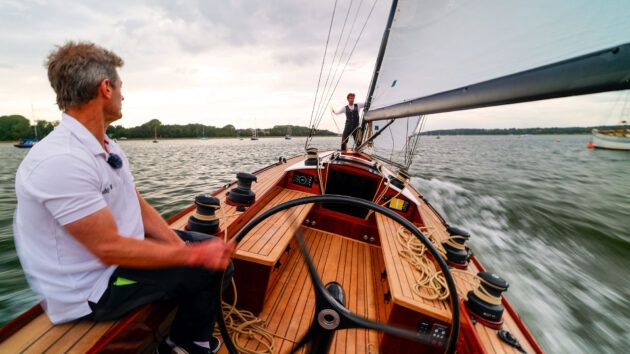
Carbon mast and rigging, in-boom mainsheet, traveller, furling headsails and powered winches make Victoria more controllable than original Qs. Photo: Paul Wyeth
Indeed, in many ways they were the forebears to the Js, using the same top designers to create stunning craft that were the first to race under the Universal Rule from 1904. In Falcon’s case, it was Starling Burgess, who then went on to design Ranger, the comparisons in their lines being evident.
Head over heels
When Peter Silvester bought Q7 Falcon in 2023, he fell hard for these lines… so hard he wanted to create a whole new class of them. The 57-year-old Brit, a recently retired senior executive, spent two years sailing Falcon from his California home, where his plan for the revival of the class blossomed.
He commissioned Dykstra Naval Architects, the specialist Dutch designers behind many of the J Class and classic yacht restorations of the modern era, to redraw Falcon’s lines to make a current version buildable.
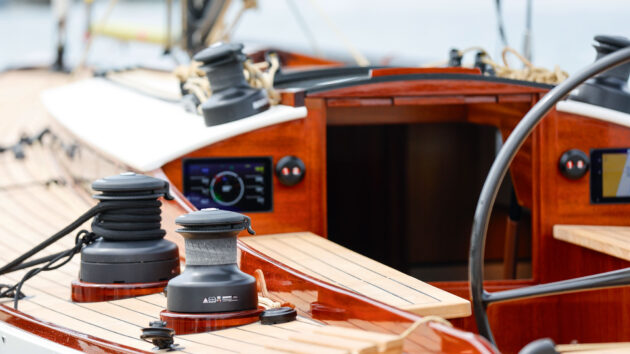
Modern classic marriage on deck: Harken Performa winches sit on varnished mahogany bases, while B&G instruments are flush mounted in the coachroof’s brightwork. Photo: Paul Wyeth
The premise was that if Burgess had access to today’s tech, what would he have done?
The resultant new Q7-1 Victoria commission is a classic style yacht ‘elegantly re-imagined’, with powered winches, electric propulsion, bow thruster, and exquisite interior, which not only makes it an inviting package to daysail comparatively short-handed, but brings a new level of prestige and gentleman’s club detailing.
An avid car enthusiast, Silvester hopes the ‘restomod’ element, as successfully achieved by companies such as Singer to re-imagine classic cars, helps brings a new niche.
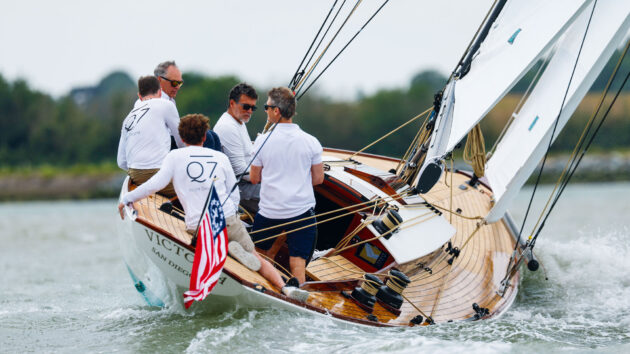
Toby sailing here with a full crew. Low freeboard means gunwales are soon damp. Photo: Paul Wyeth
I joined Silvester and his crew aboard Victoria, sailing from the Royal Harwich Yacht Club during early sea trials. As first impressions go, Victoria’s lines will stop anyone in their tracks. You could never tire of looking at this hull, while her rich, glossy brightwork then further elevates this affection.
After that, reactions may be more mixed, particularly from the more traditional classic enthusiasts. The stark black rig and carbon wheel in particular belong much more in a modern classic camp. So too does the flush glazing in the coachroof and butterfly hatches, albeit exquisitely done by this world-class yard.
But the decisions above the waterline and contemporary deck gear make good sense when you go sailing, particularly if you have the sporty conditions we enjoyed.
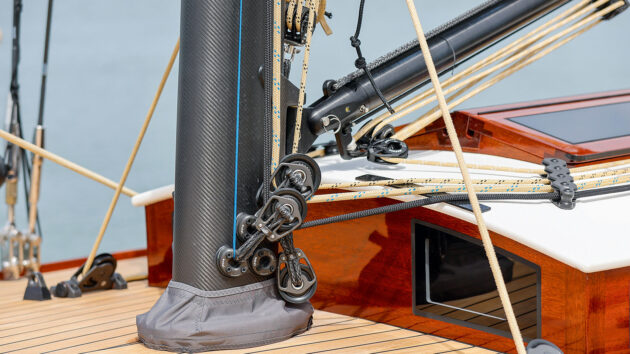
Butterfly-style hatch behind mast has toughened flush glazing, which avoids the need for protective grills. Photo: Paul Wyeth
With able hands aboard, we were able to throw plenty of canvas up, including a full-on kite run, while we could also short tack up narrow river channels with just two of us on deck. And that’s the easier use type of daysailing modern sail handling brings.
This leads to the touchy subject of the wheel, a topic I raised as we initially fetched down river. Where the original Qs have tillers, Silvester has specc’d the new Q7 with wheel steering only. Arguably, a tiller should be offered as an option, as it offers a direct sensation that can’t be replicated. However, Silvester feels a wheel is more approachable for the less experienced sailors – and he should know as he only began sailing post-pandemic.
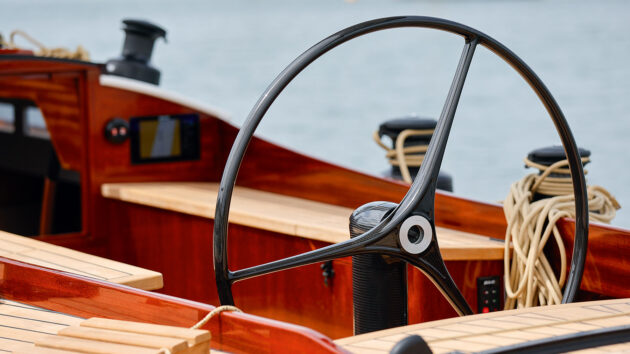
Coamings are extended aft to the wheel, offering the helmsman a dry derriere; the carbon wheel and pedestal are kept simple and unobtrusive. Photo: Paul Wyeth
A wheel also frees up significant cockpit space, every inch of which is needed when typically racing six up.
As we reached down the Orwell and then tacked out past the imposing docked ships, a Force 5 aggravated the strong ebb tide, which made conditions a little fruity.
Once the gusts are in the upper teens, Victoria heels quickly so easing the mainsail, which is enormous compared to the jib, becomes key to keeping the leeward decks afloat. The modern, carbon Tecnhora sails can be kept obedient and well trimmed though, thanks to having push-button controls such as traveller, backstay and Cunningham to hand.
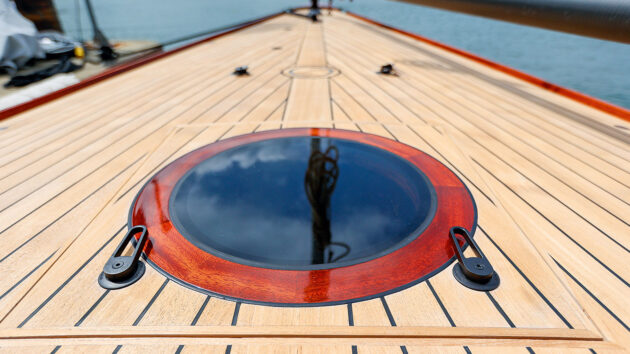
Wonderfully crafted circular mahogany hatch replicates original clamp-down style. Photo: Paul Wyeth
Getting nostalgic
The feel of a long-keel yacht is a rare delight today. Victoria offers an inviting motion, plenty of stability from all that ballast hanging below, and is well-balanced and behaved. She carries her weigh hypnotically through lulls and tacks.
The helm is graceful yet direct – you can leave it without fearing she’ll misbehave.
While they are clearly shown on B&G Nemesis displays flush mounted into the aft coachroof, I rarely glanced at the numbers. But in summary we spent the majority of the day clocking between 7-9 knots. Like any larger long-keeled displacement yacht, there’s no great variety of speed differences whether going up or downhill.
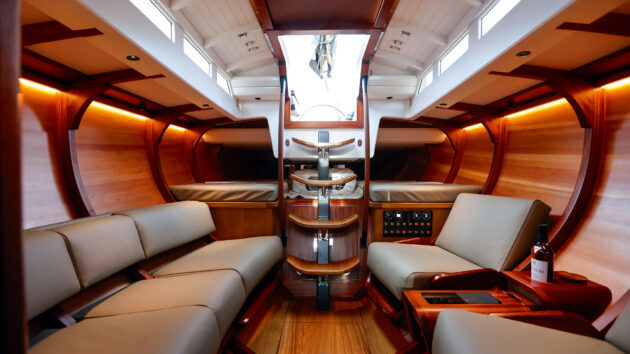
Celebrating the materials: Sipo mahogany planks, Douglas fir frames, over which two layers of glassfibre is vacuum infused; whisky cabinet between armchairs is a showpiece of joinery. Photo: Paul Wyeth
The mainsheet leads from the short traveller on the aft deck forward through the boom and back to high-speed self-tailing Performa winches, a set-up which really helps deal with the long boom efficiently while going through tacks and gybes.
These winches are also within easy reach of the helmsman, particularly if you straddle the wheel or sit forward in the mainsheet trimmer’s spot, from where you can also better sight the telltales.
After fetching around in the River Stour in search of enough water for a spinnaker run and backdrop for the photographer, we set up for a quick downwinder. Skipper Aaron Woolf kept things calm and measured, while Spirit’s Alastair Sutherland worked the foredeck.
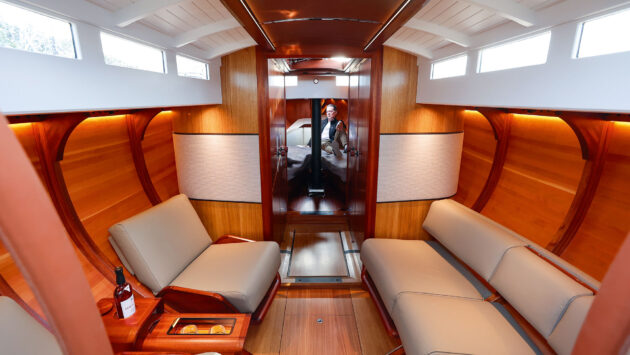
Unique ‘pod’ designs for galley and heads. Photo: Paul Wyeth
The asymmetric cracked into life. As you get a puff or a wave, you can feel Victoria load up, but rather than the skittish surf you expect from today’s craft, she just digs in and keeps ploughing up a larger wake, unperturbed. Now the wheel feels reassuring and keeps you in direct control.
With gusts of 22 knots buffetting an ebbing tide, in a narrow, short stretch of river, and with a commercial vessel making its way downriver towards us, our short kite run was a lively affair and one that confirmed it wasn’t worth trying the symmetrical spinnaker and pole that day!
Considering Silvester confessed he won’t take Falcon off the dock in over 15 knots, here was concrete proof of the appeal that his sportier new version offers.
He describes the difference as “like sailing Falcon with the training wheels taken off”, as the high modulus carbon rig allowed the design team to do away with running backstays, which really helps promote sailing with less crew. A masthead backstay, traveller and boom vang also help bring modern tuning aids to the heritage party.
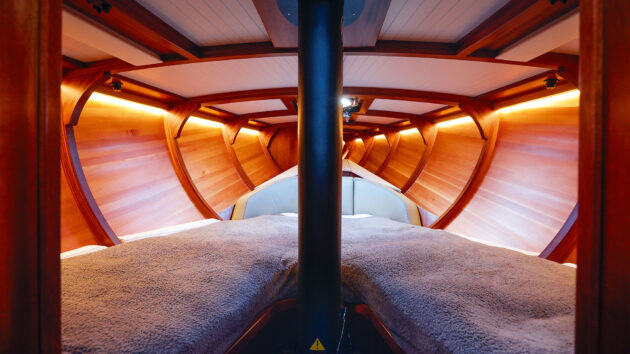
Hull sides or reclining backrest offer relaxation space in the forward cabin. Photo: Paul Wyeth
And so it was for the evening part of our sail, sailing Victoria two-up now as we chased some final glimmers of evening sun in the upper reaches of the Orwell.
With project manager cum skipper Woolf working jib trim and 10-18 knots of wind over flat water, we were gifted that dreamy spell of sailing this yacht deserves.
As we glided elegantly over glassy river sections, a puff of breeze would roll down the bright green fields, ripple across the water, before meeting Victoria’s sails and persuading her to lean elegantly into acceleration. It was compelling, magnetising sailing, within sight of where 30,000 human hours went into her creation.
Were it your thing, it would surely be time for a wee dram, perhaps? The Q7 offers a very inviting interior in which to kick back and debrief, complete with all the comforts needed for short stays aboard. After all, like the Js, the Qs had to have a fitted interior, be capable of arriving at a regatta under their own keel.
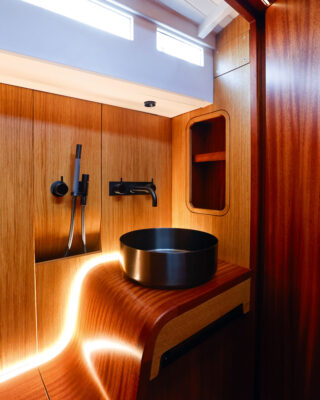
Sensuous S-shaped curves of the beautifully veneered shower seat in the heads. Photo: Paul Wyeth
Wood appreciation
The armchairs and whisky cabinet are deliberately crafted to invite you to relax and appreciate the surrounding skill on show. Whether the gentleman’s club style is to your taste or not, there’s no denying the stunning craftsmanship.
Silvester wanted to exhibit that aspect as much as possible. Two unique multipurpose ‘pods’ conceal modern amenities while maintaining the visual integrity of the hull structure.
Even the anchor locker is offset to one side to maintain a clean view of the Sipo planking and Douglas fir frames, all the way to the tip of the pointy stem. Equally, the aft sections are left exposed to show the steering gear as if it were the chrome bling of a hot rod.
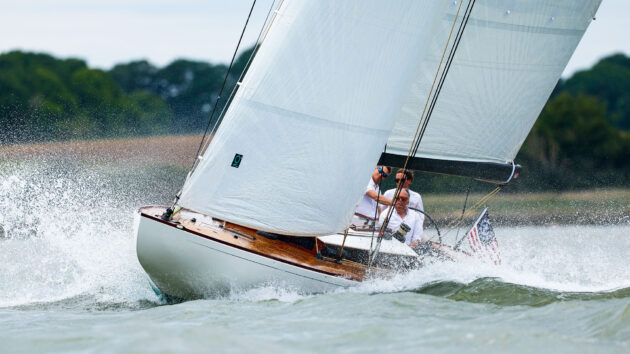
‘It was compelling, magnetising sailing’. Photo: Paul Wyeth
Spirit Yachts’ Thomas Smith designed something truly special, in particular the pods born out of Silvester’s desire to not monopolise space for functions used for only a fraction of the time on such a yacht. One provides an induction hob and fridge, the other an electric heads and shower. The beauty is in the build and finish.
The mindset is evidently that owners will only spend short stays aboard and take removable gear, as there is little in the way of usable stowage. Instead, luxury Globe Trotter removable luggage is stored on the engine box below the cockpit, including leather-lined boxes for place settings, and an elaborate safety box for flares.
Modern tech lies below the timber facade. The wiring for the deck power is hidden, run through the companionway handrails. And it’s a full electric yacht – below these steps is a US-made Elco electric drive, powered by a solid-state, modular battery bank that offers significant energy-density advantages over lithium.
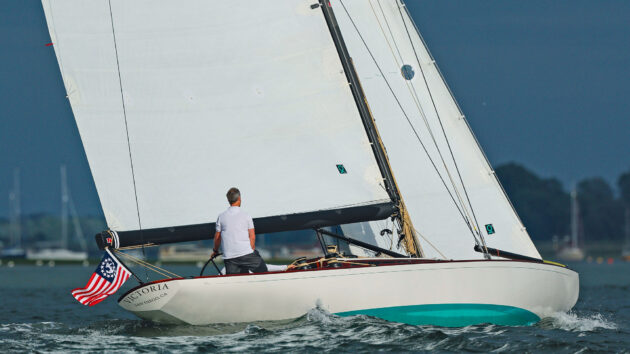
Photo: Paul Wyeth
Other than a choice of armchairs or sofas, and a large range of fabric colours to choose from, there’s very little in the way of options, however. This is no production yacht.
The future
As we went to press, Silvester began campaigning Victoria on the Med classic regatta circuit, celebrating her original sibling’s centenary in style, and with hopes of being able to compete alongside the original Q Class in time. “Our goal is to lead a Q Class revival so everyone can enjoy these iconic designs for another 100 years,” he declares.
“We want to support and promote the ongoing maintenance and racing of original Q’s like Q7 Falcon, encourage the restoration of remaining original hulls and infuse the Q Class fleet with new energy, from new builds, based on original designs.”
Q7 Yacht Designs was established to offer a limited run of up to seven new yachts (which can be built in other yards than Spirit’s). While the worlds of classics and elegant weekenders are notorious for stealing hearts, the overriding question will be whether anyone else chooses to pay the $4m required to build another.
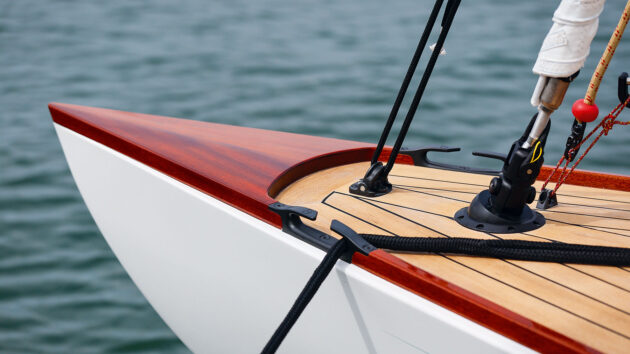
Exquisite workmanship at the sharp end. Photo: Paul Wyeth
However, as Silvester points out, even if they don’t, he’s ended up with the yacht of his dreams.
Sailing this yacht, named after Silvester’s wife, has certainly given us the chance to celebrate true boatbuilding skill, appreciate timeless lines, and enjoy the regal feeling that helming a Q Class – new or old – can bestow.
I shan’t forget the moment we glided towards the Royal Harwich hammerhead pontoon at the end of the day, milking the last catspaw of breeze, and I nudged the throttle to engage the silent engine, just in case it was needed. It was a Bond-like experience, which, given some of the luxury-goods collaborations Silvester has put in place, is perhaps what he was going for.
This has the best of British craftsmanship aligned with some statement heritage and class, and that extra wee sprinkling of showboating glam.
 If you enjoyed this….

Yachting World is the world’s leading magazine for bluewater cruisers and offshore sailors. Every month we have inspirational adventures and practical features to help you realise your sailing dreams.Build your knowledge with a subscription delivered to your door. See our latest offers and save at least 30% off the cover price.
Note: We may earn a commission when you buy through links on our site, at no extra cost to you. This doesn’t affect our editorial independence.