


The Wauquiez 55 is a quirky cruiser packed full of surprises and ideas. Blending protected luxury with easy performance, it also comes alive under sail
Wauquiez 55 review: It shouldn’t work – but it does!

Envisage a flow chart for choosing a new cruising yacht. As well as establishing fundamental decisions – such as monohull or catamaran? Glassfibre or aluminium? – it also asks if you want to be able to sail from a fully protected cockpit. So, presumably this yacht is for sailing in North Atlantic/Baltic waters. If the answer is ‘yes’, you’d likely arrive at models from Moody, Amel, perhaps Allures.
But what if a builder dared to fuse such features with additional volume, a deck layout that better suits Mediterranean cruising, and potentially some additional performance under sail? It might tear up your conventional flow chart, and lead instead to something quite different… like this. The Wauquiez 55 is definitely a unique-looking vessel. It’s a brave design, one that could only be conjured up in the current day, with a market demanding more and more space and comfort.
Why the Wauquiez 55 is extraordinary
This 55-footer can almost rival a catamaran in this respect. It can be controlled by one person from a fully protected cockpit, features a walk-in engine room with optional twin engines, a lift keel option, and is unique at this size for offering a vast master suite with private access onto an aft terrace. While the yacht’s aesthetic will have mixed appeal and presents some compromises, which we will discuss, it is undeniably an extraordinary craft.
The design draws inspiration from successful ideas of the past, while incorporating its own novel thinking, moulding these into a shape which will challenge preconceptions about its performance at sea.
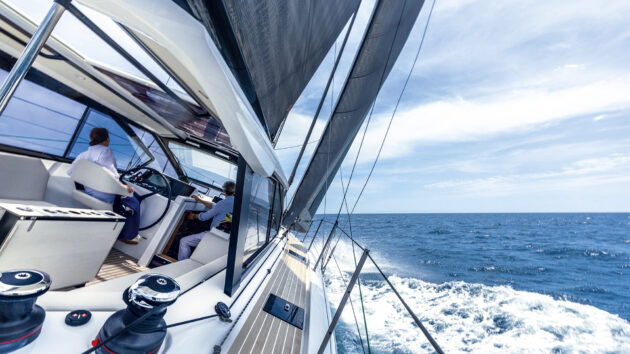
Photo: Gilles Martin-Raget/Wauquiez
A centre cockpit pilot saloon is nothing new for Wauquiez; it is something this 60-year-old yard has specialised in for decades. Nevertheless, the Wauquiez 55 is something very different. It clearly borrows elements and inspiration from market leaders Amel – consider the central pilothouse set-up with offset single wheel, the fixed guardrails and faux teak decks integrated into the mould.
Yet such comparisons rapidly pale when you look at the radically different lines, in particular, the very full bow sections with dreadnought stem and dry forefoot, the pregnant midsections – let’s call this a modern day chined version of tumblehome – and the prominent reverse sheer which slopes aft to meet an ultra wide and tiered stern. We’ve never seen anything quite like it, and it caused quite the stir when it was unveiled at the Düsseldorf boat show last year.
How the design works
To get to the how, let’s consider the why first. Wauquiez CEO Cyril Ballu initiated a design competition to help create his vision for a modern, covered centre cockpit cruiser. The Marc Lombard Yacht Design group deemed this an opportunity to realise a shape they’d been discussing for a decade or so – a pilothouse cruiser with double passageways below decks. Lombard’s Eric Levet explains that not only would this require a yacht with enough volume for that interior format, but they’d need to make it safe and roomy enough on deck to move along the side decks past the substantial pilothouse.
When you consider these points and look at the Wauquiez’s shape again, you see how the tumblehome helps create this space and interior height – where normally you’d drop down to bilge level in the passageways, these are still raised in the galley, enjoying the maximum beam of the swollen hull sides and the views from their near full-length hull portlights.
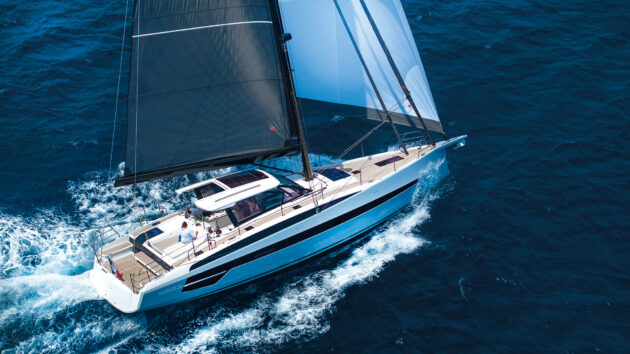
Plenty of yards have created voluminous cruising designs that abound with luxury and comfort. The Wauquiez 55 adds ease of sailing from a protected position, together with enjoyment on the wheel. Tumblehome allows near full-length hull windows and tall headroom in the passageways. Photo: Gilles Martin-Raget/Wauquiez
Meanwhile reverse sheer aids this internal height where it is most required, while reducing the visual scale of the broad transom and limiting weight in the ends.
Every detail was planned with intricate attention to weight. The result is a 20-tonne yacht – given its volume, you might assume a third heavier displacement.
The point of detailing these design techniques is to help give some reasoning behind what we experienced on the water. As our recent European Yacht of the Year coverage revealed, the Wauquiez won the luxury cruiser category, and we underscored the jury’s positive assessment of its sailing qualities.
Engaging at sea
When you first approach that 5.25m-wide tiered transom, you wonder how it could possibly engage you on the helm or point effectively to windward. But once you take the wheel under sail, you quickly realise the W55 is definitely a sailing yacht. There is none of the disconnect you might expect from a covered centre-cockpit design– it feels like a much more nimble yacht than its bulk suggests.
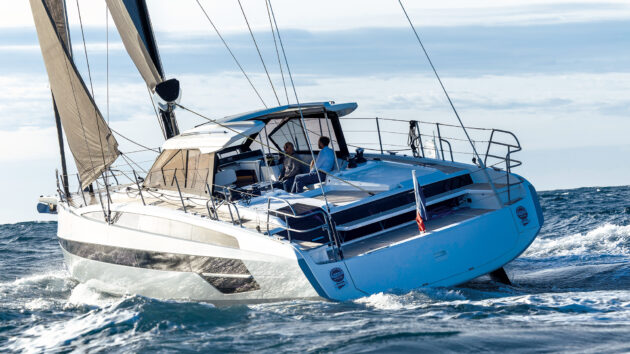
‘The helming experience is akin to steering from your living room’. Photo: Gilles Martin-Raget/Wauquiez
This is a powerfully rigged boat to help ensure that volume will shift. I sailed the W55 in ideal conditions, a Force 5 touching 6 one day, and a lighter sub 10-knot breeze the next. Close-hauled under staysail we averaged just over 7 knots at 35° to the apparent wind in 20-22 knots true. It should be noted that while a fixed L-shape keel comes as standard, the test boat is fitted with the optional swing keel (with 4,070kg ballast), which reduces draught from 4.2m to 1.7m. It’s a useful option to have, offering a deep foil for righting moment and pointing upwind, together with the ability to nose into shoal waters.
This staysail is on a self-tacking rail, which encourages a solo helmsman to throw the boat through tacks. Push a couple of buttons to douse that sail and unfurl the genoa, crack off onto a fetch, and you can then nudge into double figures almost seamlessly.
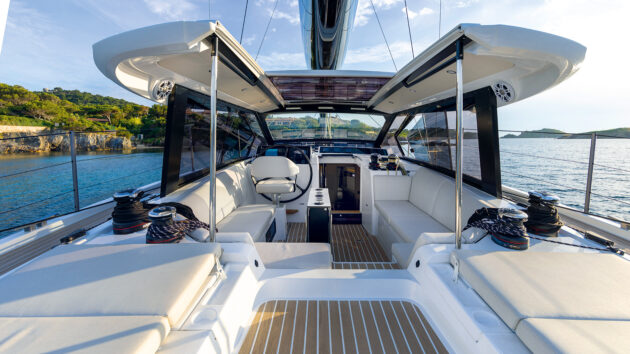
Fully protected helm station (and cockpit) includes optional remotes for most sail functions, while halyard winches are within reach. Photo: Gilles Martin-Raget/Wauquiez
More impressive still is that the helming experience is akin to steering from your living room, meaning your crewmates can join you in the cockpit, all chatting away at a normal audible level, wearing T-shirts (or slippers even) rather than three-layer wet-weather gear and boots. The difference is startling if you then step onto deck in over 25 knots apparent, realising you need to shout to be heard.
Fresh air
Visibility from the enclosed helm is fine, however I liked to open the sliding window by the wheel, stick my head out for some extra fresh air and have a full view of the telltales. It can also provide relief from the heat generated by the extensive glazing. That said, there are numerous vents around the pilothouse, including hatches above and below the 8mm tempered glass windshield.
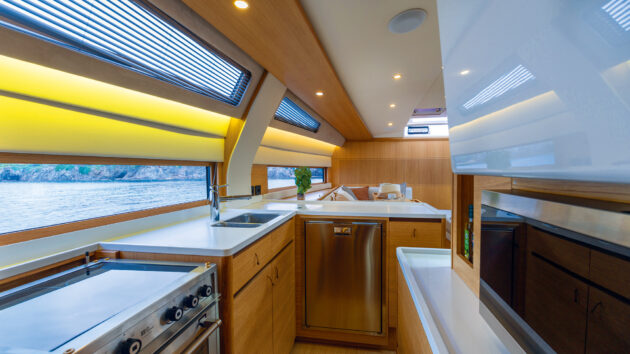
The raised linear galley enjoys plenty of light. Photo: Gilles Martin-Raget/Wauquiez
An assessment of how the full bow shape behaves sailing upwind, including experiencing it from the forward cabin, confirms it does slam going through waves. It’s an unsurprising compromise of packing all that volume. The designers and yard predicted such behaviour, creating a structurally capable build, which brings some peace of mind – even if it won’t help guests trying to sleep there under way.
Opening up
Moving off the wind and deploying the Code 0 (via simple remote switch actuations), revealed more of the yacht’s pace. We could maintain 10-knot average speeds. Indeed, the polars suggest the W55 should be able to broad reach at double figures in flat water from anything over 15 knots wind.
You can rapidly tick off long passages at such speeds. With the addition of some swell on our aft quarter, we clocked up to 12 knots at 100° to the apparent wind in 20-22 knots true. Impressive. As was the ability to actively helm this boat. The direct steering encourages you to play the swells and be immersed in the experience.
This feeling was compounded during the lighter winds of the second day, when we kept hands-on sailing even during low single figure breezes.
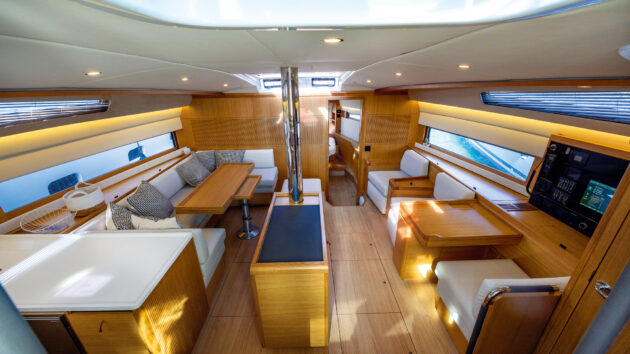
Bright, airy interior with huge amounts of natural light from the long windows. Photo: Gilles Martin-Raget/Wauquiez
It should be noted that this first boat is adorned with a sensational amount of optional extras, which both help get the most out of the yacht and exhibit what the yard can do – but balloon the pricing. The carbon mast and Mainfurl furling boom alone cost €213,564, with the performance sails adding another €70,000.
Six winches control the sails, two in the pilothouse, four aft, and these can be powered and reversing types. All are remotely controlled from the helm on the test boat, which, when combined with the mainsheet traveller on a powered flatwinder winch, allows for solo trimming from the wheel. During our second outing I witnessed how, once lines are cast, one person could easily single-hand the W55 from dock and raise sails without leaving the pilothouse – but of course this relies on the full functionality of all these systems.
This brings us to some drawbacks. There are a lot of powered systems on this yacht, some of which experienced teething troubles during our trials. And a design compromise with having almost everything within reach of the helm is the positioning of two loaded winches side by side in the cockpit, located at head height proximate to where guests sit.
Out of the cockpit, the moulded decking was on the slippery side – perhaps too much wax used in the mould, which would be easily remedied. Otherwise it’s easy to get around the deck, with the high stanchions and triple guardrails providing a good feeling of security.
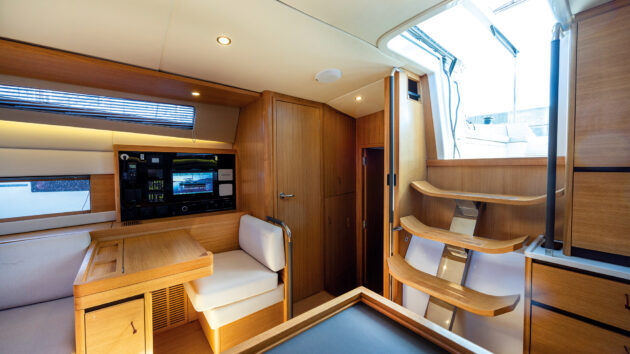
Spacious nav table. Photo: Gilles Martin-Raget/Wauquiez
Once at rest/anchor, the comfort levels abound. On the flat deck aft of the cockpit, large sunpads have elevating backrests, while that enormous aft deck offers sheltered space, plus the direct access to and from the aft cabin – a feature Wally superyachts pioneered.
Below the aft deck, deep stowage spaces span the beam. Combined with the sail locker, these offer ample deck stowage. However, the clean aft terrace design leads you to question where best to house a tender. There is space to keep a small inflatable on that terrace, or in the aft lockers, but for those wanting a larger dinghy, Wauquiez says davits (fixed or telescopic) are feasible.
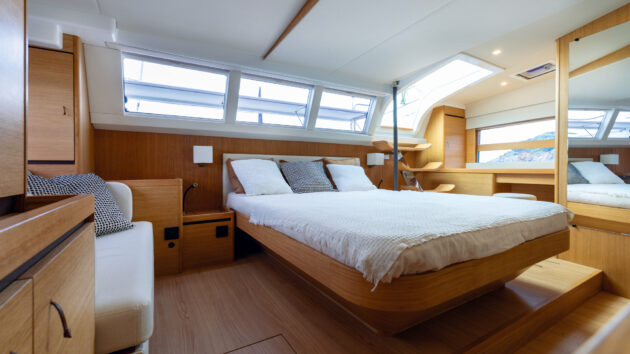
With 270° views and steps up to the swim terrace, the aft cabin certainly has the wow factor. Photo: Gilles Martin-Raget/Wauquiez
Lofty living
The cockpit functions as an extension of the interior, with space for up to eight to sit around the table, making it the primary area for crew to relax and dine. The sliding roof and surround ventilation works well when it’s hot, and there’s the option to enclose the area with soft closures in colder climes.
The second hull to launch was exhibited at the 2026 Düsseldorf boat show, where notable improvements include even more ventilation for the pilothouse and a new hard top option to allow 4m2 solar panels. Larger handrails are now being fitted, with optional solid guardrails and a crash bar at the mast base.
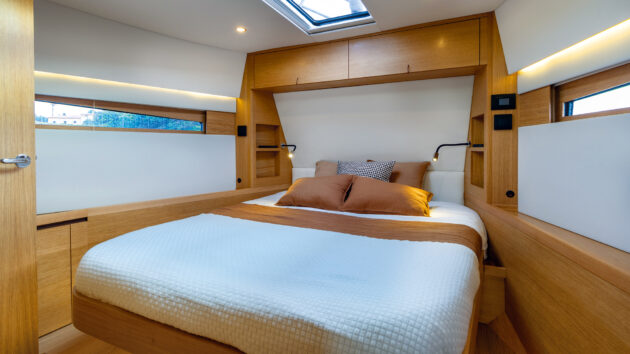
King-size peninsula berth in the forward cabin. Photo: Gilles Martin-Raget/Wauquiez
The transition as you move below decks to the raised level living area is subtle, all that glazing providing a phenomenal amount of natural light and good ventilation. The decor is bright and well executed, and finish quality is high, with plenty of solid joiner work, integrated handrails and fiddles. Weight and stiffness is well considered: for example, the floorboards are in plywood sandwich with a PVC core sitting rigidly on an aluminium structure.
The practical nature of the layout stands out, meaning the key things you may need or want to access surround the companionway on a similar level. This includes a proper chart table, the large passageway galley, a day heads, wet hanging locker, and a bunk cabin featuring ideal passage berths opposite the walk-in engine room.
So while the guest and owner’s en suite cabins are sumptuous with vast low double berths, which would require sturdy lee cloths/boards to use at heel, these don’t necessarily come at the expense of practicality for liveaboard sailors or those on passage too.
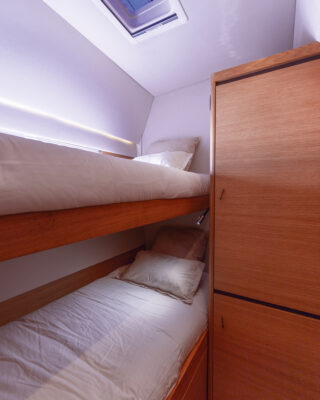
Bunk berths for passagemaking. Photo: Gilles Martin-Raget/Wauquiez
The engine space is the heart of the yacht. It provides full standing headroom, and abundant access for servicing the machinery – for which there is plenty of choice. While twin 50hp engines are standard, options include 80hp upgrades, or a single engine if the fixed keel is chosen.
The twin engines offer excellent manoeuvrability without needing to rely on thrusters. Both engines have large alternators as standard, but the test boat was specc’d with twin Integral 7kW and 9kW high-powered alternators, avoiding the need for a genset. There is also direct cockpit access to this engine bay if large items need to be removed or replaced.
More reassuring features of the Wauquiez’s build include fore and aft crash boxes, with the rudder stocks contained in a watertight compartment, while the doors for the guest and owner’s cabins are fitted with locking mechanisms to help seal them as best as possible.
This aft cabin is truly the ‘wow factor’ of the layout. During my first boatshow tour, I couldn’t help but to describe it as more of an apartment, complete with phenomenal 270° views. The ability it offers to move seamlessly from that berth to the aft swim platform in complete privacy is a form of luxury only a few sailing superyachts offer.
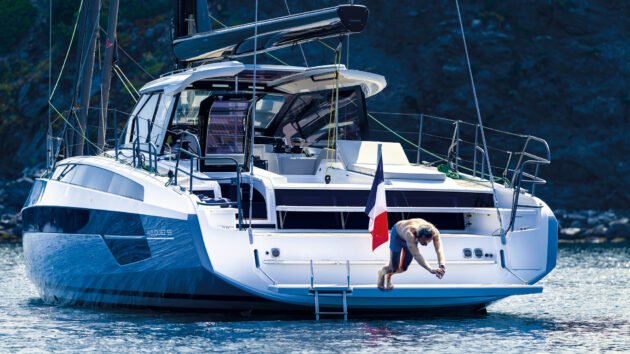
That instant access from the owners’ aft cabin to the swim terrace… and the sea. Photo: Gilles Martin-Raget/Wauquiez
Wauquiez 55 specifications:
LOA: 17.60m 57ft 9in
LWL: 15.20m 49ft 10in
Beam: 5.25m 17ft 3in
Draught: 2.40m 7ft 10in, swing keel 4.20m-1.70m 13ft 9in-5ft 7in
Displacement (lightship): 18,700kg 41,226lb
Ballast: 4,950kg 10,913lb • Berths 6
Engine: 2x 50hp saildrives
Water: 750lt 165gal
Fuel: 610lt 134gal
Sail area/displacement ratio: 22.9
Displacement/LWL ratio: 148
Test boat price: €2,271,430
Design: Marc Lombard Yacht Design & Roseo Design
Contact: wauquiez.com
 If you enjoyed this….

Yachting World is the world’s leading magazine for bluewater cruisers and offshore sailors. Every month we have inspirational adventures and practical features to help you realise your sailing dreams.Build your knowledge with a subscription delivered to your door. See our latest offers and save at least 30% off the cover price.
Note: We may earn a commission when you buy through links on our site, at no extra cost to you. This doesn’t affect our editorial independence.
Verdict
Yes, this a niche yacht. Its looks assure that. But for monohull sailors who crave some of the space of a catamaran; for those who’d like an Amel but with more deck relaxation space, sailing performance and bespoke options; or for those who also favour swing keel versatility, the Wauquiez offers an intriguing blend of some things borrowed, and something new. The sailing aspect is rewarding, which encourages hands-on helming, and a lot of sail power means W55 owners should be sailing most of the time. However, as with a multihull, you need to monitor the loads and reef accordingly. The numerous optional extras result in a pricey and tech-heavy yacht, and while powered systems can ease operation, they also bring extra complexity. Being able to enjoy sailing solo from a fully protected space, within full social communication with any crewmates who do join, may just sell this concept. If not, that single brochure image (see above) could: walking straight out of the generous aft suite, and diving off the terrace at a secluded anchorage. That’s 2026 luxury.