



The rebel designer rewriting the style rulebook, Andre Hoek, talks to Kieran Flatt
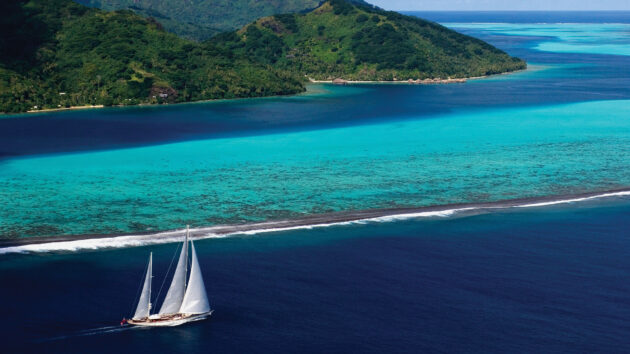
Andre Hoek, and his eponymous design company, has long been one of yachting’s disrupters. They pioneered the concept – at first fiercely criticised, then widely copied – of combining a classic above-water hull and deck with modern, high-performance hydrodynamics, rig and construction. Their trail-blazing classically styled superyachts have enjoyed great success, while their cruising yachts have voyaged as far as Svalbard, Alaska and Antarctica.
Over four decades, Hoek Design has created 175 designs – either afloat or currently in build – from 20ft to 226ft. The list includes no fewer than three J Class, desirable daysailers, hundreds of leeboarders and dozens of iconic superyachts like Athos, Elfje and Adele. This summer Hoek Design celebrates its 40th anniversary – we visited their incredible offices in the Netherlands to find out more.
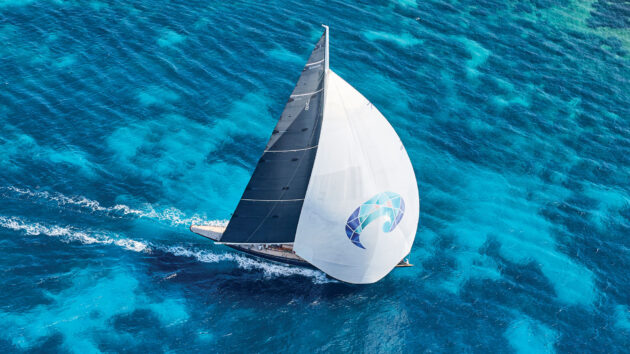
Topaz racing in the Maxi Yacht Rolex Cup off Porto Cervo. Photo: Carlo Borlenghi/Rolex
Racing roots
Hoek Design has deep roots in racing. Born into a sailing family in Amsterdam in 1955 – in the house where famed Dutch naval commander Admiral De Ruyter had lived during the 1600s – Hoek was competing at national level and optimising yachts long before he founded the firm that bears his name.
“It’s basically a hobby that grew completely out of hand,” he says with a smile. From age 15, Hoek and his brother raced the family leeboard yacht without their parents. He owned a Folkboat in his late teens and sailed it offshore, but his main focus was the traditional Dutch racing classes, Skutsjes and Lemsteraaks, where a revival was gathering pace and status.
Queen Beatrix herself sailed a Lemsteraak and the Dutch elite followed suit. Phenomenal amounts of money, effort and skill were devoted to optimising old working boats. In racing trim with leeboards functioning as asymmetric, lift-generating foils, the heavy, flat-bottomed boats sail upwind at 7-8 knots with hardly any leeway, making better VMG than a typical modern performance cruiser.
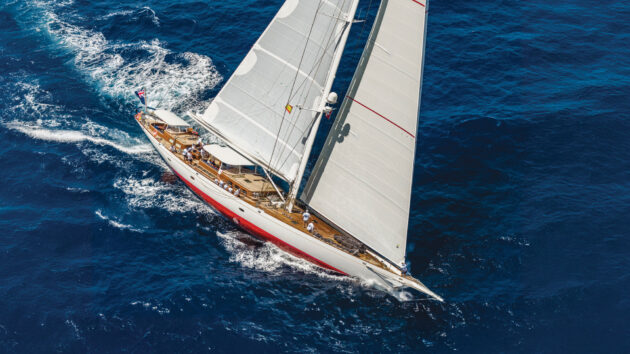
The 128ft Truly Classic Vijonara. Five TC128s have been built. Photo: Sailing Energy/The Superyacht Cup
Hoek and his brother restored a Skutsje in their early 20s. “I optimised the sailplan, stability, leeboards, handicap, the whole lot,” he says. “We were champions in the open class.” In Friesland thousands of spectators watch these overcanvassed, unballasted and unladen 50ft-70ft barges competing on canals, where they quite often capsize in spectacular crashes.
“The toughest challenge is the Shit Race, which recreates what happened in the early 20th Century when they transported cow manure from Friesland to south Holland and came back carrying porcelain,” Hoek says. “It’s a non-stop, long-distance endurance race with three or four crew and no engine. When you can’t sail, you pull the boat with a tow rope or push it with poles.”
The Lemsteraak class allows new boats to be built, but Skutsjes must be original. They can, however, be heavily modified. For an aspiring naval architect and talented sailor, there was opportunity in both fleets.
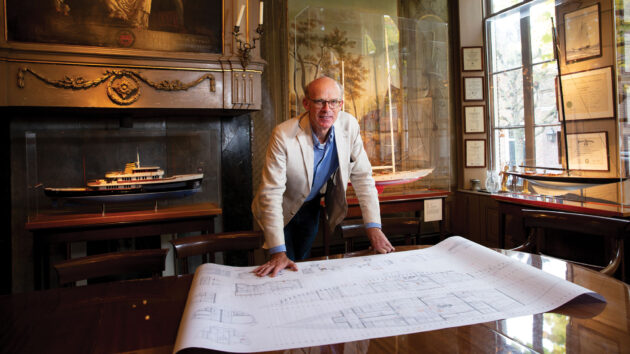
Andre Hoek in his office in Edam, a town with a long history of boatbuilding. Photo: Kos Pictures
Shaking things up
While Hoek’s racing fortunes were rising, his attempts to start a yacht design career were thwarted. After graduating in 1980 with a naval architecture degree and a year’s internship in the design office of C&C Yachts, he couldn’t get a job. “I tried Ron Holland, S&S, Germán Frers, you name it,” he says. “They all had hardly any work because of the economic downturn.”
Instead, Hoek spent his first years as a naval architect working for a company that transported offshore drilling rigs on submersible ships. Meanwhile he kept on racing and optimising Lemsteraaks, Skutsjes and his own IMS Class 3 yacht, in which he won the national championships.
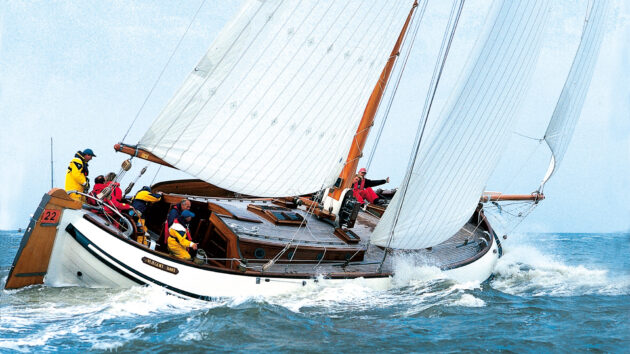
Hoek designs have dominated Lemsteraak racing since the 1980s, Vlliegent Hart being one of the most successful. Photo: Courtesy of Hoek Design
In 1986 Hoek quit his job and started Hoek Design in the attic of his home in Amsterdam. One early commission was converting an old German lightship into a sail training vessel, the three-masted barque Europa. Routine work involved improving clipper ships, optimising Lemsteraaks and designing new ones. In 1987 he won national championships in two Skutsje classes, in boats he had optimised.
“We’ve always done a lot of research,” he says. “That first year we wrote a VPP for gaff-rigged boats with leeboards, which is really complicated. We were also tank testing at Delft University and later we took a Lemsteraak model to the Wolfson Unit wind tunnel in Southampton to test different mast positions, headsail configurations, mainsail shapes and code sails. They thought we were mad when we turned up with this gaff-rigged boat.”
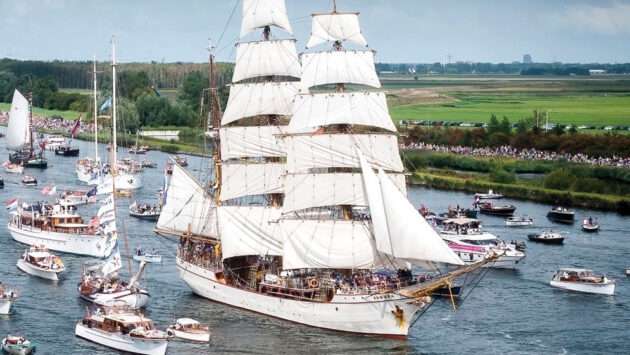
The barque Europa is an early Hoek design. Photo: Tom van Oossanen, courtesy of Hoek Design
The first Hoek-designed Lemsteraaks, launched in 1987, were almost unbeatable. But with success came controversy. “The purists tried everything to pull the rug from under our feet,” Hoek recalls.
“The class association that issued rating certificates was like a historical preservation society and every time we designed a new boat, they fought it fiercely. It took them 10 years to realise these new boats not only made the class more competitive, a lot more people were buying old boats too, so the value of all the boats went up. Eventually they started asking us for advice. It’s gone full circle, now we’re friends and we work together.”
More than 200 Lemsteraaks have been built to Hoek designs. A new design, CFD optimised like a grand prix racing yacht, is currently in build.
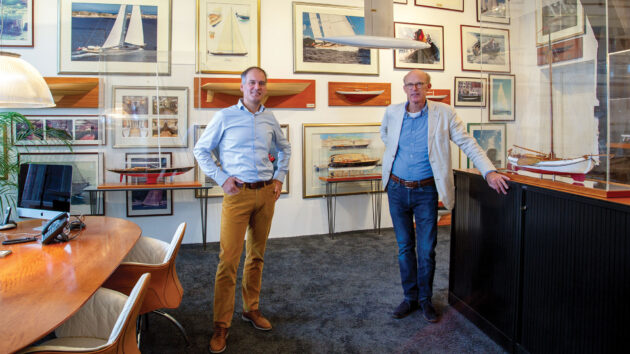
The Hoek Design partnership of Andre Hoek (right) and Ruurt Meulemans. Photo: Kos Pictures
Moving up
Hoek’s success with Lemsteraaks won him a commission from a leeboarder owner who wanted a large ocean-going sloop. The 21m (70ft) Joss, designed in 1988, was designed as a comfortable and capable fast offshore cruiser. Her concept also set the template of key design features that have become Hoek Design’s signature style. On a ketch-rigged sister ship, Kim, the classic deck and cockpit aesthetics were further refined.
Both Joss and Kim have a spoon bow and stern overhang, a flush deck with a doghouse and a lantern skylight. But they’re beamier than a true classic, there’s a lot more living space inside and the rig is entirely modern. Below the waterline, nothing is classic. The round-bilge hull provides form stability, the rudder is a balanced spade and the wing keel is inspired by Australia II, which Ben Lexcen’s team developed at Marin in The Netherlands just a few years earlier.
Like Hoek’s Lemsteraaks, these 70ft modern-classics were controversial. “Nobody else was doing that and we were criticised a lot,” Hoek says. “Many people said it’s wrong to change a long-keel boat into a round-bilge boat, you can’t do that, it’s never going to work.
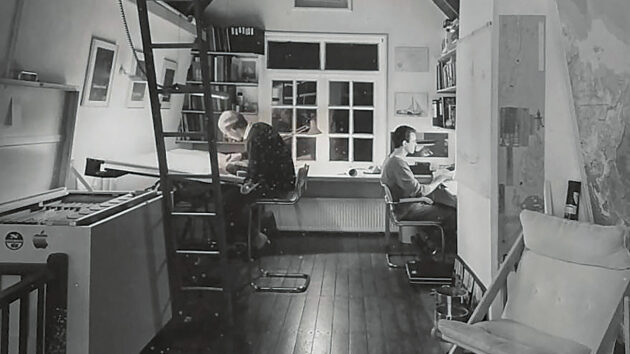
Hoek’s first office in the attic above his home in Amsterdam. Photo: Courtesy of Hoek Design
“Well, the rest is history. Those two yachts put us on the map internationally and were the starting point for a whole string of modern classics.” They also paved the way for modern-style superyachts like the 142ft Aphrodite II (now Delisha).
By 1988 Hoek Design had outgrown Andre’s attic. He moved the office to a magnificent historic building in Edam, a small town on the IJsselmeer, where the firm has been based ever since.
“Everybody thought I was mad,” he says, “but the history is important. Edam was the centre of boatbuilding for the Dutch East India Company, the VOC. The frames in our roof, built around 1560, were probably from VOC ships. I chose this building because it brings together the aesthetics of classic boatbuilding and historic architecture.” The proximity to shipyards like Vitters, Royal Huisman and Feadship is also an advantage.
The front office of Hoek HQ is a spectacular shop window. A tank test model of the 152ft Elfje hangs from a 16th century ceiling beam. Half models, photos and plan drawings of Hoek superyachts and J Class adorn the walls, alongside restorations the firm has worked on like the S&S yawl Baruna.
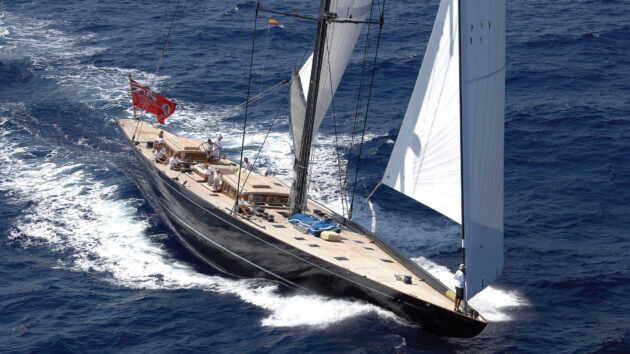
J Class Lionheart. Photo: Ed Holt/Alamy
Across the hallway is a meeting room with 18th century decor that has been astonishingly well preserved. “Our hand-painted wallpaper room is one of two known examples,” Hoek says. “The other is in the Rijksmuseum.”
Hoek’s experienced nine-strong- team tends to do all aspects of their designs in-house. “We often deliver a complete package,” Hoek says. “Interior design, exterior design, naval architecture, structural engineering, all under one roof. It makes communication much easier than working with people from different firms in several countries. Though we do sometimes work with outside people on big custom projects.”
Partners in design
In 1999 Ruurt Meulemans joined Hoek Design. Meulemans, who has an academic background in both aero engineering and naval architecture, shared Hoek’s passion for R&D and clicked with him on a technical level despite their different sailing backgrounds.
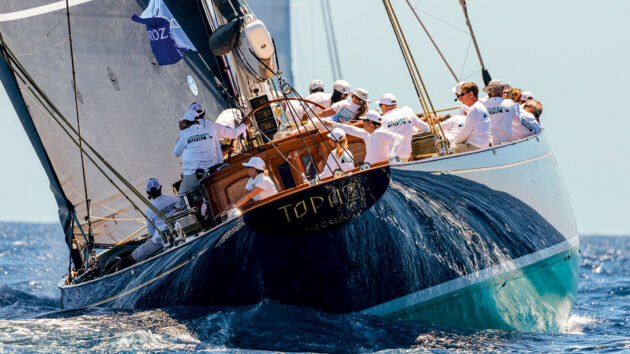
J Class Topaz at the Superyacht Cup Palma. Photo: Sailing Energy/SYC
Ruurt was a cruising man, having grown up in the 1970s sailing long offshore passages in small glassfibre boats. He was hired as a yacht keel specialist with deep experience of tank testing, wind tunnel research and VPP models. These were crucial skills as the firm was starting a massive R&D project for a yacht much larger than any they’d previously designed: the 180ft ketch Adele.
“We already had a specific VPP for large yachts with shallow draught keels, but I improved it. You can’t just scale up a normal fin keel for a 50m yacht,” Ruurt explains. “It couldn’t enter most harbours. Adele was the first big superyacht we tank tested and a lot of that work was comparing three different types of keel.”
Built by Vitters and launched in 2005, Adele won a hat-trick of design awards and followed that up with cruising exploits in Svalbard, the Pacific and Antarctica in her first two years. Hoek was on board for a month of each voyage and saw for himself how well she handled violent storm conditions off Cape Horn. Ruurt was in her crew for the first Superyacht Cup: “Everyone thought she wouldn’t perform but she was very competitive even in just six knots of breeze,” he recalls.
Twenty years on, Ruurt is joint managing partner with a 50% share of the firm, which they’ve run as a double act for the last decade.
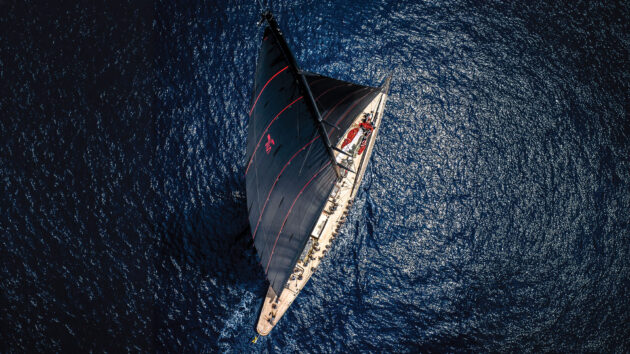
Spectacular Hoek designed and Vitters-built J Class Svea competing in the Superyacht Cup. Photo: Sailing Energy/The Superyacht Cup
Truly classic
An early milestone project came in 1991 was a 56ft sloop for Michael Peacock, the UK Admiral’s Cup team captain of Juno fame. “That boat was called Truly Classic,” Hoek says. “The idea we had together with him was to market a hull designed for semi-custom series production, which is easy to customise inside. In the Truly Classic series we’ve done about 50 boats in total from 51ft to 128ft, we’re still designing and building them now.”
The Truly Classic concept allows owners who aren’t experts in the foibles of classic yachts, to own a boat that looks like an elegant 1930s original, but handles like a modern fast cruiser. The original Truly Classic’s many victories in Caribbean and Mediterranean regattas, with Peacock at the helm, was a great marketing tool. When he later sold her to Pete Townshend of The Who, that also helped with publicity.
The boats have shown their potential offshore – the almost 20-year-old TC78 Drumfire winning PHS overall and a Division win in the Rolex Sydney Hobart Race in 2023 and 2024. No fewer than five of the TC128 series superyachts were also built, with identical hulls.
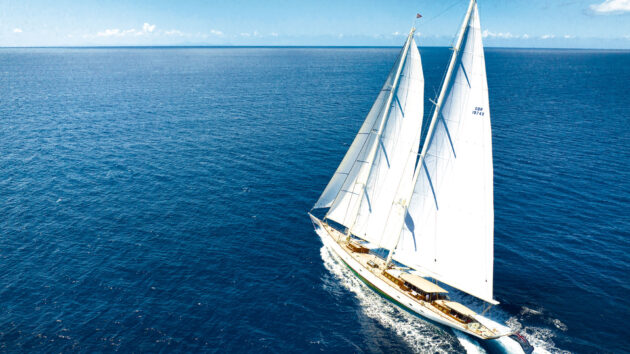
Superyacht Athos cruising in British Columbia. Photo: Oli Riley
Innovative shapes
The Pilot Classic style of yacht is another Hoek innovation, combining the above water aesthetics of a Bristol Channel Pilot Cutter with a moderately beamy, light displacement round-bilge hull, deep fin keel with torpedo bulb and spade rudder. The first was 36ft Tintel, built in 2001 as a coastal cruiser. Twelve more Pilot Classic designs have been built since, the largest being Elfje, with yet more on the drawing board.
Next came a monster that turned into a minnow. In 2003, Andre Hoek and Luca Bassani of Wally Yachts were riffing on the sort of yacht Fife and Herreshoff might design if they were still alive. An extreme 200ft oceangoing racer-cruiser was fully developed and engineered for a full carbon build.
That never happened but the concept, scaled down to 37ft, became the Wallynano. Re-engineered by Hoek Design in 2016, this planing dayboat stormed back onto the regatta scene sailed by Jesper Bank and Joop Doomernik, whose boatyard has now built 14 of them.
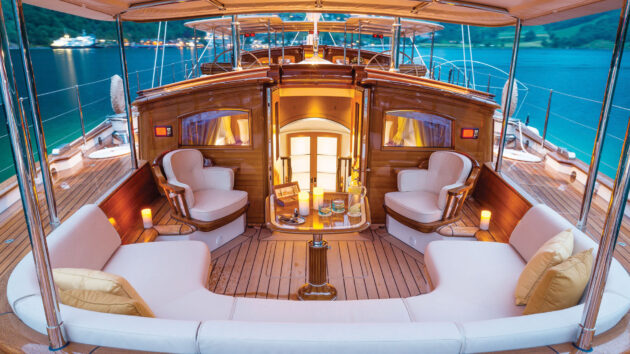
The sumptuously comfortable aft cockpit of Wisp, a 156ft Hoek Design built by Royal Huisman. Photo: Cory Silken, Courtesy of Hoek Design
“We’re often asked to design boats with the look of a J Class in a much smaller size,” Hoek says. Those enquiries inspired the Eagle cabin cruisers, built in series by Leonardo Yachts since 2015, with slender, light displacement hulls, deep fin keels and very low freeboard.
Ten years ago they also started designing “the sort of motor yachts that appeal to sailors,” Hoek says. Power projects have included the magnificent 180ft Blue II, the herring lugger-based superyacht Far Niente, and the 76ft chase boat Stargazer, with a 148ft retro-classic currently in build at Royal Hakvoort.
Meanwhile, the largest Hoek-designed sailing yacht ever built, a 224ft ketch, is well under way at Vitters, due for delivery next year with a 278ft three-masted schooner also on the drawing boards.
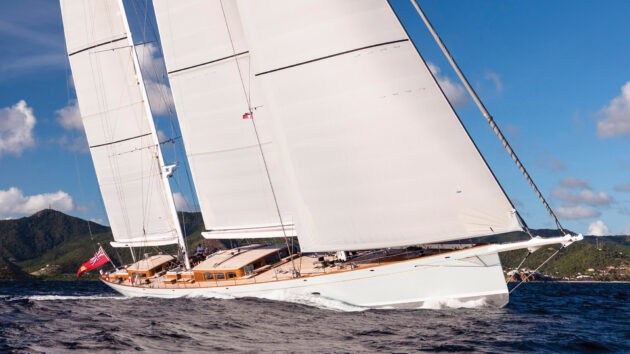
Elfje is the largest of Hoek Design’s Pilot Classics. Meulemans says she’s “the most balanced design we’ve done”. Photo: Cory Silken, Courtesy of Hoek Design
Expansion shift
After four full decades in the yacht design game, Hoek has not yet set a retirement date.
“The company has grown a lot,” he says. “I started on my own, at times we’ve had 16 staff. It’s a business that goes in waves. When you’re on the crest of a wave you don’t have enough people. Between waves you try to support the people you have. You need big nerves, it’s always been the case. Like sailing, you need to know when to tack.
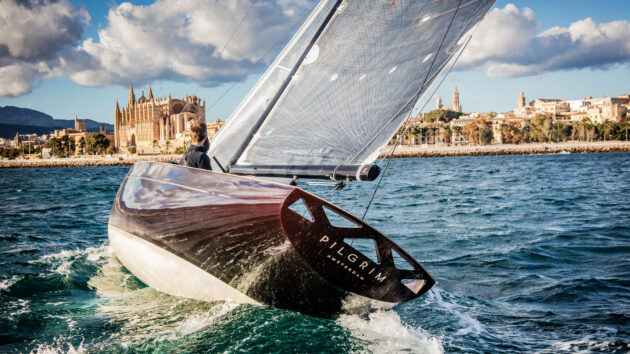
Wallynano Pilgrim, a 37ft Hoek-designed retro-classic carbon daysailer. Photo: Jesus Renedo
“We try hard to do new things,” Hoek says. “It’s been fun, it’s been exciting, it’s been stressful, it’s been very rewarding. We’ve been working like mad all these years. But there are moments, like when I look at the photo in our office of six Js racing in Newport. Both Ruurt and I were on board. Then I think ‘Wow, we are so lucky to be able to do this’.”
The last word goes to Elizabeth Meyer, queen of the J Class, who was one of Hoek Design’s fiercest critics for a number of years. She later wrote a letter that hangs in his office.
‘Dear Andre,’ it begins, ‘I now wish I could eat my words…’
 If you enjoyed this….

Yachting World is the world’s leading magazine for bluewater cruisers and offshore sailors. Every month we have inspirational adventures and practical features to help you realise your sailing dreams.Build your knowledge with a subscription delivered to your door. See our latest offers and save at least 30% off the cover price.
Note: We may earn a commission when you buy through links on our site, at no extra cost to you. This doesn’t affect our editorial independence.