


Rupert Holmes reveals how essential, big-ticket items performed after a full-on, around the world, real-life test
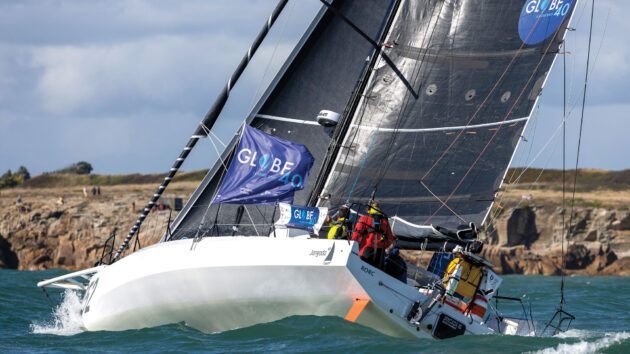
There are some key ‘big ticket’ items that any ocean-going or bluewater yacht will rely on. Water, power, connectivity, steering: the things you need to just work to keep the miles flowing under the keel. But how do you know what to choose and fit?
Sailing around the world, via the Great Capes, double-handed with limited stopovers is surely the ultimate test of any gear or onboard kit. Reliability, durability, and ease of function become critical.
Add in the fact that this was a race – the Globe40 around the world race – and high performance is also key.
So after more than 34,000 miles of punishing sailing, which of the ‘must-haves’ really stood up to the job? Rupert Holmes reviews his top performers from the race.
VHF and AIS
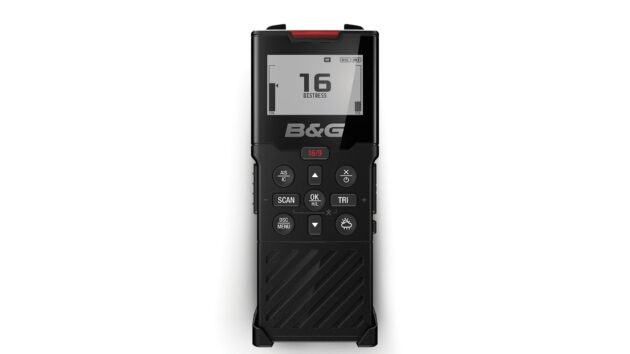
The pre-race refit of our Class 40 Jangada 40 included installation of new B&G electronics. We added a B&G V60 VHF with SP100 external speaker and H60 handset, partly because the remote handsets have wireless charging.
When offshore this is a better option than using a handheld unit on deck as you can transmit using the masthead antenna with the full 25W of power. In the end we were able to mount the main unit next to the companionway, so the remotes were not strictly necessary.
But it’s still a unit I’d choose for any boat where it has to be located at a nav station and out of easy reach to anyone on deck. It also has the benefit of a built-in AIS receiver with output to the NMEA network.
For AIS transmitting we used an Emtrak B953 CLASS B+ unit with an integrated splitter and GPS receiver. A big attraction was the Class B+ specification that sends out a 5W ping, rather than the 2W of a standard Class B unit. This increases range from 6-8 miles up to 16-18 miles, with a negligible increase in power consumption. This extra range is transformative for fast boats where closing speeds can be very quick if you’re sailing at speeds in the mid teens.
Even so, in the open ocean almost every ship we encountered on a near collision course made a course change for us just inside 30 minutes of the time to CPA (Closest Point of Approach). Often that was at a distance of 12 miles off, so well outside the range of standard Class B transmitters and navigation lights. That was both enormously reassuring and gave us opportunity to call ships on VHF in ample time for us to make a subsequent course change if they still failed to respond.
Radar
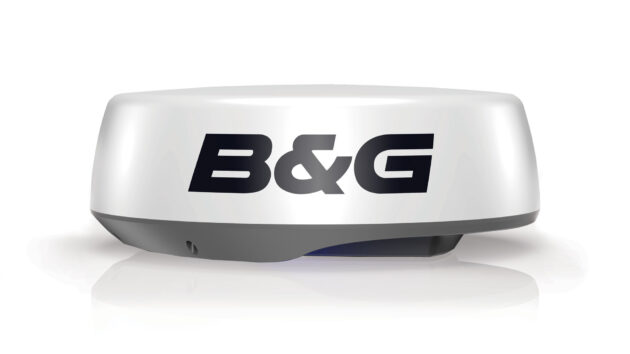
We used the B&G Halo24 extensively for tracking squalls, especially at night, and it worked well for that purpose, even if occasionally it failed to pick up light rain. It was also used close to shore, in an attempt to see smaller poorly lit – or even unlit – fishing boats.
Wooden 8-10m boats were picked up reliably, depending on sea state, at a range of around 0.75 miles. The system also proved useful in fog off Cherbourg peninsula on a French bank holiday weekend, when even small RIBs and peche promenades with no radar reflectors could be picked up at around 400m. While that’s not a great distance, it’s still enough to avoid a collision if you’re paying close attention.
On the downside, the UI is a little clunky in some respects. For instance, it’s not obvious at a glance which mode you are using and the powerful MARPA automatic target tracking is not intuitive to use.
Watermaker
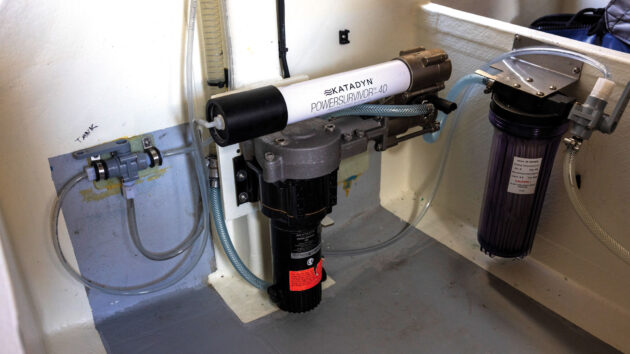
We fitted a Katadyn PowerSurvivor 40E watermaker. This 12V model is a staple for both long distance short-handed racing and ocean rowing. It’s a compact unit weighing only 11.3kg, available with a handle for manual operation in the event of total power failure.
However, the latter aspect is glossed over in the installation manual and careful planning is needed to ensure it’s mounted somewhere with enough space to fit the handle, or can easily be moved to a position where that’s possible.
Output was consistently around 5lt per hour, so a couple of hours use every day or two was sufficient. It draws around 4-5A at 12V, so each litre of water produced uses a very modest 12W of energy.
The unit itself worked flawlessly, though the initial installation was problematic. This had the water intake just in front of the keel and drew in big air bubbles at speeds above 3-4 knots.
We later learned this is a common problem for any watermaker used on high performance boats. A solution for vessels with a saildrive is to tap into the feed for the engine cooling system, the intake for which is low down and well aft. Jangada 40 has a shaft drive, so we plumbed it into the water ballast system instead.
Keel camera
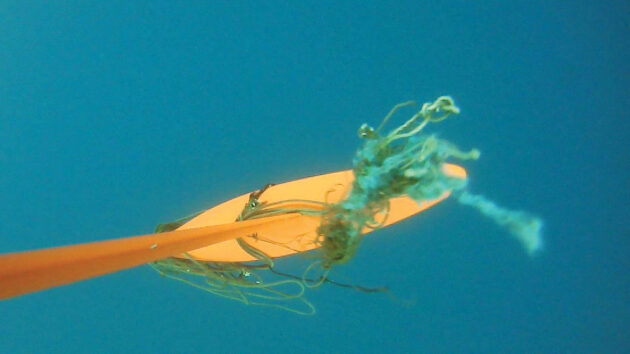
Snagging weed or debris on a T-bulb keel markedly reduces boat speed – while backing up unnecessarily to shift it is also slow. A keel camera that clearly shows whether the leading edge is clear is therefore a game-changer.
The Offshore Tec system immediately proved its worth just south of the Canary Islands, where we snagged a 20m length of polypropylene line. Later, in the South Atlantic, we caught a heavy duty hawser, numerous fragments of discarded fishing net and plastic sheeting. Off the coast of Patagonia it was thick lumps of kelp, while the North Atlantic had huge amounts of sargassum weed for 1,800 miles (between 4-34°N).
In all cases the camera proved extremely useful in both spotting problems and solving them. The unit has a USB connection to the PC monitor, which is clearly visible from the helm. It was therefore easy to round up head to wind and see the obstruction fall from the keel as the boat gathered sternway.
On the downside, the first unit we installed proved not to be fully watertight, resulting in failure of the internal electronics between Sydney and Valparaiso. We’re told production processes had been changed before manufacture of its replacement.
Autopilots
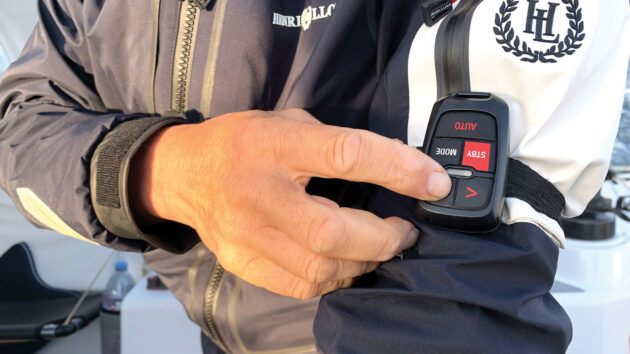
Among the pre-race refit of our Class 40 yacht Jangada 40 was the installation of new B&G electronics, including an H5000 pilot, with Pixel sur Mer Exocet Essential overlay and sensor monitoring.
Meanwhile the existing Raymarine linear rams for the pilot benefited from a full factory service. All worked impressively well, even in severe conditions, though after weeks at sea the system occasionally benefitted from a re-boot.
The Raymarine linear rams are used extensively throughout both the Class40 and IMOCA fleets, irrespective of the brand of electronics and pilot computers on board. We had two permanently connected rams running off separate
data buses.
Each has their own B&G H5000 pilot computer and most sensors are duplicated. Equally, the Pixel sur Mer Exocet pilot overlay and sensor management system can work with either ram. In the event of one pilot – or data network – failing, this allows almost instant switching to the backup system. Happily, it all worked smoothly and we never needed to switch to the backup other than for testing.
The H5000 pilot was capable of steering a good course across a very wide range of wind angles and strengths and we tended to use it in the very strongest conditions. The Exocet overlay, however, allows a far wider range of parameters to be used for steering, although it requires a steep learning curve. Coaching from both Pixel sur Mer and Pip Hare, who uses the system on her IMOCA, helped us considerably in this respect.
For instance, if powered up on a reach you can steer to a heel angle, so the boat automatically heads up in the lulls and bears away in the gusts, exactly as a skilled helmsperson would.
We used apparent wind angle in conjunction with speed or heel for a lot of the race. The heel safety function was enabled all the time and kept us going many times when others were broaching. We could continue sailing fast, yet with less wear and tear on sails and deck gear.
When steering with a pilot you’re dependent on sensor data and networks continuing to function smoothly. The Exocet system addresses this with comprehensive sensor monitoring, including sensor failure management, and will automatically switch to a back-up unit if necessary.
Sat comms
Starlink has transformed communications at sea. Before the Globe40 start, the race doctor highlighted a situation in the last Transat Jacques Vabre when a competitor sent him a photo of a burn via WhatsApp. That enabled him to immediately and confidently identify its severity, advise treatment required and reassure the skipper they could continue racing. It’s a hugely different scenario to describing injuries on the phone or via text messages.
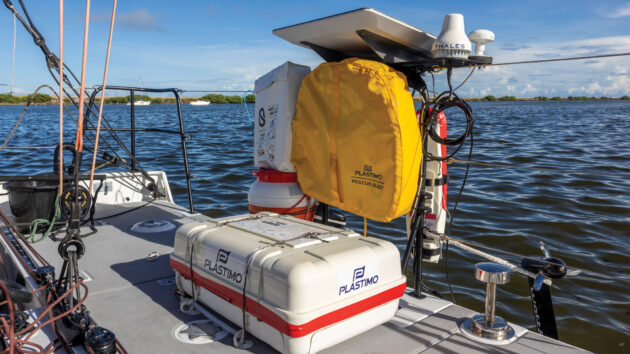
However, anyone fitting Starlink needs to bear in mind several important factors that are frequently overlooked. Our full-size, flat, high performance Gen3 dish was power hungry, drawing around 6-8A at 12V while in use and 13A at startup. So it was generally only used a few times each day, rather than run continuously, which also suited our 50Gb per month data plan.
In remote parts of the ocean it was often slow to connect – 15-20 minutes being typical and two attempts occasionally needed to get online, especially deep in the Southern Ocean.
The boats with Starlink Minis appeared to have more trouble connecting and by the time we left Sydney all teams who’d started out using it as a portable device had permanent installations on the transom.
The one aspect Starlink doesn’t handle is telephone voice calls, as distinct from VOIP services such as WhatsApp. For safety every boat was also required to have a satellite phone capable of receiving telephone voice calls 24/7.
We used an Iridium 9555 handset for this, which has a low power draw, and had a second unit in the grab bag. Starlink is offered on monthly contracts, with terms and conditions, including pricing, that can change at very short notice. So we also carried an Iridium Certus 200 with 192kbps data speed – almost 100 times faster than the 2.4kbps offered by the older Iridium units that were widely used as little as five years ago.
If specifying a system from scratch today the Iridium GO! Exec would be a strong alternative, with considerably cheaper hardware and a wider range of data packages.
In the end we didn’t use the Certus 200, but it was reassuring to have it as a backup, especially in areas with challenging weather and in which Starlink struggled to connect.
Small satellite communication devices are also appealing as a last resort as they use very little power. We had a handheld YB3 tracker in the grab bag that has a 9-month battery life if pinging position twice per day, and can also be used for sending and receiving short text messages.