




Whirlwind II is a true labour of love: a fleet-footed catboat design, just like one prized by shell fishermen 150 years ago and recreated for modern-day racing
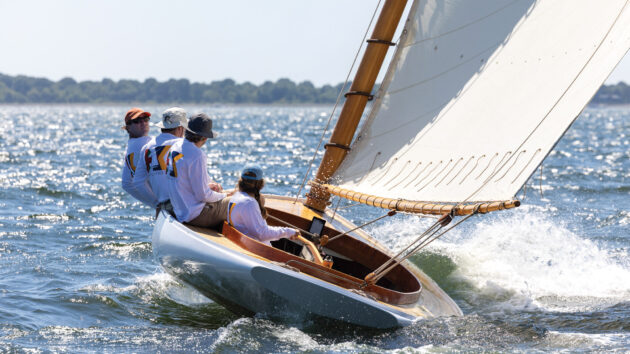
Whirlwind II is the result of an intensive reverse engineering project, sprinkled with a healthy dose of creative license. She’s a near replica of a design by legendary US boatbuilder Gil Smith, circa 1898, and was largely created from a scan of a half model found buried in a closet at the Suffolk County Historical Society on Long Island, New York.
When catboats were de rigueur in the late 19th and early 20th centuries, Gilbert M Smith (1830-1940) was one of the most prolific designers of the time. His early years were spent mostly designing catboats for shell fishers, who favoured the shoal draught design for their speed in getting their valuable catch of oysters and clams back ashore as quickly as possible before they spoiled.
The unstayed catboat rig, which sits well forward, also allowed plenty of room for fishing gear in the cockpit. Later, as the catboat became more widely popular, Smith designed more pleasure and race boats. But they all shared one desirable characteristic: speed.
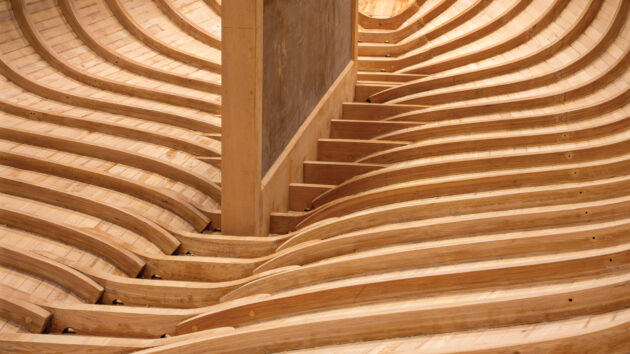
Frames are Douglas Fir with planking in milled cedar strips. The first plank went on at the turn of the bilge, with most simply bent to shape. Photo: Alison Langley
“His (Smith’s) sailboats were ever-faster, often beating contemporary Nathanael Herreshoff’s designs,” wrote Maine-based yacht designer Art Paine in an article for Maine Boats, Homes & Harbors in 2019.
“Smith’s boats were also uniquely beautiful. A Gilbert Smith racing catboat was a sight to see, if you could catch up with her.”
Gil Smith designs were so fast, legend has it that one day he caught none other than Herreshoff, the famed designer of five consecutive America’s Cup winners between 1893 and 1920, climbing around his boatyard. When Smith asked him what he was doing, Herreshoff is said to have replied, “Trying to figure out what makes your boats so fast.”
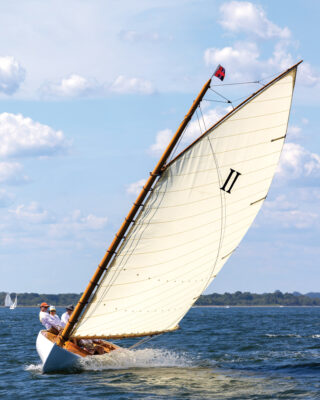
Thorne’s family has sailing roots that date to the Clipper Ships era and includes a defence bid for the 1930 America’s Cup. Photo: Alison Langley
Lure of the catboat
Yarrow Thorne, a 48-year-old designer and supporter of the arts from Jamestown, Rhode Island, became enamoured with the catboat concept when he saw an 1899 photograph of his great-grandfather, Edward Delafield, who had circumnavigated Long Island in a 21ft Smith-designed catboat, Briseis – no small feat, as the island is some 118 miles long. The picture of Delafield standing in the cockpit of Briseis captured Thorne.
As a youth, Thorne struggled with dyslexia and found relief with hands-on activities. “For me, a big part of sailing was learning how to feel the water through the tiller or rudder or sail,” says the 6ft 4in Thorne, who promotes art design in public places. “The physicality of sailing drew me to it.”
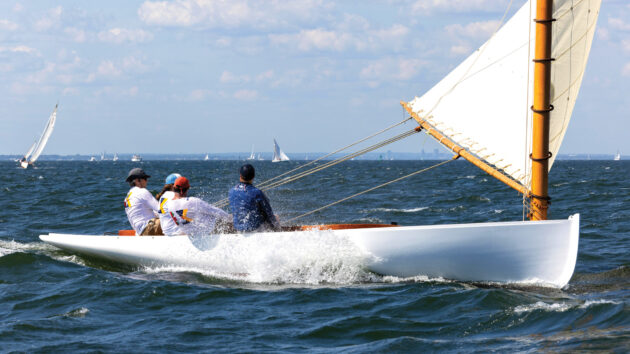
Large overhangs for its size. Photo: Alison Langley
He moved to Rhode Island in 2000, in part to become a better sailor. His family tree has many sailing branches, dating to the Clipper Ship era of 1850, where the name Whirlwind originates.
Thorne’s great-grandfather on his father’s side, Landon K Thorne, co-owned and skippered the Herreshoff-designed J Class yacht Whirlwind in the 1930 America’s Cup defence trials.
When selecting a boat for his family, Thorne chose a catboat because of their important history around Narragansett Bay and southern New England. “When you show someone a pic of a Gil Smith, people’s eyes tend to widen. They say, ‘Wow! What is that?’,” says Thorne.
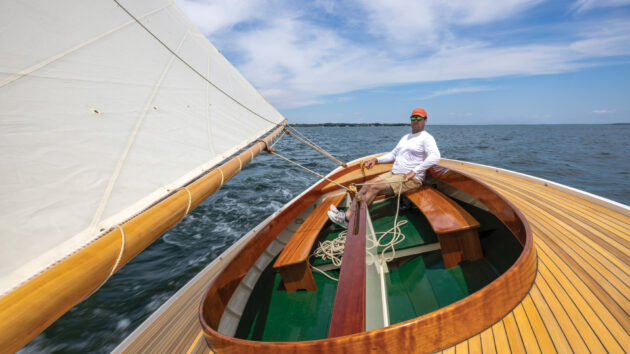
Whirlwind II owner Yarrow Thorne enjoys a sail on Narragansett Bay. Photo: Alison Langley
“The Mystic Seaport Museum has a lot of boats on display, but there’s only one Gil Smith. Everyone knows the story of it, and everyone wants to touch the transom. It’s sort of a phantom thing.”
Creating Whirlwind
But picking a Gil Smith design to copy wasn’t as simple as opening a book of lines plans. Such a book doesn’t exist. Also, Thorne wanted a length that would be appropriate for his wife, Mary Ann, and their two children.
That’s when Thorne’s long-time college buddy, yacht designer, architect and classic yacht investigator Ezra Smith, led Thorne towards Mariam, a Gil Smith design from 1898 that he built to “beat all his other designs.” The 26ft Mariam was named after the designer’s wife, who sewed all the sails for his designs on a foot-powered sewing machine.
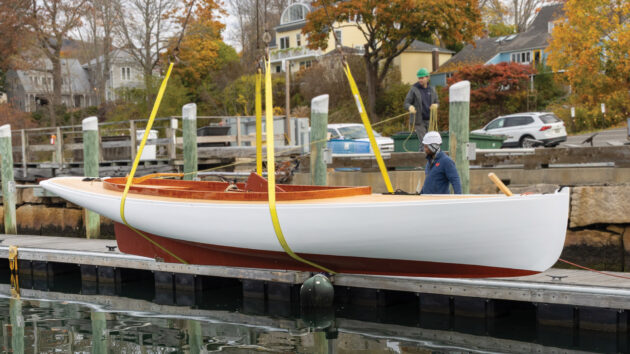
Cat boats have notably shallow draught. Whirlwind II has a gybing centreboard and lead shoe, though the rudder had to be redesigned as original lines plans were too small. Photo: Alison Langley
The problem was there was no set of lines plans for Mariam. Shortly after its completion, Gil Smith sold Mariam and it later vanished, whereabouts unknown.
There was, however, the half model at the Suffolk County Historical Society, which Smith likely carved by hand. There also was a single article on the boat in an issue of The Rudder magazine, the leading yachting publication of the day.
Thorne visited the historical society and, after some coaxing and a donation, was granted permission to scan the model. The rendering was entered into a computer design program to develop a full-size model. From there, structural and sail plans were developed, aided by a good deal of creative license.
The half hull depicted the keel deadwood and the canoe body, but not the centreboard trunk or rudder. Determinations had to be made about frame spacing, ballast, rudder size and rig. The balancing act was to make the recreation as close to the original as possible.
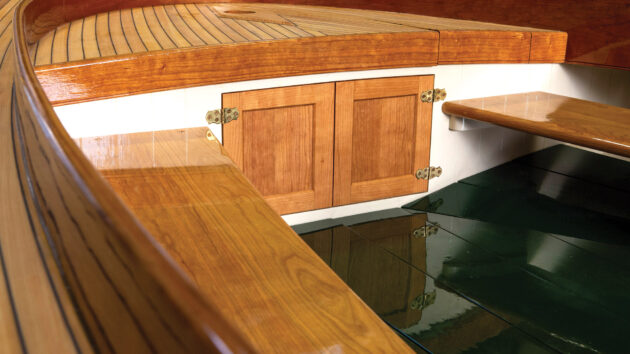
Coamings are a continuous cherry lamination, steam bent to the tight radius aft. Photo: Alison Langley
“We found some discrepancies when comparing the article in Rudder to some of the details we found on surviving Gil Smith designs,” says Ezra Smith, owner of Newport Yacht Builders, who project-managed the build and brought Whirlwind II to life.
“The half-hull model didn’t depict the centreboard trunk. But looking at his other designs, the centreboard trunk started at the forward end of the cockpit. So, we were confident that the lines plans in the article had to be wrong. Same with the rudder. The one depicted in the article was smaller and not representative of any other plans we found.”
“There were some details we had to recreate because they weren’t in the half hull,” adds naval architect Matt Smith, who did much of the design work in consultation with Ezra Smith. “Little details, like the rabbit line at the stem, the shape of the stem and how it transitions into the keel.”
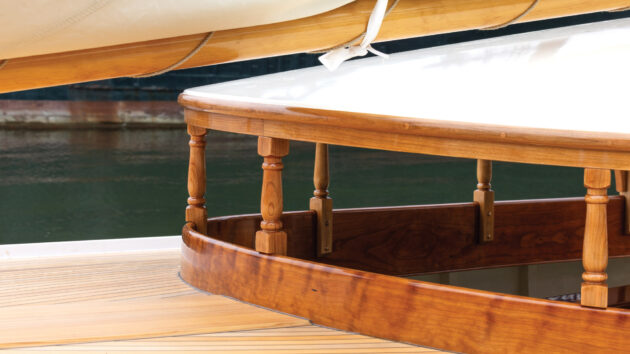
A custom canopy was constructed and can be fitted for cruising with the family. Photo: Alison Langley
When it came to deciding how much ballast should be in the keel, Thorne’s team again relied on past illustrations and articles. In the end, they added a 500lb lead shoe to the keel. “We had a target weight in mind and knew where we wanted the boat to float due to the pictures,” says Matt Smith. “From there we played around with the geometry of the shape and came up with a volume that made sense.”
Classic and modern
Whirlwind II was built by Alec Brainerd at Artisan Boatworks in Maine. Artisan has gained a reputation for quality craftsmanship, and this project illustrated their ability at applying modern technologies to classic forms.
“This is the perfect example of what we love most and do best, recreate a timeless piece of art,” says Brainerd. “Yarrow was intent on having it built in such a way that it looked as it would have in 1898, but we took advantage of modern construction elements.”
Whirlwind II has 24 frames on 12in centres. The frames are laminated with 1/8in old-growth Douglas Fir veneers using West System epoxy and bevelled to meet the planking inside and out.
The centreboard trunk is 3/4in Maranti plywood. The inside is sheathed with 10oz glassfibre cloth/epoxy and then painted with four coats of epoxy-based Coppercoat bottom paint. The outside has a 1/2in Douglas Fir face frame that incorporates notches for the floor timbers. The plywood trunk sides extend through the keel plank and deadwood and are capped by the lead ballast keel.
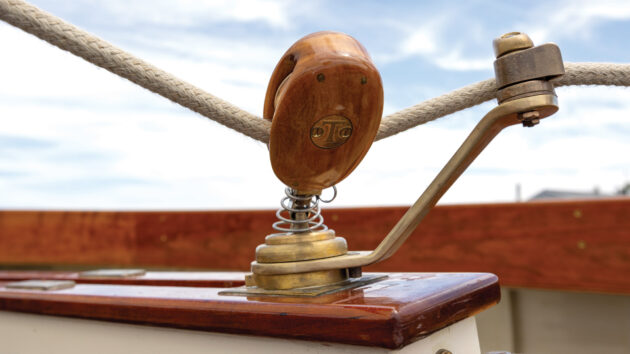
Mainsheet block has a ball-bearing sheave in a wood frame; cleat swivels on a brass arm. Photo: Alison Langley
The hull is tongue and groove planks of milled cedar strips with glassfibre over it. After the planks were faired the hull was sheathed in bi-axial cloth set in epoxy resin. The deck is cypress planks sprung on a plywood sub-deck. The coaming and a lot of detail trim is cherry.
“The hull we built is no more than 1/4in away from what Gil Smith carved,” says Ezra Smith. “We went with strip planking rather than plank-on-frame for ease of maintenance and overall structure stiffness. The big mainsail and unstayed rig generate lots of loads and we wanted some durability. The same with the laminated frames.”
Throughout the project, decisions were made with regards to traditional versus modern materials. For instance, Thorne insisted on a wooden rudder post, even though a carbon fibre or aluminium post would have worked better in the bearings.
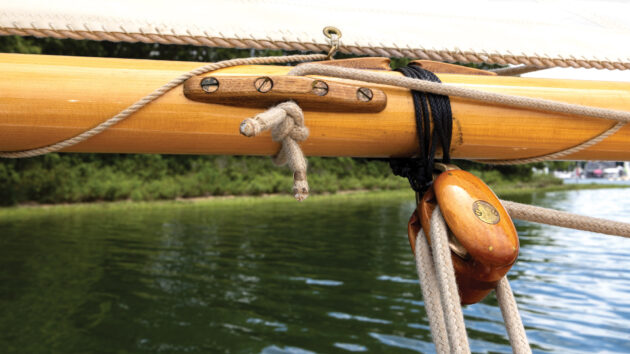
The double-sheave mainsheet block on the boom allows for a 4:1 mainsheet purchase. Photo: Alison Langley
The boom is made of spruce, but the mast and gaff are both carbon creations from composite engineering specialists Moore Brothers’ autoclave in Bristol, Rhode Island.
The mast tube is 28ft long and tapers from a 7.5in diameter at the base to 4.75in at the masthead. It is also painted to replicate an old wooden spar.
The gaff measures 16ft 10in and tapers from 2in at the inboard end to 1.5in at the outboard. The carbon fibre cloth was laid in a way to mimic the bend characteristics for extra support in carrying the massive 536sq ft mainsail.
The gorgeous classic launched at last year’s WoodenBoat Show at the Mystic Seaport, where it was a co-winner of the Professionally Built award in the Concours d’Élegance.
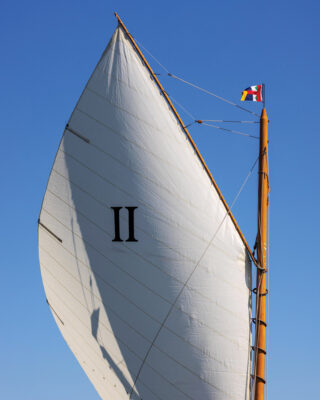
The gaff and mast on Whirlwind II are both made of carbon fibre by Moore Brothers and painted by local artist John Shehan to replicate classic wooden spars. The gaff measures nearly 17ft in length but can be a bear downwind in a breeze when it bleeds over the bow. Photo: Alison Langley
Holding a lane
On the water at its first regatta that year, the Herreshoff Classic Yacht Regatta on Narragansett Bay in Rhode Island, Whirlwind II showed some real teeth. Racing against other classic designs, Thorne’s narrow 26-footer held her own.
“Performance-wise, I was impressed,” says Oliver Moore, co-founder of Moore Brothers Company. “Those regattas can be tough, because of all the different types of boats. We were trying to hold a lane with a fully pimped-out Luders 16. It was 4ft wide and going straight into the wind. But we were able to pace him, it was cool.”
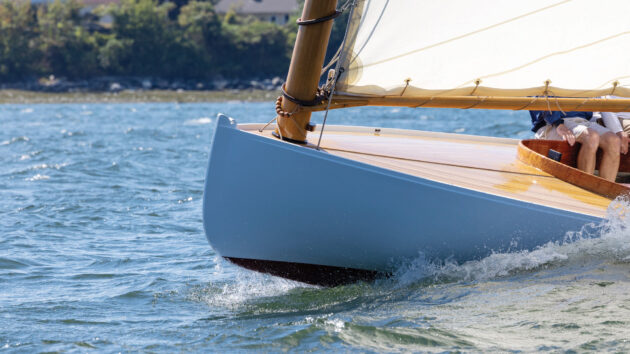
Whirlwind II has a distinctive rounded bow, while many earlier cat boats had plum bow shapes. Photo: Alison Langley
Downwind, Whirlwind II proved a bit more unruly. The crew hit boatspeeds of 10-12 knots, but the top of the large mainsail on a gaff rig kept trying to wrap around the bow with the sheet eased all the way out. That created a bit of wobble in the helm, and the crew had to fight spinning into a gybe broach.
“The problem with catboats downwind in a blow is the sail gets way out ahead of you,” explains Ezra Smith. “The boat wants to get out of control and starts to death roll. You must steer aggressively to keep the boat under itself. We were surfing at 11 knots. I’m not sure how much better we could’ve done.”
“For all intents and purposes, the boat worked really well. The builders and design team did an amazing job,” Thorne adds. “The boat really performs. It can sail in light winds and heavy winds. We got quite a few comments from other conventional boats as to how we were pointing so high and staying with them.
I’m not sure how we did that, but I have to think it’s based on this innovative thinker who drew designs to get shellfish back to shore faster.”
 If you enjoyed this….

Yachting World is the world’s leading magazine for bluewater cruisers and offshore sailors. Every month we have inspirational adventures and practical features to help you realise your sailing dreams.Build your knowledge with a subscription delivered to your door. See our latest offers and save at least 30% off the cover price.
Note: We may earn a commission when you buy through links on our site, at no extra cost to you. This doesn’t affect our editorial independence.