



Rising over 3,000 metres above the Indian Ocean, the French island of Réunion offers active volcanoes, lava tubes, and a vital haven for sailors. Rupert Holmes reports.
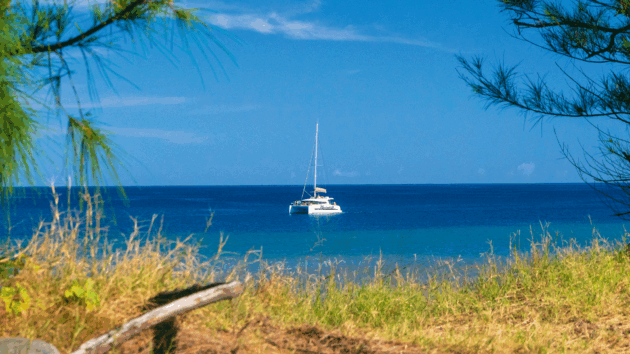
Réunion is a stand-out destination, even if it appears only as a tiny speck on maps of the Indian Ocean. Situated at 21° South it’s a place of huge contrasts. The 3,070m peak of Piton des Neiges is the highest in the Indian Ocean and more than 40% of the land area is recognised as a UNESCO World Heritage Site.
Yet the northern and western coasts are densely populated, with most of the rapidly growing population of 900,000 living here. And the whole island is just six times the size of the Isle of Wight.
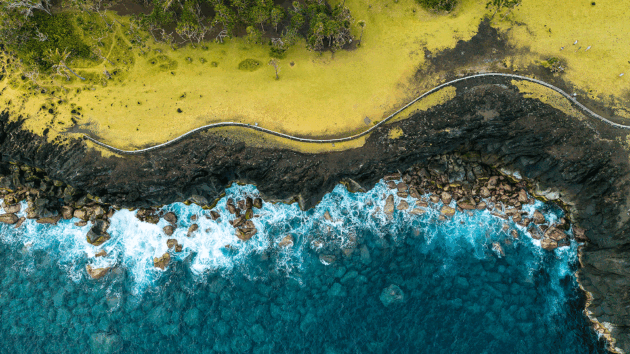
Remote and often rocky coastline means most yachts stay in marinas. Photo: Jean-Marie Liot/ Globe40
The island is a regular stop on both the World ARC and the Oyster World Rally, and an important cruising hub for boats preparing for the daunting leg to South Africa. I spent almost a fortnight there late last year, on a stopover during the Globe 40 double-handed round the world race. It’s also been a place of safety for numerous round the world racers whose voyages have ended in the South Indian Ocean.
For us La Réunion was a haven at the end of the longest leg of the race – almost 7,000 miles and 40 days from Cape Verde. South of the Cape of Good Hope we had to contend with big weather and the Agulhas current, with its many powerful eddies, and frequently hit boat speeds in the upper teens.
Crossing the Mascarene high pressure ridge therefore provided respite before we picked up the south-easterly tradewinds in which Réunion sits. Cruising vloggers SV Delos took a similar route, having set out from Cape Town, and found it to be some of the most challenging sailing they encountered during their circumnavigation.
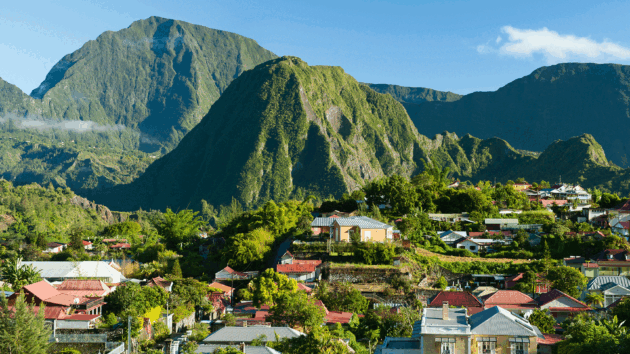
Hilltop Hell Bourg village in Réunion’s Cirque de Salazie caldera. Photo: Loop Images/Universal Images Group/Getty
Most cruisers, however, are sailing in the opposite direction, with Réunion typically marking a final stop in the tradewind belt.
Richard’s Bay in South Africa is a popular next destination. It’s a 1,370-mile passage that crosses the Agulhas further north, where it’s less pronounced. From there it’s only 720 miles to Cape Town, so those with flexibility in their schedule can sail inshore of the Agulhas in good weather, making two or three stops en route.
The World ARC, for instance, allows six weeks of free sailing over Christmas for this section.
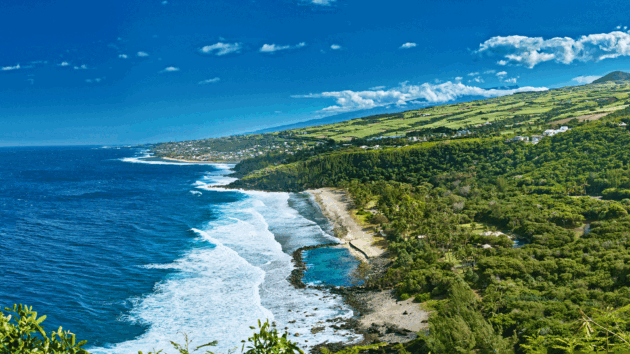
Looking towards Petite-Île on Réunion Island. Photo: Fabrice H/500px/Getty
Réunion history
Réunion is a part of France, governed from Paris. While relatively unheard of in the English-speaking world, it’s a major holiday destination for French tourists, seeking everything from beachside resorts to spectacular hiking and action-adventure sports.
The island has a distinctly European feel, albeit with a tropical vibe, while services and facilities are good, though Réunion is more expensive than many other Indian Ocean destinations. Some 2,000 yachts and motorboats are based here, so a wide range of marine trades are available and there’s a small, but surprisingly well-stocked, chandler at the marina in Le Port.
Being part of France it’s also easier to get spares sent here than many far-flung destinations, though they are subject to customs checks at the airport, even though flights from the capital are considered to be internal. All types of engineering repairs are also possible.
Réunion has no indigenous population and was not inhabited until the 17th century, when settlers from France and Madagascar arrived. They created a plantation economy with sugar as the key cash crop and imported East African slaves to work the land. These were subsequently followed by Malay, Vietnamese, Chinese, and Indian indentured labourers.
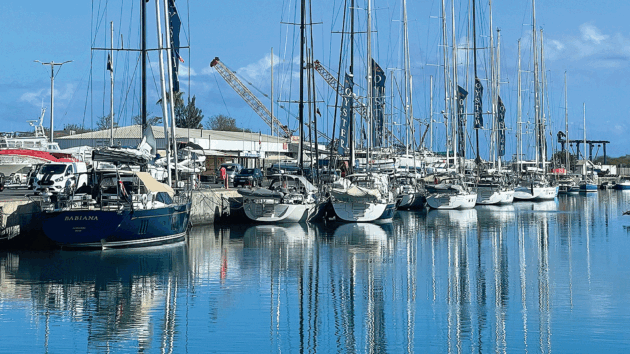
Oyster World Rally fleet at Réunion. Photo: Oyster World Rally
Despite the historic injustices, and a wide socio-economic gulf disparity, today islanders from a multitude of backgrounds and religions appear to live without friction. The local creole evolved within 50 years of the island becoming inhabited and remains widely spoken. It’s mainly derived from French, but includes terms from Malagasy, Hindi, Portuguese, Gujarati and Tamil.
Few people speak good English, unless they work in tourism or a related field. At only 3.5 million years old, the island is very young in geological terms, and is still growing thanks to ongoing volcanic activity in the south east. It’s still considered to be the third most active in the world, though apparently it’s always the safer type of eruption and no one lives within the enclosure where 98% of activity takes place.
The latest spanned February to April of this year, when eight weeks of eruptions produced a 7km lava flow that crossed the coastal road and reached the Indian Ocean, where it produced acidic steam/gas plumes.
During my stay I explored inside the lava tubes created during the 2004 eruption here. They’re formed when the top of the lava flow cools, but the molten rock below the surface continues to flow. The result is a labyrinth of tunnels between 1m and 3m high, with occasional larger caverns, making for a unique experience in a part of the planet that’s barely more than 20 years old.
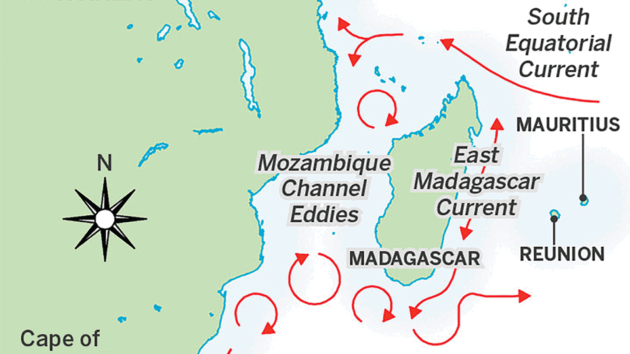
Sailors heading for South Africa from Réunion will have to cross the notorious Agulhas Current. Photo: Richard Thomson
Agriculture remains important for the local economy, with key produce including tropical fruits such as bananas, lychees, pineapples, papaya and mango, while wheat is grown at higher altitudes where sheep and cattle also graze. Réunion is therefore far more self-sufficient in food than many small islands.
There are still 2,500 sugar cane producers and although there are only two processing factories left now – where once almost every community had its own – these are modern and sophisticated plants. In addition to producing sugar and rum, the biomass of the discarded part of the plant is used to generate a significant slice of the island’s electricity.
Island of two halves
In many respects this is an island of two halves, whether you split it north and south, or east and west. The windward eastern side has enormous rainfall of 4-6m per year and a softer landscape, with gentle gradients and wonderfully lush vegetation. In contrast, parts of the west coast have fewer than 40 days with rain annually, as well as excellent beaches. This is therefore where the mass tourism is concentrated.
Main population centres are linked by modern motorway-standard roads easily as good as the autoroutes of mainland France, but struggle at times to cope with the volume of traffic.
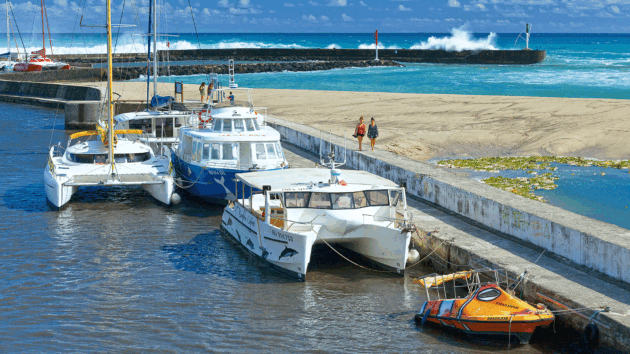
The island is a welcome safe haven in the middle of the Indian Ocean. Photo: Gwengoat/iStock Editorial/Getty
The south is largely undeveloped and sparsely populated, though it gives access to the most spectacular of the island’s inland scenery. Most of the place names inland and in the mountains are Madagascan – a relic from when escaped slaves headed to the mountains in an attempt to carve out a tough, but free, life.
St Denis, the island’s capital, is home to around 170,000 people in the north-east, while St Paul on the west coast is a lively town of similar size and home to many of the larger hotels and resorts. This is where the clipper ships of old used to anchor and remains the island’s best anchorage, though it’s often subject to swell and is little used overnight.
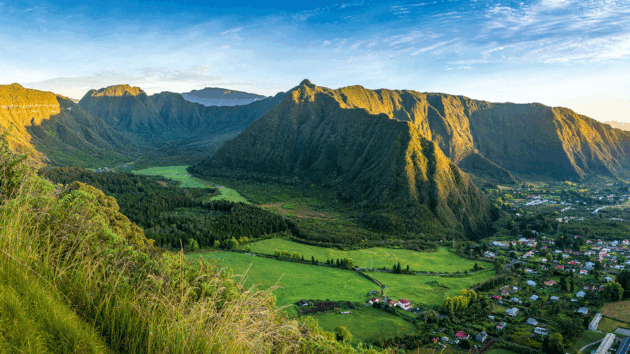
Dramatic topography and lush vegetation characterise the island. Photo: Fabien Techer/Getty
St Pierre, further to the south-east also has a similar population, with more good beaches. There’s also a small marina here, where YouTubers SV Delos were able to stay for a few weeks in 2017. They described the island as greatly exceeding expectations: “It absolutely blew us away with its natural beauty and friendly people… incredible hiking, waterfalls, diving, surfing, and culture.”
Other cruisers who visit Réunion invariably praise it highly for the stunning terrain, as well as the excellent provisioning. Melissa Hill, who visited two years ago with husband Brian and two young children on their 50ft St Francis catamaran, describes the island as “a slice of heaven,” adding: “It’s unlike anywhere we’ve ever been or anything we’ve ever seen and we can’t stop saying ‘wow’ as we travel from one stunning spot to another.”
Article continues below…
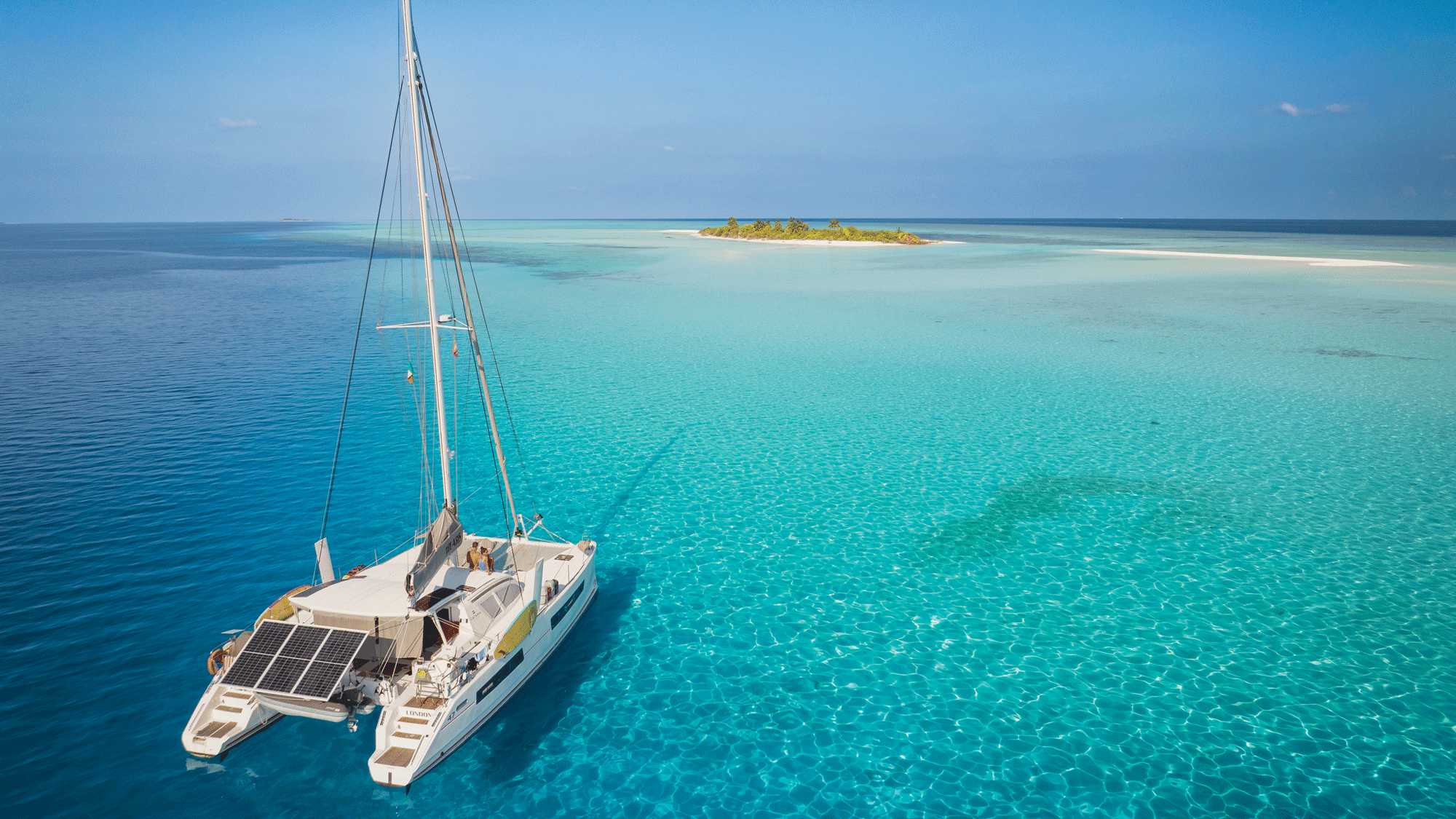
‘The blur of sea and sky is separated every so often by turtles breaking the surface’ – An Indian Ocean passage
Katabatic winds tumble down Phuket’s hillside, sending marbled streaks across the boat-scattered bay. Our anchor comes up with a thud…
Exploring further
However, the practicalities of living on a boat in Réunion can be more challenging than elsewhere. Almost all visiting yachts remain at one of the marinas in the western basins of Le Port for their stay and rent a car to explore the island. This can therefore make Réunion an expensive stop compared to destinations where it’s possible to remain at anchor.
Le Port’s artificial harbours were built from scratch, starting in 1886, on land that was largely barren, and the immediate area still has a utilitarian feel. Depending on where you’re berthed, it’s a level 10-30 minute walk (or 10-minute bike ride) to the small town centre, where there’s a collection of friendly bars and restaurants.
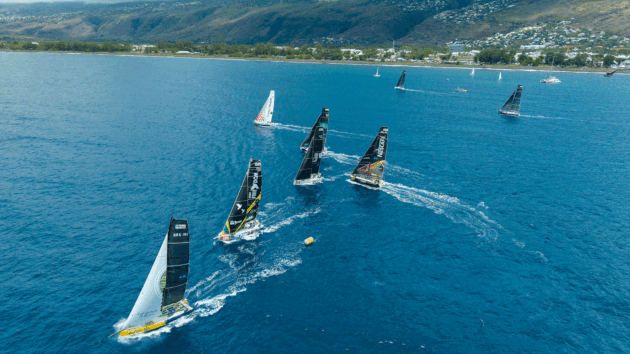
The Globe40 double-handed around the world race had a stopover in Réunion. Photo: Jean-Marie Liot/Globe40
As is common in France, this is primarily a Tuesday to Friday lunch destination and you’d be lucky to find any of the dozen or so cafes and restaurants open on a Sunday evening.
The town centre also has a good bakery, a helpful pharmacy and a couple of small supermarkets are nearby, while the nearest big hypermarket is just two miles from the marinas. However, there’s no direct bus and outside of airport transfers local taxis have limited availability. As a result many cruisers rent a car for their whole stay.
Nevertheless, the attractions of visiting Réunion remain strong and overall it’s a good place to recuperate for those bound for South Africa. En route sailors will have to cross the notorious Agulhas current, giving the onward stage from Réunion potential to be one of the most challenging passages on a circumnavigation.
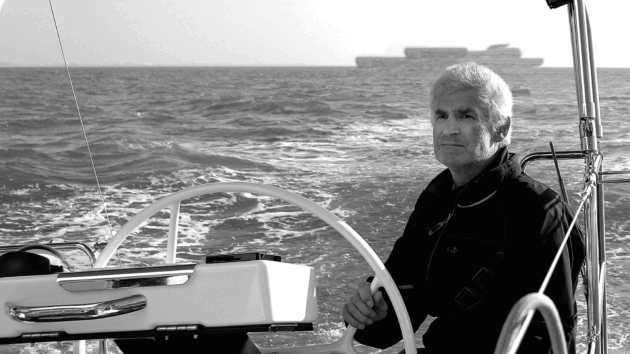
Rupert Holmes has sailed 125,000 miles on more than 200 different boats. He recently circumnavigated double-handed in the Globe 40 race.
Weather and climate
The dry season is April-November and rainy November-April, so the time of year most yachts arrive – mid October to the end of November – is one of change ahead of the hotter and more humid southern hemisphere summer. Rainfall is highest from January to March.
Dry season minimum daily temperatures on the coast is 17-20°C with daily maxima typically in the 26-28°C range. These increase to 21-24°C and 28-31°C during the rainy season, but higher humidity makes it feel warmer.
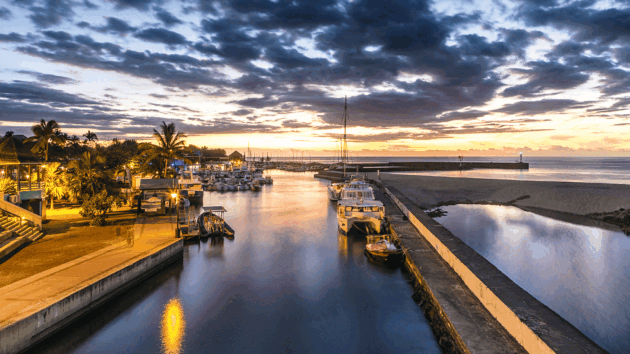
Marina at St Gilles-les-Bains, on the west coast of Réunion. Photo: Didier Marti/Getty
It can be cold overnight and in the early- to mid- morning at altitudes of 1,000m and over. This is the best time to visit the mountains, before the day heats up and before cloud and rain builds in the afternoon.
The island is in the Indian Ocean cyclone belt, which runs from mid-November to April, peaking in January and February. Réunion has had only seven direct eyewall hits in the past three decades, though three of these were in the last eight years. Storm Garance, in February 2025, produced maximum gusts of 125 knots on the east coast. Five people lost their lives and damage estimated at €380 million was caused.
Arrival & approach
In typical tradewind conditions Réunion is a 140-mile overnight sail on a reach from Port Louis, Mauritius. Most visiting yachts arrive from there and are heading towards South Africa.
Visiting yachts are required to seek permission to enter at least 48 hours in advance. They must then clear in at Port Ouest, Le Port, during opening hours of the harbour master’s office – generally 0800-1500, though weekend hours are shorter.
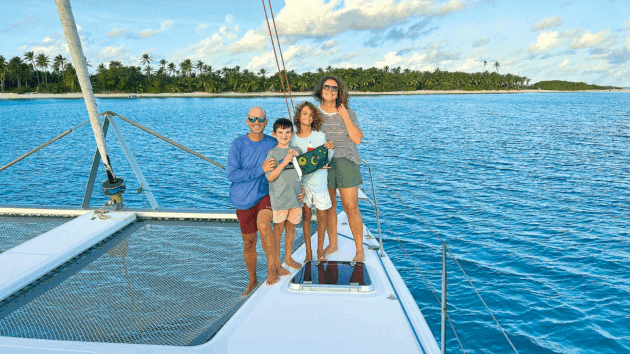
The Hill family cruised to Réunion in 2024. Photo: Melissa Hill
The entrance is well sheltered from the prevailing south-easterly tradewinds and approximately 100m wide between moles, with depths of 10m. However, tropical cyclones have potential to create powerful onshore swells and shoaling has been reported in their aftermath. Tidal range is a maximum of 1m.
Yachts will be directed to moor either in Darse Titan, the newer marina closer to Le Port town centre, which has a LOA limit of 16m, or in the larger Bassin Pere Gueze. At busy times, and for many rallies, they’ll berth on the western stone wall.
 If you enjoyed this….
Yachting World is the world’s leading magazine for bluewater cruisers and offshore sailors. Every month we have inspirational adventures and practical features to help you realise your sailing dreams.Build your knowledge with a subscription delivered to your door. See our latest offers and save at least 30% off the cover price.
Note: We may earn a commission when you buy through links on our site, at no extra cost to you. This doesn’t affect our editorial independence.