


A 10-year circumnavigation in a 25ft yacht proves to Carina Juhhova that you can still ‘go small, go simple, go now’
“We made it!” said Christophe, “L’Envol has crossed her own wake, we have just completed a circumnavigation.”
I looked around. We were still more than 100 miles from the Brazilian coast after 14 days of an unleashed run out of St Helena Island. There was the same glorious blue surrounding us as there had been minutes ago, but the moment was now filled with joy. A dream had just materialised.
Even if there was nobody but us to witness it, the feat of looping the planet on a 25-footer felt like a victory, defying everything we’d heard and read about bluewater yacht sizes and cruising budgets. It had taken us almost 10 years and we’d clocked up nearly 50,000 nautical miles. (It would be another year before we could celebrate L’Envol’s arrival in French home waters.)
Things began innocently enough in 2015 when I was working at the Cape Horn Tourist Information in Puerto Williams. It had taken me five years to hitchhike from Estonia to Chile, where I decided to settle. After three years living on Navarino Island, I could recognise a sailor when I saw one. The technical clothing and unique smell from their boats’ heating always gave them away. But Christophe Mora had neither.
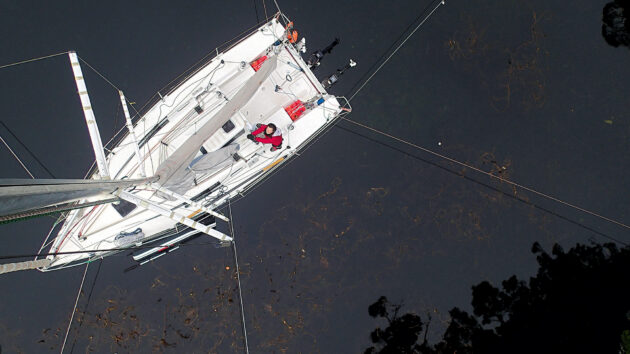
Photo: Carina Juhhova/Christophe Mora
The Frenchman’s yacht was not only heater-less, but the smallest I had yet seen make it down to the ‘Furious 50s’. Its captain was not an old salt but a handsome 41-year-old, sailing single-handed, and altogether one of a kind.
I invited him out for a hike, he invited me aboard for a coffee and four months later we sailed off together into the Patagonian winter. L’Envol was Christophe’s first yacht. I had no sailing experience whatsoever. What connected us were the values of a simple life and an adventurous spirit.
Unusual choice
At 36, Christophe, a professional mountaineer and ski instructor, took a crash course in seamanship by crewing on different yachts across the Atlantic. Living out of a backpack, he was in heaven. When he returned he decided to sell and give away everything unnecessary. This was the beginning of a metamorphosis: the alpinist was changing elements. His future was at sea. But on what kind of yacht?
Christophe’s priority was to depart as soon as possible, and not spend time on a fixer-upper, hence the decision to buy a new boat. This narrowed down options to smaller models. Another criteria was that the boat had to be able to sail in light winds and seaworthy enough in heavy weather. Hence, despite the size, she had to be built with a circumnavigation in mind.
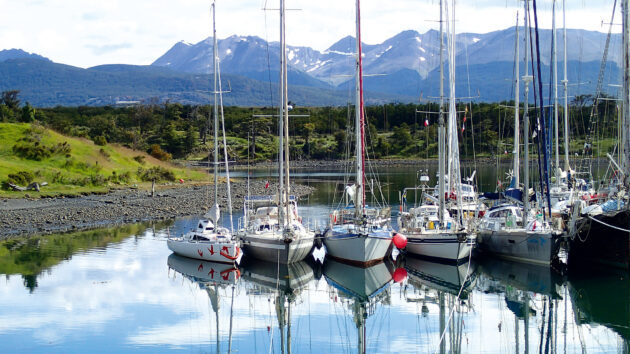
Rafted up below the ‘Furious Fifties’ at Micalvi Yacht Club in Chile, L’Envol is the smallest yacht at the end of the line. Photo: Carina Juhhova/Christophe Mora
With a draught of 1.2m and weighing under two tonnes, the sporty Django 770 caught his eye. This glass-hull twin keeler is infusion moulded for structural strength and light weight. Designed by Pierre Rolland it is a cousin of the Mini Transat pocket racers. It was far from being the cheapest for her size – a bigger second-hand yacht could have been bought for half the price. But fewer creature comforts did not put him off. The goal was a sailing base camp, rather than a floating house, a place from which to discover spots accessible only by sea.
Down below L’Envol has room for a V-berth, two bunks, and a galley comprising a sink and two-burner gimballed gas stove. One stainless steel pot, a pressure cooker and a kettle is the only cookware aboard. Three bowls, three plates and three cups, all of tough and light melamine, together with a thermos flask, are stowed behind (a yoghurt maker and teapot somehow managed to sneak their way in when I moved aboard a year later!).
Opposite, the nav station hosts a small chart table with a Toughbook running OpenCPN and SASPlanet software with marine charts and satellite images as our main navigation tools. Above it is the electrical panel with a VHF/AIS receiver, an electronic marine barograph and a battery monitor. A sat phone gives us weather updates in remote areas and offshore in high latitudes. For most passages in the trades the old fashioned free weather faxes caught by the HF radio receiver do the job.
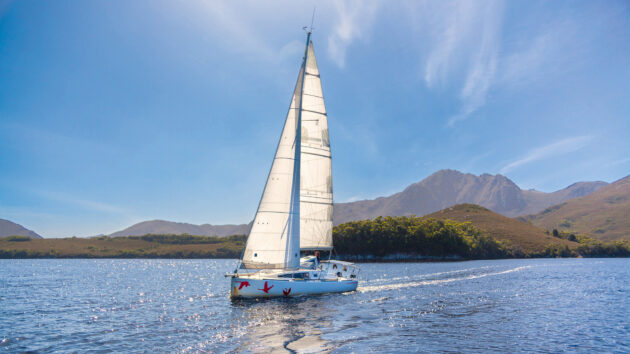
L’Envol splashed in 2013 – and is the first and only Django 770 of well over 100 sisterships to have sailed around the world. Photo: Pat Fazackerley
Basic amenities
“What you have not got, cannot break,” Christophe likes to say. We have no head, no shower, no fridge, no oven, no heater, no table, no cupboard doors, no lighting (and hence no wiring for it). Our bathroom is ‘bucket and chuck it’ and a two-pint spray bottle to wash in the cockpit. Elastic bungee cord keeps everything in the cupboards and a powerful headlamp with a rechargeable battery fixed to the mast support works as the saloon light. Every inch is too precious and every ounce costs in performance at sea.
We took off from Puerto Williams on the threshold of winter which, unlike summer, has more predictable weather. We soon became used to living in 0-10°C aboard, putting on extra layers the rare times the thermometer took a dip below zero.
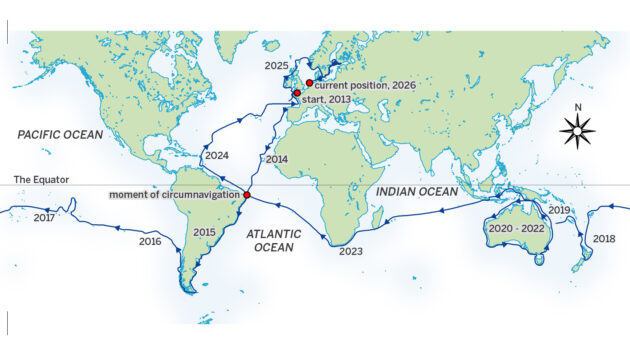
Christophe Mora and Carina Juhhova have proved that it’s still possible circumnavigate the globe and have an adventure in a small yacht
Cold was not a problem: during the day we were outside hiking, while expedition sleeping bags kept us warm through the night. Every once in a while we would run the 1kW generator to give the batteries a boost, and for an hour were able to warm up the cabin as well as dry wet gloves, socks and towels.
One of Christophe’s favourite choices was the decision to sail without an inboard motor. Instead L’Envol has a 9.8hp 2-stroke outboard on the transom. The space under the companionway could then be taken by a 12gal water tank. Another 22gal of water are carried in jerrycans.
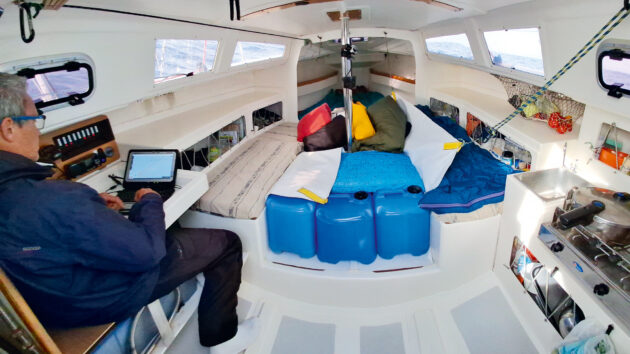
L’Envol’s minimalist but well ordered interior has proved plenty roomy enough the couple. Photo: Carina Juhhova/Christophe Mora
Gearing up
To make this compact weekender a robust offshore yacht Christophe wanted a hard top – an option that did not exist in the Django’s original design and was custom-built for L’Envol. When we left the Pacific Gambier Islands in our wake, it was the end of May and winter depressions had already started sweeping the southern latitudes bringing fresher winds and bigger seas. It was supposed to be an easy five-day run to the atoll of Hao but instead of the 25 knots forecast, we got 50! Twice L’Envol fell from atop a wave, twice a blanket of water covered her. With just an orange storm jib hoisted, we were averaging 5 knots.
When things get rough we don’t stay in the cockpit –after we’ve reduced sail we shut the wooden door behind us and control the autopilot from the dry shelter. The hard top has three portlights which provide good visibility to poke our head up for a look-around.
Winches were up-spec’d to four size 30s. The deck-stepped mast has two sets of reinforced swept spreaders, a fractional rig, multi-tackle Dyneema backstay and a removable Dyneema cutter stay. The carbon whisker pole, though pricey, has proven its worth many times over when sailing downwind in the trades. L’Envol’s wardrobe of six sails, aside from the mainsail, furling genoa and reefable jib, includes a furling gennaker, furling asymmetric spinnaker, both set from the removable bowsprit, and a storm jib.
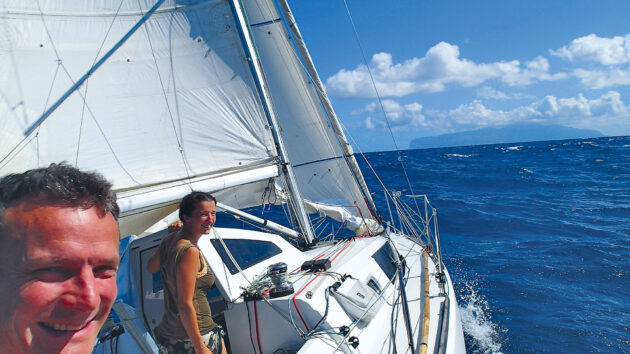
Fatu Hiva in sight approaching the Marquesas from the south. Photo: Carina Juhhova/Christophe Mora
The anchor is our ship’s insurance policy and our 21lb Spade was money well spent. A second Fortress anchor is stored inside. There is no windlass – after nearly 800 anchorages, we reckon we have manually weighed 25 miles of anchor chain.
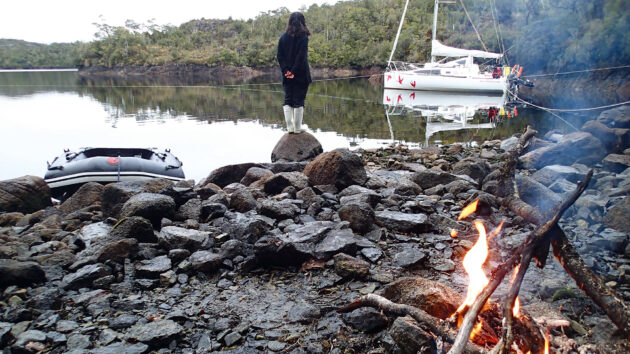
Of all the places we have anchored, few can rival Patagonia for beauty, scope and solitude. There is an abundance of snug anchorages to choose from, though swinging room is often limited.
Because we would tuck in close to the trees for better protection, we also carried 400m of floating shorelines; sometimes before a gale we secured the boat with as many as six lines tied to trees and rocks. In Fjord Pasqui, a narrow cove subject to strong funnelling winds: our instruments recorded wind speeds oscillating from 10-60 knots. When one of the trees we had tied L’Envol to gave way in a gust, we were glad our anchor held!
L’Envol has a hydrogenerator on the transom, which boosts the 140W solar panel on overnight passages or during rainy days. There is also a 1kW generator. Ten gallons of fuel for the outboard and a 28lb gas bottle are stored in the cockpit lockers together with the autopilot’s linear drive connected to the rudder quadrant. For longer passages these lockers have enough space for extra jerrycans of water.
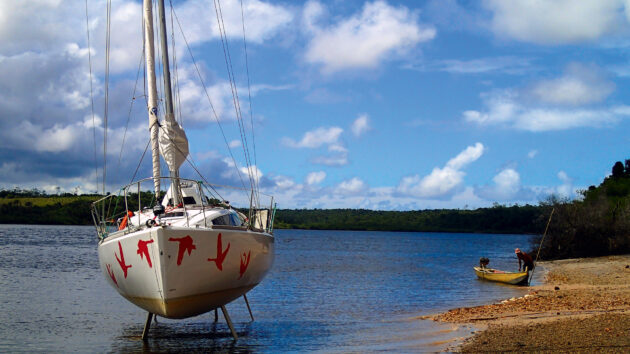
Twin keels and a grounding leg allows L’Envol to dry out at Camamu Bay, Brazil. Photo: Carina Juhhova/Christophe Mora
Watch that weight
Halfway around the world, in Tasmania, we had an opportunity to repaint the ship’s topsides. I suggested raising the antifoul line a few inches higher to avoid growth on the stern chines – an accumulated four seasons’ worth of clobber aboard had made L’Envol gain a few extra pounds, and it was showing!
Christophe suggested: “Let’s just get rid of more things and make the boat lighter instead.” So we sold and gave away any gear and clothes we could live without, replaced two heavy lead-acid batteries with a single 100A lithium, and downsized our anchor chain from 50m of 8mm to 60m of 6mm, then used a plastic pipe to bring the chain aft into the cockpit to take weight out of the bow.
We always have to watch L’Envol’s weight so as not to lose performance. On an average ocean passage she’ll easily sail 130-150 miles in 24 hours. Even though many passages were hard work, sailing up the Brazilian coast from Cabedelo to Salvation’s Islands in French Guyana was as easy as a sleigh-ride. We crossed the equator without ever seeing the doldrums, there were no rain squalls and we never had less than 10 knots of wind. The equatorial current brought ‘free’ miles, up to 50 a day!
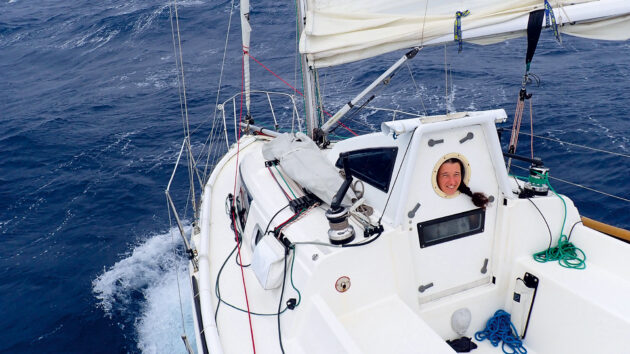
Crossing the boisterous Indian Ocean from Bali to Rodrigues in Mauritius – 3,108 miles in 23 days at sea. Photo: Carina Juhhova/Christophe Mora
We beat two voyage records on that trip: our fastest 24 hours: 186 miles sailed in 12 knots of breeze filling our gennaker on a comfortable close reach. And best overall passage speed: 6.84 knots average during the 8 days and 8 hours it took us to cover 1,367 miles.
But a smaller, lighter boat will be less seaworthy and less seakindly in heavy conditions. We have to watch the weather carefully before every passage. There have been difficult moments. Beating to windward for a week from Fiji to New Zealand was one of the most uncomfortable legs of the entire circumnavigation. And during our 23-day Indian Ocean passage L’Envol became a near-submarine for over a week due to sustained 35-40 knot winds and a heavy swell hitting her across the beam. With the door securely closed, three reefs in the main and no headsail L’Envol was surfing at nine knots. We were safe inside and nothing broke, but it was impressive to witness.
Simple life
When no-one wanted to insure his small solo ship below the roaring 40s, it became evident to Christophe that he did not want anyone – much less so an insurance company – to dictate where and how he could sail. So L’Envol has sailed around the world with no insurance whatsoever. Neither did we have health insurance. People often ask how much this voyage has cost us. We like to answer it’s less than you may think, but all that we’ve got.
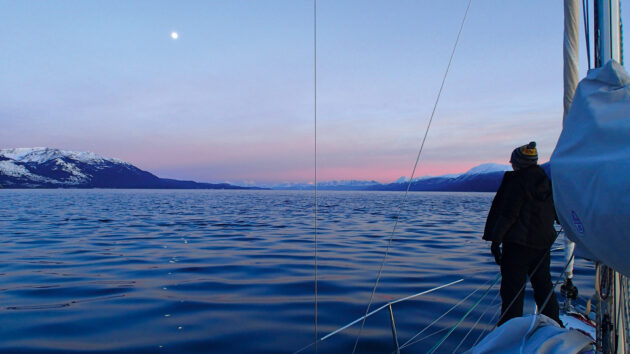
Bergy bits lookout in the Patagonian channels. Photo: Carina Juhhova/Christophe Mora
We live on a budget of £450 a month, sometimes less, which includes boat maintenance and the day-to-day living costs. The key has been the lifestyle which we love: going with the wind rather than using fuel, anchoring instead of using marinas, hitchhiking instead of hiring a car, and not once taking flights.
Running costs will always be smaller on a 25-footer than a bigger boat. We rarely had to order spare parts, and have done all the maintenance work ourselves. That L’Envol can dry out helps, as cleaning the hull and antifouling can be done by beaching between tides. We can sail in as little as 5 knots of breeze and use less than two car tanks of fuel a year.
It’s a paradox that most ocean-going yachts have been conceived with bad weather in mind, but on a westbound circumnavigation the main challenge – much more often than storms –is inconsistent and lighter winds.
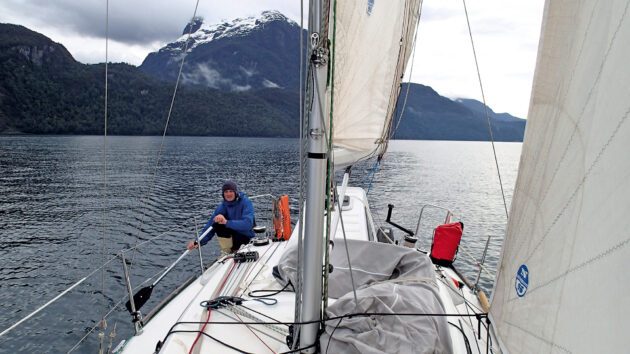
In extremis a small yacht can be rowed. Photo: Carina Juhhova/Christophe Mora
Although it can be tempting to just furl and power, we gave ourselves no choice by only having an outboard with a small fuel tank. From Darwin to the Kimberley we sailed 230 miles across the Bonaparte Gulf, also known as the ‘Blown Apart Gulf’ owing to its calms.
We moved the water jerrycans around to heel the boat or used our gennaker as a Code 0 to sail higher. There were some magical moments seeing L’Envol cut along through the flat ocean in just 4-7 knots of breeze. But also many frustrating hours of inching our way forward at a snail’s pace. When we finally glimpsed the red rock formations near King George River, it seemed as if we had travelled to another planet.
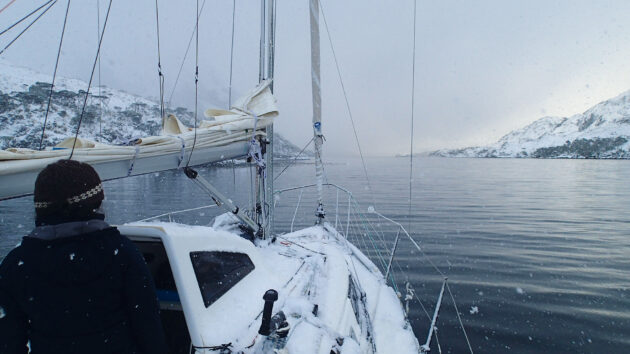
Caleta Dardé anchorage. Photo: Carina Juhhova/Christophe Mora
Making a living
We started crowd funding (via our blog intothewind.fr) during the Pacific crossing and our followers helped us out in emergencies, such as replacing torn sails in New Caledonia or paying for a medical bill in Australia. It’s been amazing to experience the solidarity of our readers, family, friends but also strangers at times when we felt most vulnerable. At times we worked – I taught at a school in New Caledonia and later in Tasmania we both picked fruit, helping harvest ripe cherries, olives and grapes.
After sailing for six months around the west coast of Australia, we got to Tasmania right on time for southern-hemisphere summer. Then Covid hit. As the boat was our primary residence, we were allowed to live aboard, self-isolating in scenic Tasmanian anchorages. Once our visitor visas were about to expire, we applied for pandemic visas, which allowed us to work in critical sectors like agriculture. With the borders shut and no cases on the island, we were stranded in a lost world.
Money has often been a worry but never a problem. We realised along the way that we do not need that much to live. Young sailors shouldn’t fear the uncertainty of not having an income, but trust that the voyage provides the ideas and solutions when the need is actually there.
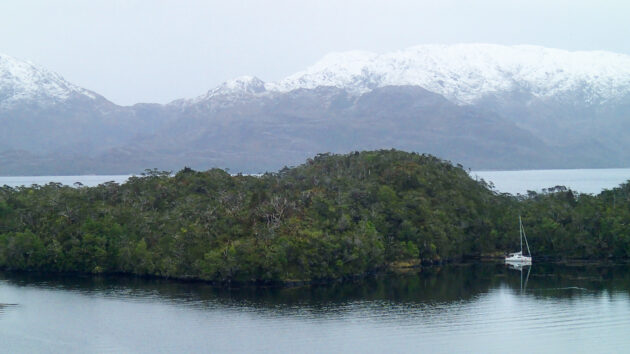
Heading out of Puerto Williams in May. Photo: Carina Juhhova/Christophe Mora
Sailing on a budget makes for a unique journey made of unpredictable situations, human kindness and luck with many priceless moments and experiences. And yet the most important gift our formula of life has given us is time.
Christophe’s initial plan had been a four-year circumnavigation. Little did he know! Together we discovered the pace of cruising which suited us best: instead of spending just a couple of months over the summer, we took an entire year to explore the Patagonian channels.
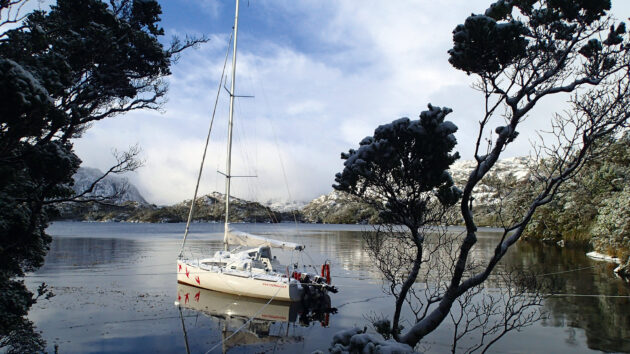
Moored with shorelines in Caleta Dardé, Patagonia. Photo: Carina Juhhova/Christophe Mora
Twice that winter we were weatherbound for two weeks, waiting out gales. For a novice sailor, that forced downtime was welcome – I got to learn the slow rhythm of living aboard in a sheltered cove. As we made our way north, we started seeing more people.
On the island of Chiloe we were invited to participate in a traditional communal Curanto, where seafood and meat are cooked in an earth oven with wild rhubarb leaves for a lid. Being at anchor in front of that small village, we had become a part of it.
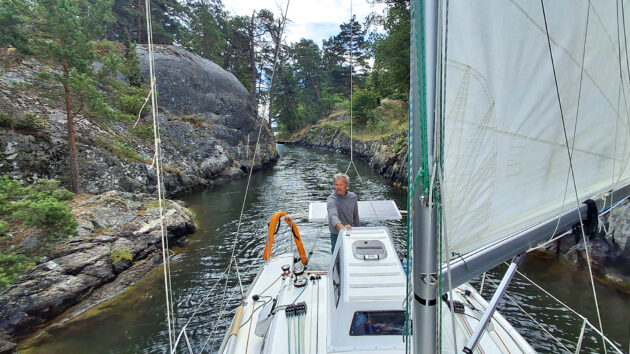
Traversing Sweden’s narrow Draget Canal. Photo: Carina Juhhova/Christophe Mora
Then, instead of trying to jump across the Pacific in one season between cyclones, we spent more than three years island-hopping along the Coconut Milk Run. We were lucky with the weather and could visit Robinson Crusoe Island, Easter Island and Pitcairn, known for their often untenable anchorages.
Now 13 years after casting off, we are not ready to wash off the salt. Even in winter we have remained full-time liveaboards, spending the off-season in southern France and cruising northern Europe the rest of the time.
At the time of writing, we are in Scotland’s Inner Hebrides, with the stunning Isle of Skye as our back yard.
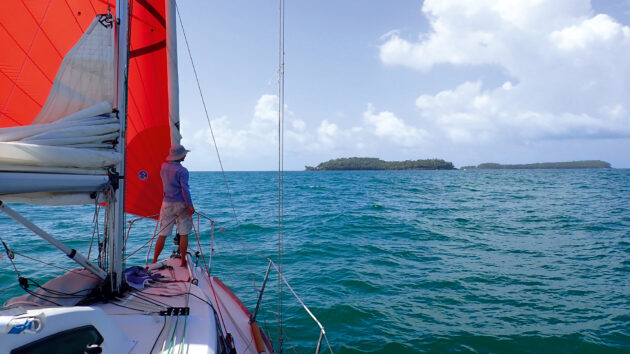
Having set a course north from Brazil, the Salvation Islands off French Guiana hove into view. Photo: Carina Juhhova/Christophe Mora
With each nautical mile added and our desire to continue exploring still as strong as ever, we realise that sailing a small boat on a shoestring was not just a means to go around the world but a way of striving for a simpler life. Our home, rather than in one place, is in the movement. We have become nomads.
 If you enjoyed this….

Yachting World is the world’s leading magazine for bluewater cruisers and offshore sailors. Every month we have inspirational adventures and practical features to help you realise your sailing dreams.Build your knowledge with a subscription delivered to your door. See our latest offers and save at least 30% off the cover price.
Note: We may earn a commission when you buy through links on our site, at no extra cost to you. This doesn’t affect our editorial independence.