




Thomas Coville and Sodebo have less than 48 hours to go in their Jules Verne around the world non-stop record bid – but Biscay is set to serve up brutal storm conditions
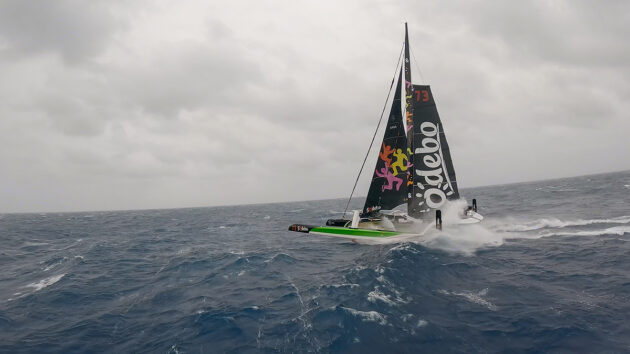
Thomas Coville and his crew on the Sodebo Ultim 3 trimaran are less than 1,000 miles from crossing the finish line of the Jules Verne Trophy, and are currently more than 600 miles ahead of the record time set by Idec Sport in 2017.
Coville and crew must cross the finish line before 2031 on Sunday, January 25 to beat the coveted non-stop fully crewed around the world record of 40 days, 23 hours, 30 minutes, and 30 seconds.
But over the next 24-48 hours, the crew could yet face their biggest challenge yet with a huge winter low pressure system – named Storm Ingrid – in the North Atlantic.
“A very large winter storm is coming our way and will accompany us all the way to the Bay of Biscay,” explained skipper Thomas Coville in an update from the team today. The systems is expected to produce winds of over 40 knots, gusts up to 50 knots, and “swells of over 10 meters,” he adds.
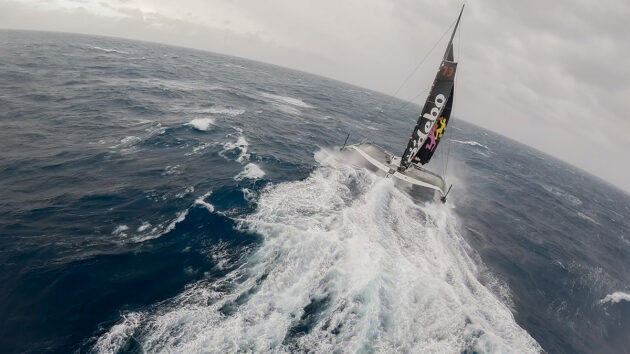
The Ultim Sodebo filmed by drone by the team in the Southern Ocean shows its extreme speed, even in larger sea state. Photo: Leonard LeGrand/ Team Sodebo
Sodebo’s Jules Verne attempt
This is by far the most successful record bid ever by a foiling Ultim trimaran, following repeated attempts by Sodebo, Gitana 17 and SVR Lazartigue over the past six years. All of those previous attempts ended less than halfway around the world after the boats suffered damage or collisions with underwater objects.
In passing the Azores, Sodebo’s circumnavigation has also become the longest non-stop around the world passage by an Ultim – Charles Caudrelier sailed Gitana 17 solo around the world in the Arkea Ultim Challenge in 2024, but made a brief stop in the Azores when he faced an impassable system in Biscay with potentially boat-breaking sea states.
Approaching the final North Atlantic stage, Coville and team have maintained an advantage they have held almost continually – albeit narrowly at times – since setting off at 2101hrs on Monday 15 December, 2025.
Skipper Coville explained at departure: “It’s a very good North Atlantic window, the likes of which we haven’t seen for a very long time. It allows us to make a great track.”
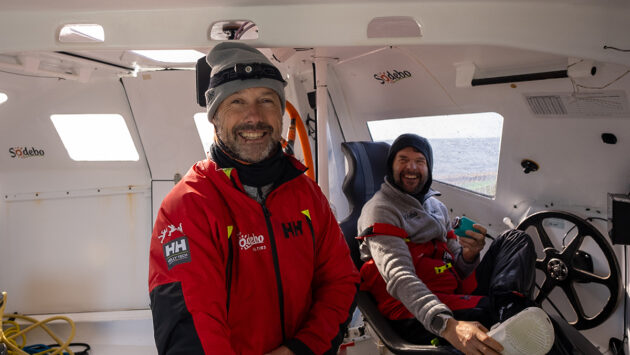
Skipper Thomas Coville onboard during the 2025/26 Sodebo Jules Verne record attempt. Photo: Team Sodebo
Despite optimum conditions, they were just a few hundred miles ahead of the 2017 record, set by Francis Joyon on Idec Sport, for most of the Atlantic – demonstrating just how tough Idec’s benchmark time would be to beat.
However, just four days and four hours after setting off, Sodebo crossed the Equator, setting a new record for the first section (set by Spindrift 2 in 2019).
Despite having to take a westerly route around the St Helena High, the South Atlantic saw them rapidly build their advantage to 800-plus miles over Idec Sport, extending to 1200-miles by the Cape of Good Hope. Again, they set a new record time, rounding the Cape after just 10 days and 23 hours (this one beating the record set by Gitana Maxi Edmond de Rothschild in 2021) on Boxing Day.
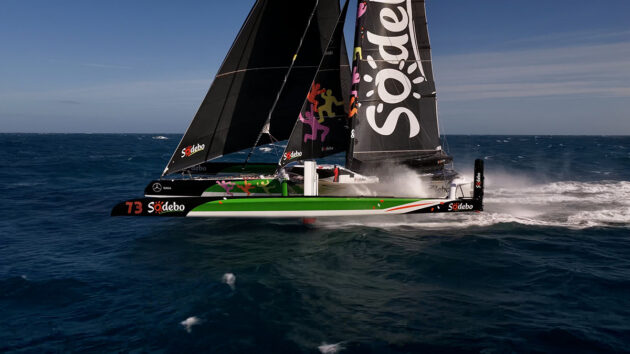
The foiling Ultim is capable of maintaining average speeds of 30-35 knots and beyond. Photo: Team Sodebo
Fighting for every mile
Tricky conditions in the Indian Ocean saw that lead eroded almost completely, dropping to just 250 theoretical miles around the Kerguelen islands. They passed Cap Leeuwin less than 200 miles ahead of Joyon, but still set another record on the way.
“They didn’t gybe once during the entire crossing of the Indian Ocean,” recalls Sodebo co-skipper/navigator Benjamin Schwarz, comparing their routing to Idec Sport’s. “We’ve already done 19 gybes since the Cape of Good Hope, and there are about ten more to go to Tasmania!”
The Sodebo team dropped further and further back as they traversed south of Australia, briefly falling behind the record as they passed the longitude of New Zealand.
In the Pacific, they began to regain some of those lost miles – regularly sailing at 35+ knots to overtake the record pace again. Sodebo set a third benchmark time rounding the last ‘Great Cape’ of Cape Horn, with nearly an 11-hour advantage over Idec.
The return up the South Atlantic was another game of snakes and ladders, Sodebo gaining and losing hundreds of miles over the record time before crossing the Equator on 19 January.
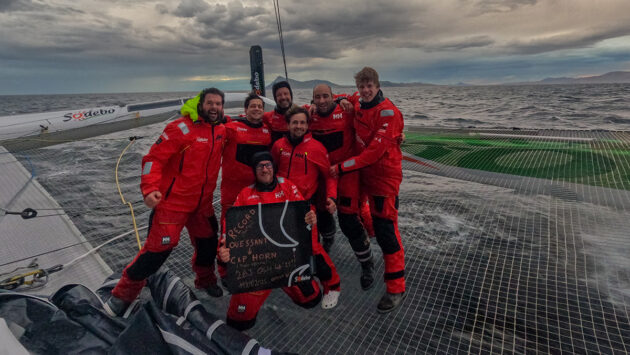
The Sodebo team has set new benchmark times at all three Capes and both Equator crossings. Photo: Team Sodebo
Finding the boat’s limits
In a daily update, the team explained their strategy for contending with Storm Ingrid: “The goal is to continue sailing upwind as long as the wind and sea conditions allow. Routing is being adjusted to force us further west whenever possible. The idea is to create more leeward space so we can sail downwind when the wind and sea are at their strongest.
“While we’ll discover the boat’s behaviour and limits in these conditions, we believe that sailing beyond 110-120° TWA is definitely safer than sailing at 90° to the wind.”
The team press release also notes that these conditions are ones which “the boat has never encountered, but for which it was designed”.
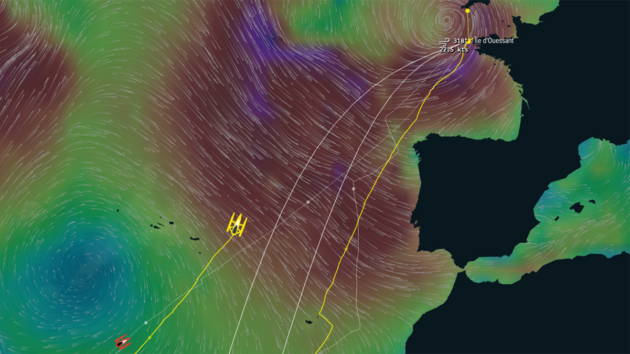
Wind conditions in the North Atlantic for Sodebo (yellow) on Friday 23 January. Red is the Idec Sport benchmark record time. Image: Sodebo team tracker
Coville, who has previously held the solo non-stop around the world record, is sailing with Benjamin Schwartz, Frédéric Denis, Pierre Leboucher, Léonard Legrand, Guillaume Pirouelle and Nicolas Troussel.
You can follow the team’s record bid on their superb tracker at sodebo-ultim3.sodebo.com