


The new flagship from the Cantiere del Pardo yard reveals a quality fast cruiser with a few surprises
Grand Soleil 60 review: Italian style meets true bluewater capability
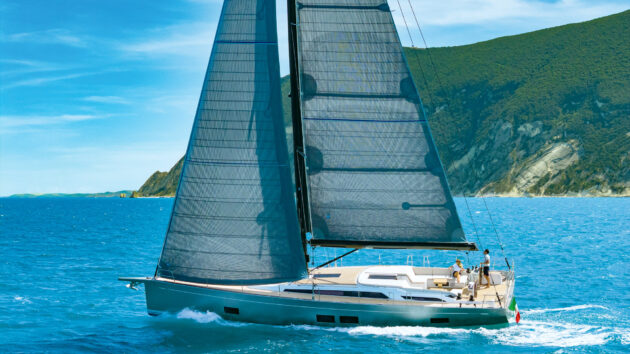
It may not be the stuff of offshore adventures, but a light wind sail can often uncover or expose many traits. Sea trials of Grand Soleil’s new 60ft bluewater cruiser took place within touching distance of Ravenna’s featureless coast in balmy Adriatic conditions forecast to top out at 3 knots. Luckily, however, the yard team knew where and when the sea breeze would fill in.
The Grand Soleil 60 is the flagship of the Italian yard’s standard range, although its semi-custom ‘Plus’ line, built in Fano, goes up to 80ft. It has ditched its distinction between ‘Performance’ and ‘Long Cruise’ variants, moving this discussion to the options list with the argument that every model performs well and is capable of making oceanic passages with ease.
Instead, the yard is emphasising the new levels of comfort that the Grand Soleil 60 offers. Luca Pedol of Nauta Design, which styled the interior and exterior, is frank: “The main concept behind this yacht is bringing standards of luxury, comfort, functionality and elegance which are more typical of contemporary interior design for residential projects.”
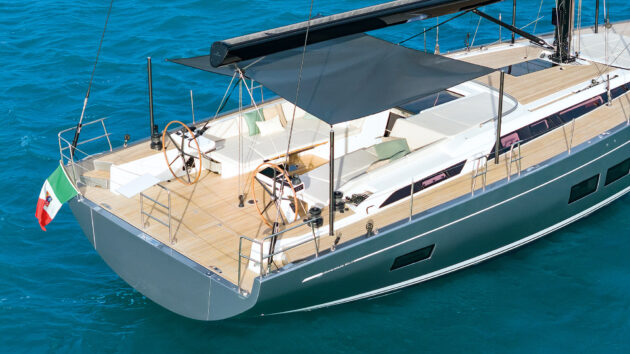
Optional bimini deployed. Each electric winch has local control as well as remote console control. With multiple crew, you’d need careful communication to avoid unexpected winch activation. Photo: Gianluca Napthalina Camporesi
Family continuity
We’ll examine that claim later, but naval architect Matteo Polli is keener to underline continuity with the boat’s smaller sisters – most notably the Grand Soleil 44, launched in 2020 under the brand’s ‘performance’ line.
“An owner came to me saying he’d done 20,000 miles in the GS44,” says Polli. “He said he’d seen every kind of sea state, every kind of wind, and the boat was perfect in any situation. So from this feedback I concluded that this hull shape works for racing and also for cruising.”
Taking this hull form as his starting point, Polli has adapted for the extra length, working with Nauta Design to fashion a yacht that looks every inch a Grand Soleil. That means a generous 5.80m beam carried back to the quarter, dedicated guest cockpit and low-slung coachroof. Together, they have created a lot of interior volume by drawing very high topsides with modest chine amidships and marked flare.
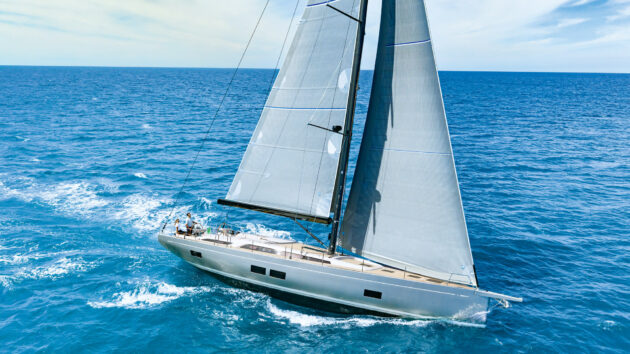
As a cruiser, the GS60 is designed with a pinhead mainsail. Our test boat was fitted with Mainfurl in-boom furling, which functions well once the vang is correctly levelled. Photo: Gianluca Napthalina Camporesi
“All these families of hulls are very narrow at the waterline and get wider rapidly towards the sheerline,” says Polli. “The section is very flared, so when there is light wind, you have a very minor wetted surface, and when you heel over, you have all the power that the very wide hull can deliver.”
Polli has resisted what he labels as a French-led trend for broader bows and twin rudders in this boat. The scale has helped here, making it possible to offer a fine entry at the bow for slicing through waves without compromising too much on the internal volume.
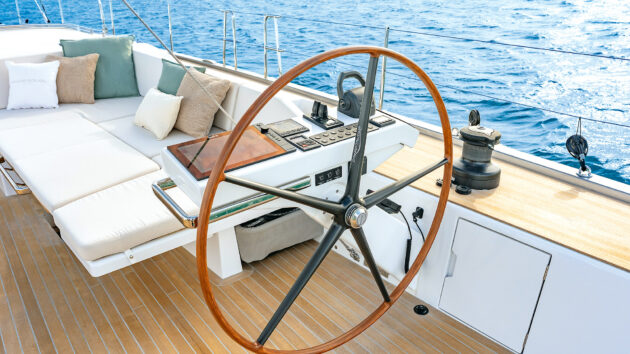
At the helm you feel a little perched over the water sitting on the coaming. But in reality, there is the side deck and generous freeboard between you and the waves. Visibility ahead is good. Photo: Gianluca Napthalina Camporesi
Easy sailing
How does that translate on the day of our test? Well, despite her 27 tonnes, the boat accelerates well as the wind picks up. Pinching a little at 28° apparent, we manage an easy 5 knots of boat speed in 7.5 knots of true wind. Bearing away just a few degrees with wind at 8.5 knots saw us graze 7 knots through the water.
That’s thanks in part to the large sail area of 205m2 upwind. But it’s also a conscious decision from Polli, who has moved the mast aft somewhat to increase the size of the headsail. “The foretriangle is really important for acceleration in light winds,” he says. “And it’s very forgiving in strong winds, because the mainsail gets a little bit smaller compared to the size of the of the full sail plan, and the mainsail is the one that makes you broach.”
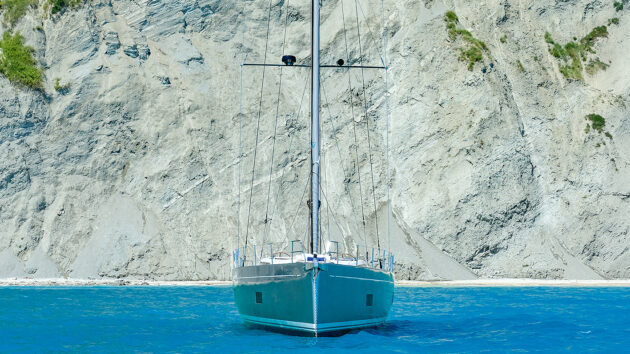
The 60 is the largest of Grand Soleil’s production line of boats. Photo: Gianluca Napthalina Camporesi
In such low wind conditions, we waste no time in setting the Code 0, which is tacked to a flush-fit electric furler at the bow. It’s a bit fiddly to tension the halyard without snarling the head of the sail around the genoa, but once the sail is out and pulling, it adds an easy 1-2 knots to our reaching speed. Acceleration is smooth and the helm remains perfectly responsive, although the yard acknowledges it has to address light resistance in the Jefa steering system.
The boat is fitted with running backstays in Kevlar on a hydraulic tensioner, but they are mostly for sail trim rather than safety. You need the backstay on if you’re using the staysail, but otherwise it’s about optimising mast shape and controlling the draught of the mainsail. It also helps to prevent the mast from pumping if you’re beating into stiff seas. The standard is for rod rigging but you can upgrade from aluminium to Axxon carbon spars.
The first hull has no mainsheet traveller, however, eliminating one source of fine adjustments to the shape of the main. The mainsheet itself comes back to a block between the two helm stations, following the German system.
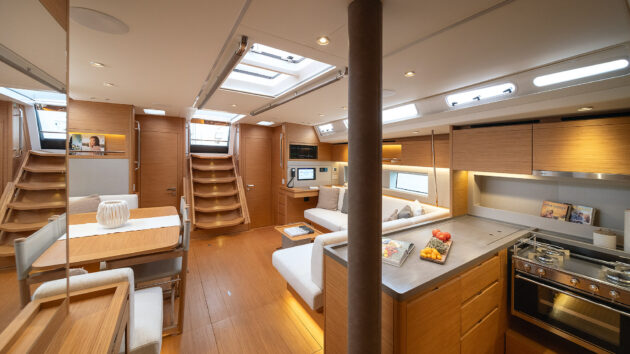
U-shaped galley looks over the saloon’s relaxing area with its deep, comfy sofas and dining opposite. Photo: Gianluca Napthalina Camporesi
You could remedy this by opting for a cockpit arch, which gives much tighter control, or by asking for a traveller to be built into the aft deck.
Helm stations are nicely designed, cantilevered out from the coaming and offering a not-too-busy instrument panel. Push button controls on the main console handle the jib and Code 0 furlers, with winch controls placed on the side, where they’re easier to reach as you tail the line. You can command both jib winches from either helm, and could certainly manage the rig single-handed with a bit of experience.
Stowage is excellent on this boat – one of its key ‘bluewater’ design principles. I liked how lines could be tidied into big fabric ‘baskets’ under a lifting section of the cockpit seating. There’s a deep stern locker in the aft deck and a cavernous sail locker at the bow. Should you want more, opt for the transom boxes which double as helm seats and help to close up the stern somewhat.
At this scale, the cockpit can be well separated from the sailing functions further aft, allowing members of your party to admire the action without getting in the way. It has been designed for maximum flexibility.
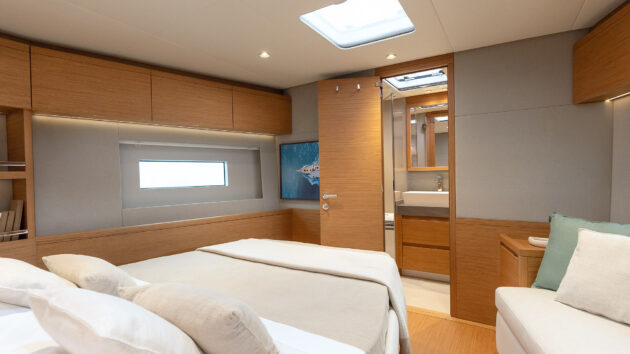
Forward-facing berth in the master cabin; there’s a line of locker space under the deck head. Photo: Gianluca Napthalina Camporesi
“The double-C cockpit is very efficient because the tables can be set in different positions,” explains Pedol. “Set at the same height as the seats, they can become a sunbathing area on both sides, or you can have two coffee tables, or two dining tables, or any combination.”
Interior comfort
But it is really the interior that sets this boat apart. It’s voluminous compared to its smaller siblings thanks to the beam – but the dining area is comparatively modest (still enough for six or so) to create a large relaxing area. Down a single step, the galley lies athwartships, but still open plan. This has the curious effect of putting someone standing preparing food at a much better level for conversing with those sprawling on the devilishly comfortable sofas. It’s a subtle Italian design thing – you’ll just have to take my word for it.
The master cabin is in the bow, the berth facing forward for a more comfortable motion underway. As Pedol points out, this also puts your head slightly closer to the mast and the boat’s centre of balance. From the pillow there are views out through large hull windows on either side and the shower room and heads make a bulwark between the cabin and the sail locker forward.
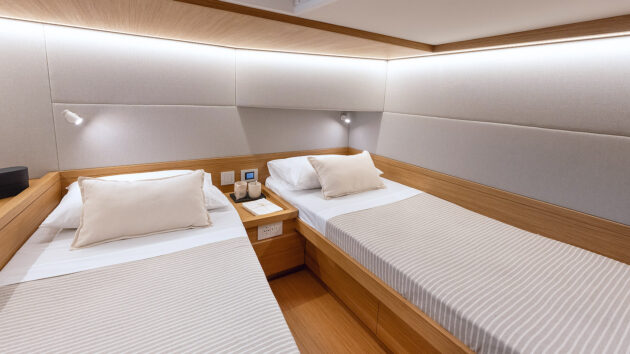
Two double or twin cabins are aft of the saloon. Photo: Gianluca Napthalina Camporesi
Two double cabins lie aft of the saloon and there is the option of a fourth cabin, arranged as a Pullman, opposite the galley. This is the set-up on hull No1, but if you defaulted to the three-cabin configuration, this space would revert to a worksurface, breakfast bar and wine fridge. Appliance options include induction hob, microwave, dishwasher and washing machine.
Cruise ready
There’s one more attractive design feature to the Grand Soleil 60 which comes to good use on a test day of low wind and searing temperatures, and that’s the swim platform. Activated electrically, the platform lowers out of the transom, steps unfolding as it goes. A telescopic ladder emerges from its hollow centre, and the tender garage is revealed for a craft up to around 2.65m long.
Adding to the ultimate weight of the boat, but vital for long passages, generous tankage gives real range. There’s over 1,100lt for diesel, 970lt for fresh water and 215lt for black water. Mastervolt AGM batteries provide over 500Ah of storage at 24V – equivalent to 12.5kWh. You can double this with the high power pack, which is required if you opt for solar panels.
Grand Soleil 60 specifications
LOA: 19.68m 64ft 7in
LWL: 16.70m 54ft 10in
Beam: 5.80m 19ft 0in
Draught: 2.80m 9ft 2in
Displacement: 27,000kg 59,525lb
Ballast: 7,400kg 16,314lb
Sail area: 215m2 2,314ft2
Displacement/length ratio: 160.9
Sail area/displacement ratio: 24.2
Water: 900lt 198gal
Fuel: 1,140lt 251gal
Designer: Matteo Polli/Nauta Design
Price as tested: €2.2m
 If you enjoyed this….

Yachting World is the world’s leading magazine for bluewater cruisers and offshore sailors. Every month we have inspirational adventures and practical features to help you realise your sailing dreams.Build your knowledge with a subscription delivered to your door. See our latest offers and save at least 30% off the cover price.
Note: We may earn a commission when you buy through links on our site, at no extra cost to you. This doesn’t affect our editorial independence.
Verdict
As we motor back into Ravenna at an easy 8 knots, I’m left with the inevitable sense that this boat hasn’t stretched her legs. That large beam creates fantastic living areas below and an expansive cockpit, generating real comfort without neglecting good nautical features like abundant handrails. A confident cruising family would thrive on this boat, which also offers just enough space to make crewed operation a possibility. With the soul of a Med cruiser and the capabilities to cross oceans, all this boat lacks is a real consideration of renewable power. Solbian solar panels are an option, but the yard has reasoned that at this scale, the best option is to stick in a 12.5kW generator.