




Pete Goss gives his practical guide to cruising the Isles of Scilly, from dodging channel fog to safely drying out and careening on falling tides
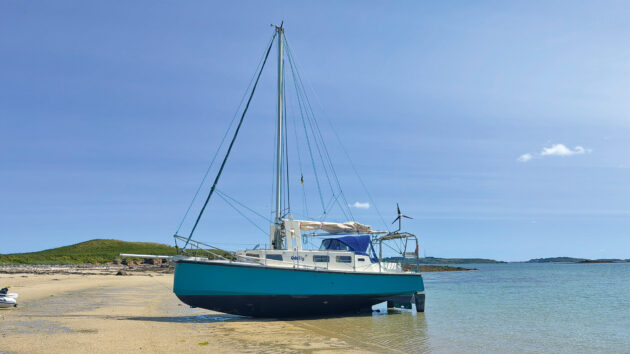
With life pulled in too many directions, we’ve come to the conclusion that any window of opportunity must be buttered up with optimism and grabbed with both hands. So it was with this in mind that we slipped our mooring and motored down the Tamar River on a late morning, already hazy in the heat.
With plenty of vacant moorings, I counted 10 cormorants hanging out their wings in a vain attempt at drying out in the humidity. Despite this salient reminder that nature often trumps optimism, we hoped for better luck!
We went with our gut after a pit stop in Mayflower Marina for fuel and water, deciding to follow the sun on its daily descent to the west. Clearing Rame Head, we disappeared into the clammy bosom of our first fog bank. With no radar, we fell back on good old watch-keeping and AIS transposed across our cockpit plotter.
‘Do we stop or carry on?’ became a constant echo. Every time we felt close to bailing, the fog would lift just enough to entice us further. But it wasn’t too bad, and our persistence felt vindicated as we motored up the Helford River and burst into a tranquil anchorage set within a vibrant sunset. Owls hooted in response to our heartfelt toast to life.
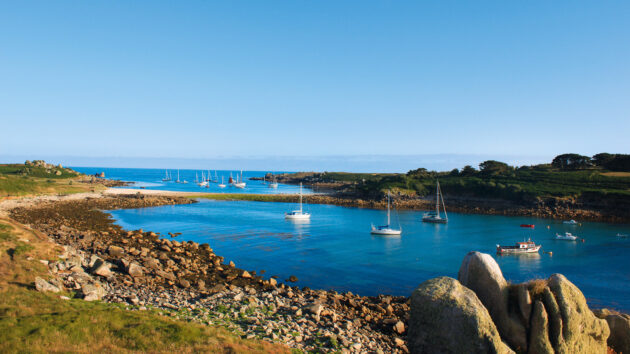
The Cove, on the far side of the isthmus, is a good first port of call in the Scillies. Photo: Theo Stocker
Setting the alarm for an early tide tickled a frisson of excitement. On closing the Lizard, committed by an accelerating current, the first unforecast fog bank rolled in. I could see from AIS that there was little shipping about, so we pushed on to find visibility improving as we made rapid ground to the west.
Swerving hazards
In my view, the Isles of Scilly have an unfair reputation for being hazardous to yachtsmen. Admittedly, there are numerous shipwrecks to back this up, but with better forecasts, navigational aids and charts, I find them full of options – options that increase exponentially with a reduction in draught. They are tailor-made for my 32-footer, Oddity, with her lifting keel and internal ballast.
For those who are coming for the first time and perhaps feeling a bit wary, I would start by anchoring in the cove that lies between Saint Agnes and Gugh Island. With the wind in the northerly quadrant, it provides easy access from deep water to have an overnight rest. Saint Agnes has some lovely walks, with the Turks Head pub being the perfect watering hole before heading back on board.
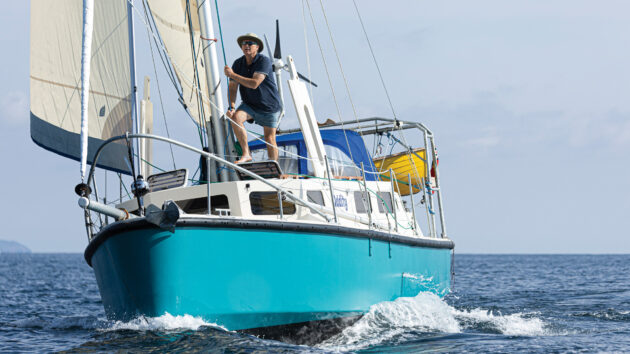
Oddity is a capable 32ft cruiser as well as a creek crawler. Photo: Lloyd Images
The high ground, coupled with a map, also reveals a bird’s-eye view to get your bearings, and a sense of the unique beauty and opportunities that lie between the navigational challenges. There are a lot of rocks and shallow water, but with a sandy bottom it’s easy to see what’s what, and much like sailing in the Bahamas, polarised sunglasses become an asset.
Things to bear in mind while planning your approach to a drying anchorage:
Tides
Oddity can sit on her bottom without legs, which is a huge bonus. But being wary of uneven ground, it’s heartening to know that our daggerboards are structured to act as legs.
My planning starts with the tides, as I like to dry out a couple of hours after high tide to give plenty of ‘buoyant’ time as the tide once again rises. You never know what might happen, and if you end up stuck for whatever reason, a few extra days on a tide that is slipping into neaps is no bad thing.
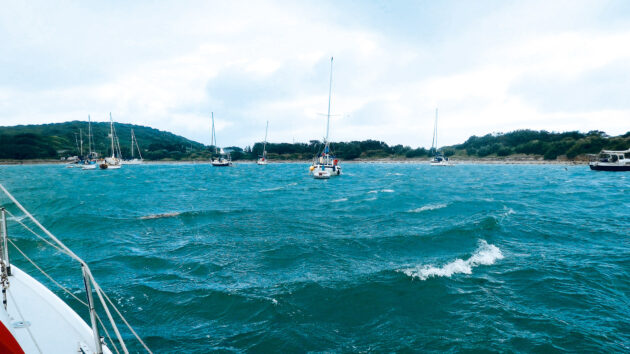
Swell can be problematic in some Scilly anchorages. Photo: Ken Endean
Wind
My next bit of crucial information is the forecast, which starts with the wind. It’s nice to dry out into a headwind so that the boat lies in line with the incline of the beach. Drying out is just the start of the time frame.
What will the wind be doing while aground? What will happen to the strength and direction? If it does change direction, might it swing you into a hazardous area once you refloat?
If this is the case, how can it be mitigated? I always drop a kedge before beaching so that I have extra control and the ability to pull myself off if I’m not initially happy. If I know the wind will change I’ll sometimes redeploy the kedge on foot once the tide is out.
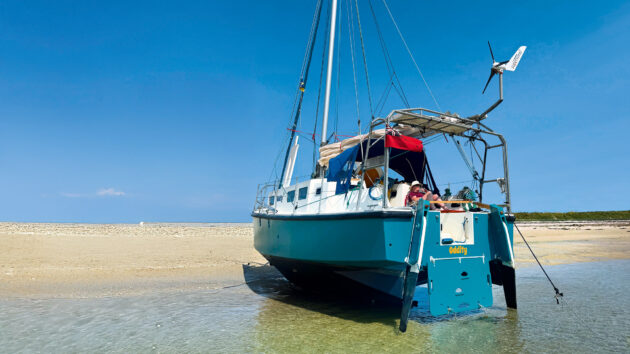
Oddity’s transom doubles up as bathing platform and boarding ladder, while her short twin rudders don’t need to be lifted. Photo: Pete Goss
Swell
Once I’m happy with the wind, I move on to the swell, which is probably even more important than wind. The problem with swell is that the boat can take a horrific pounding as it is about to float. I’ve experienced this once, and the impotence of having to wait while the hull and rig echo with the juddering impact felt desperate.
The thing about swells is that they can come out of nowhere and from any direction on a perfectly glassy day; a pulsating threat that ripples out from a distant storm like a malevolent heartbeat set on destruction. Various online forecasts include wave and swell prediction and it’s worth paying attention to these.
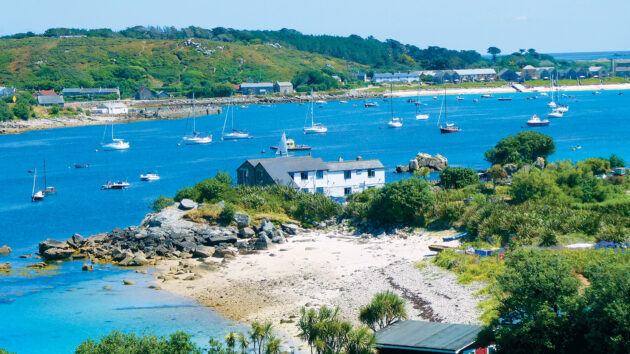
New Grimsby Sound offers good, deep water anchoring and mooring, but is exposed in some wind directions. Photo: Ken Endean
Dodging storms
Having said all this, there is an upside to drying out in a storm – as was proven in Storm Evert, which brought sudden gales to the south-west in July 2021. Such was its strength that moorings, let alone anchors, were dragging.
The lucky few who could dry out ran up the beach and sat it out in complete safety. Be wary of beaching, but don’t forget that it can at times be the safest of options. Beyond drying out, we are also lucky to have the option of dropping our mast to dramatically reduce windage.
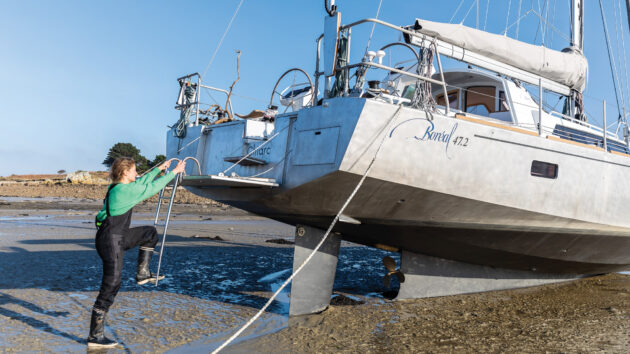
Photo: Jean-Marie Liot
Scouting the anchorage
We often anchor off our chosen beach for a cycle of tide. This allows us to get a sense of the bay, and to dinghy in at low tide to check the ground for obstacles and hidden rocks. Our preference is a moderate incline so that Oddity dries out level.
Once we have chosen our spot, I’ll shove some sticks above the high water mark to act as a transit. If the bay curves around us I might consider a side transit to pinpoint our location, but this is for fun as much as anything.
Secure the boat
We will then consider securing the boat. The kedge is checked and everything flaked out for ease of deployment. We approach with the dinghy launched so we have a ready tug to push or pull should the need arise. Is there a good rock or tree that we can secure the bow to?
Some suggest running beyond your drying out position to drop the main anchor before backing into position on the kedge. That’s great in theory but can become unnecessarily complicated, particularly if there are only two of you on board.
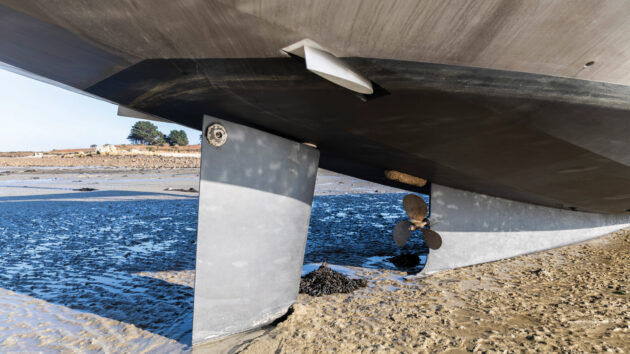
Photo: Jean-Marie Liot
We tend to run into the beach and leave the engine on tick-over for a few minutes to let the bow take the ground. It really is amazing how quickly the tide falls. If needs be, I will set the main anchor by foot once we’re dried out.
Tools to hand
‘Tide waits for no man’ in many ways and I am always amazed at how quickly the boat dries out, so I prepare for any jobs before we beach. A good long-handled scrubbing brush. A small hard-bristled brush for those gnarly bits and a set of screwdrivers to clear out small barnacles within the skin fittings. I’ll dig out the new prop anode and make sure the right tools are to hand.
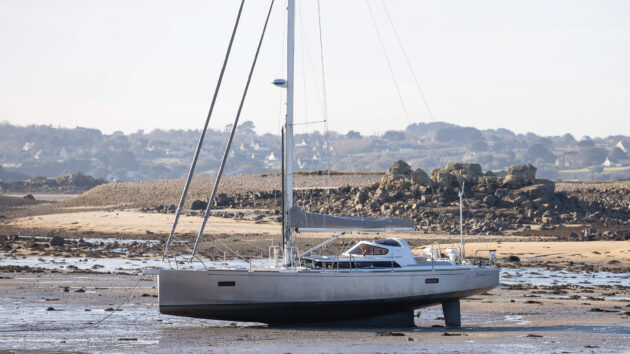
Photo: Jean-Marie Liot
Boarding
Having designed Oddity for just this sort of thing, we don’t have to worry about a ladder as our transom is multi-functional: a transom when up, bathing platform when horizontal and a boarding ladder when down. But if you’re in a taller bilge-keeler or a boat with sea-legs, you’ll need to ensure you can reach to climb back aboard from the sand. Our rudders have about a foot of clearance and the prop is well clear of the bottom – all things, if not designed into the boat, that need to be considered before grounding.
Finally, a tip from Breton sailors: fill a bucket or two with seawater before the tide disappears. One can be used for washing muddy, sandy feet to keep the boat clean when you clamber back aboard. The other can be used to flush the heads if needed (into the holding tank).
There’s nothing more satisfying than floating on a clean bottom and so it was that we re-anchored under Tean Island to carry on with our Scilly foray. With so many nooks, crannies and rock outcrops, it’s a perfect place for my paddleboard.
Of all the islands I think our favourite is St Martin’s, as it seems the least touristy and, being bigger and furthest from Hugh Town, it’s less crowded.
The residents are an eclectic bunch and it’s always fascinating to find out what brought them to such a unique location. The ex-environment officer who runs Polreath Tea Room; the landlady of the Seven Stones Inn who came here on her honeymoon 30 years ago, saw that the Inn was for sale and the rest is history. There’s a vineyard for which we ran out of time and have saved for our next visit; we will be back before long.
 If you enjoyed this….

Yachting World is the world’s leading magazine for bluewater cruisers and offshore sailors. Every month we have inspirational adventures and practical features to help you realise your sailing dreams.Build your knowledge with a subscription delivered to your door. See our latest offers and save at least 30% off the cover price.
Note: We may earn a commission when you buy through links on our site, at no extra cost to you. This doesn’t affect our editorial independence.