


Grand Soleil’s new flagship marks a bold move for this mainstay production yard into the sphere of semi-custom ‘small superyachts’, all in true Italian style
Grand Soleil 80 review: Compact Italian superyacht

Porto Cervo, Sardinia, is a gold standard of yachting venues. If you fly in over the Strait of Bonafacio, your face will be firmly pressed against the window, transfixed by the achingly beautiful waters of the Costa Smeralda.
It’s a view which seems almost fantastical, particularly in today’s world of AI generation, and makes you yearn to get afloat. Small wonder that some of the world’s most prestigious regattas are held here.
It was a shrewd choice then for Cantiere del Pardo to hold its main rendezvous regatta here in May. Were you a potential Grand Soleil owner, or an existing one toying with an upgrade, then a five-star event held from the esteemed Yacht Club Costa Smeralda pre-season might just tip the scales. In fact, the conversations I had during the final prizegiving indicated significant interest in both this new 80 and upcoming 60LC.
It’s also an appropriate backdrop to introduce a new flagship. For this 80 Plus LC, Grand Soleil solidified a formidable design team, which combines Nauta’s distinguished superyacht experience with the bold, powerful and race-proven, in-demand lines of Matteo Polli. However, looks alone won’t cut it at this
ultra-competitive size, not with the likes of Swan, Solaris, Ice and Y-Yachts all currently very active in this 80ft premium performance cruiser sector of the market.
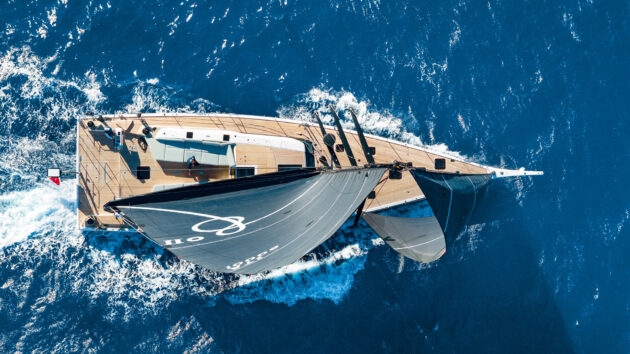
Photo: naphtalina.com
Grand Soleil dipped its toes into this sector before, seven years ago, with the Ceccarelli-designed 80, but that was more of a custom one-off. Since then, it brought in the highly experienced racer and boatbuilder Franco Corazza, who has helped spearhead and then galvanise a new semi-custom Plus line from 60ft, which includes the 65 and 72 we have previously showcased.
Corazza persuaded the Cantiere del Pardo yard in Forli to buy the Adria facility in Fano, an hour further south on Italy’s east coast, where it had previously subcontracted large builds to upskill in-house quality.
Full of firsts
As the models grew, they improved, and here is a flagship the historic brand deserves. Not only does Bianca II, the first Grand Soleil Plus 80, show the Plus line stepping up a gear, but it is an example of how bespoke and versatile this operation can now be.
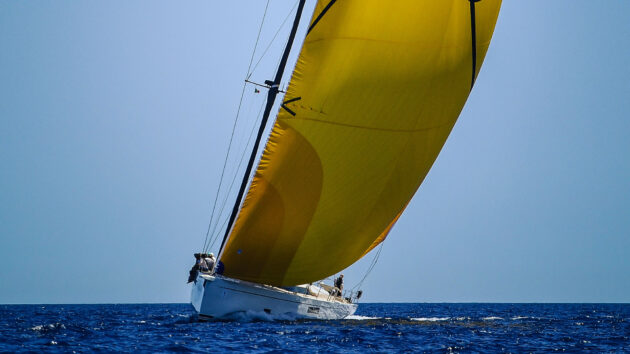
The fixed bowsprit flies both traditional and furling gennakers. Photo: naphtalina.com
Moving up from his previous 72, this owner sought a yacht he could enjoy himself for regatta racing, but would also serve a busy charter programme. It makes for an intriguing mix, as do some of the choices made.
A telescopic keel, for instance, is nothing new, particularly at this size, and works well in the LC (Long Cruise) format, as it’s contained below the sole in the raised saloon. But this decision encouraged Polli, a long-term single rudder proponent, to conduct studies comparing shallow draught rudder profiles against twin rudders. It resulted in Grand Soleil producing its first twin rudder yacht in 50 years. The design of these blades also differs from the norm – more on that later.
Bianca II is also the first Grand Soleil Plus with a hybrid system, again at the owner’s request, as he is well versed in the technology. Likewise, it’s an unusual choice for a yacht heading into charter. With twin generators, vast battery capacity and the extra cabling required, it brings additional weight (1,700kg), space and cost considerations (+10%).
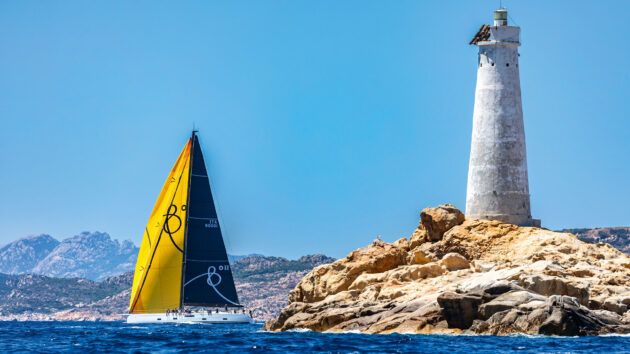
Bianca II, the first Grand Soleil 80 Plus, looking right at home in the stunning waters of northern Sardinia’s Costa Smeralda. Photo: naphtalina.com
And then there’s the task of making a performance yacht that can compete in regattas, one that is also convertible to an easy-to-use luxury charter vessel. Hence, she has a second crew cabin in the forepeak in place of a dedicated sail locker. Every inch of the first GS80 is used.
Sound of silence
From a charter perspective, silently motoring out of port or anchorage is a relaxing benefit that should not be underplayed. You can be enjoying a coffee in the saloon without really even knowing you’ve left port. Equally, if you often sail in light wind areas, the ability to add power to up the apparent breeze could help give the guests a peaceful sailing experience they wouldn’t otherwise have.
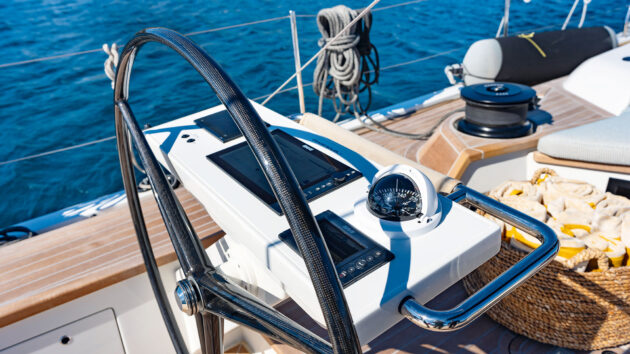
Outboard helm positions with a bank of hydraulic sail controls. Photo: naphtalina.com
The sound of hydraulic motors engaging every time a winch or captive winch is operated does impact this serenity somewhat. Aboard Bianca II, though, this again shows the semi-custom nature the Plus line accommodates at this size, with the owner specifying hydraulics for the power-hungry systems rather than using pure electric. Winches, keel, and sail trim adjustments are all powered via a central hydraulic circuit, which makes for an efficient layout.
We didn’t have the 25-knot Mistrals associated with this location – too early in the season for those iconic scenes of maxis charging through Sardinia’s ‘bomb alley’. Instead, light winds combined with a full house aboard and some teething issues with the sails. The latter constrained us to just the mainsail and self-tacking jib, where a Code 0 could have been transformative. However, I did have two very pleasant days/sails aboard, plus a comparative trial on the 65P for good measure.
The helm feels comparatively neutral when the yacht is even slightly upright, which persuades you to watch the numbers for guidance. When that was in the lighter, sub-10-knot breezes, while laden with full tanks and 14 aboard to swell our 47-tonne displacement, we still averaged 7.5-9 knots upwind and reaching.
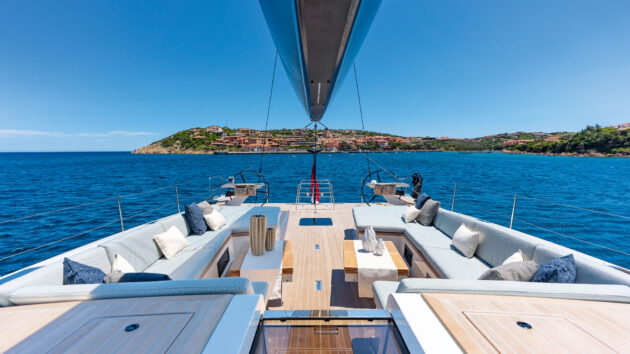
Powered telescopic cockpit tables convert into sunpads. Photo: naphtalina.com
At such times, an offwind sail would obviously help enormously, as would a genoa. Polli reckons the difference between the self-tacking jib and genoa is considerable, pointing out that the new 65P sailing with us could keep up with us when using its genoa.
It’s also worth registering how adaptable the sailplan is for these large Grand Soleils to suit different sailing: the 80LC can have inner stays for staysails and storm jibs, while its fixed bowsprit flies both traditional and furling gennakers, the latter on an anti-torsion cable.
Thankfully, the following day, there were half the number of people aboard and a fraction more wind, which together made a telling difference. Once the wind creeps into double digits, the heel angle and sensations change, as you get some motion through the rudders. You can feel the 80LC come alive, with much more dynamic engagement on the helm. That’s when you really know you’re at the wheel of something special.
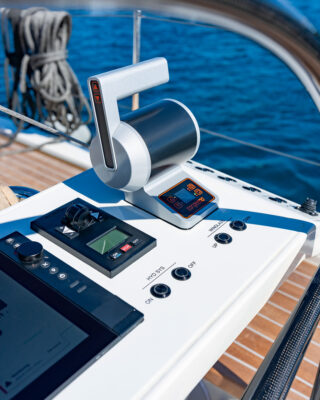
Handle on the throttle – hybrid drive system for silent power. Photo: naphtalina.com
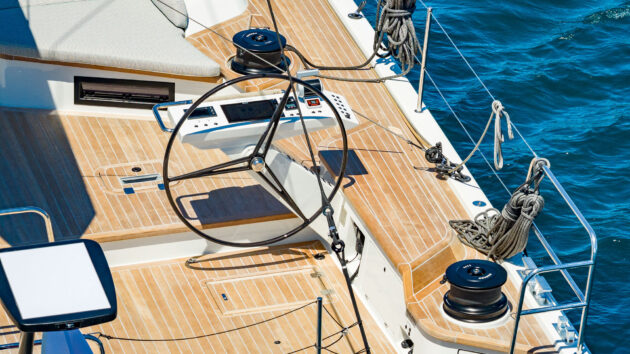
It’s also well set up to sail short-handed and/or actively encourages the helmsman to trim. The helm pedestals are a neat design, as they incorporate a bank of hydraulic trim controls outboard for the helmsman to tweak easily. The Harken captive main on a mini joystick is an effective solution for short-handed trimming, and leads through a single deck point to a pre-tensioner and winch in the lazarette below. Equally, the V-boom simplifies mainsail handling.
As the photos convey, the deck design elsewhere is scrupulously clean, with sailing systems led to the winches by the helm area without impacting the vast guest cockpit space. The custom-made 3D inhauler is a smart example – it avoids the need for tracks in the deck and conceals the sheets underdeck, which exit directly to the primaries.
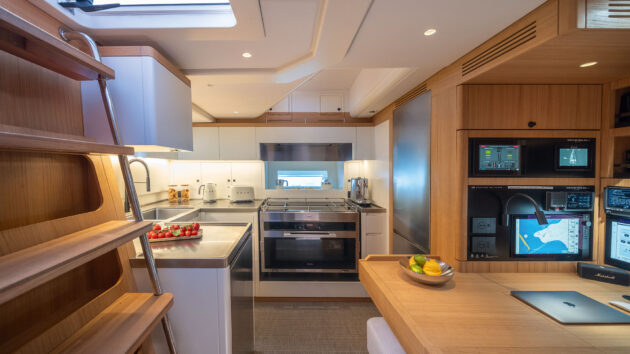
Practical U-shaped galley. Photo: naphtalina.com
Some disturbance was noted from the folding prop, perhaps in regeneration mode. Bianca II has a folding prop for racing, which is swapped out for a fixed prop optimised for regeneration when cruising. This sacrifices around a knot in speed, which may seem incongruent for a performance yacht, but again best serves this particular owner.
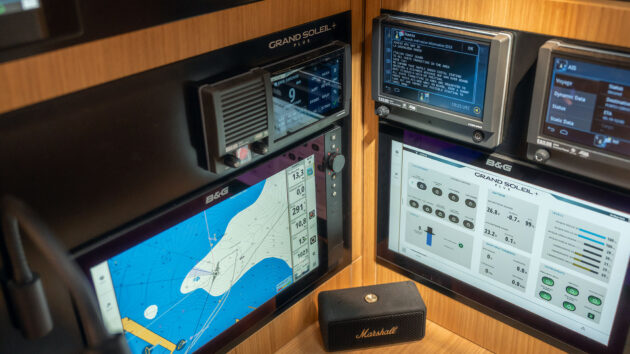
Adjacent navstation doubles as a crew mess table. Photo: naphtalina.com
Twin rudders?
Peek over the windward quarter at this point, and you may be surprised not to be able to see the windward blade. Polli believes most current yacht designs set the rudders too far apart – optimised to work well when properly heeled to get the working blade at the optimum angle and the windward one clear of drag. But such designs can be trickier to steer when upright and have to rely heavily on thrusters when in port, he points out.
So these 80LC rudders are comparatively close together, which should aid manoeuvrability. “They are normally set at a 20° dihedral angle – I went for 16°.”
Also, as the rudders don’t come out of the water, Polli was able to reduce the size of the blades.
Still, in his view, twin rudders only make sense when used with a telescopic keel, paired to allow the yacht to enter shallow waters. The second hull will have the standard single rudder and 3.95m fixed keel.
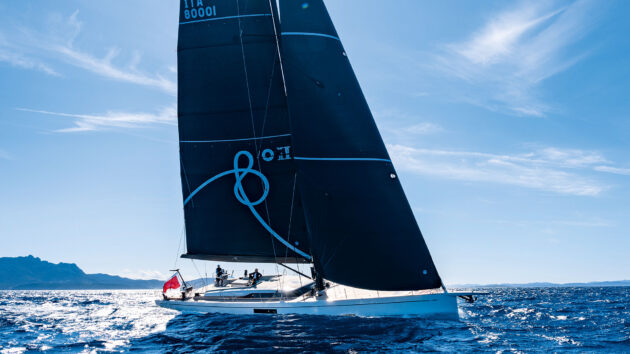
The composite sandwich structure is carbon reinforced and uses vacuum-infused epoxy-based vinylester resin. Photo: naphtalina.com
There are plenty of options to choose from with Grand Soleil’s current range, starting with the main decision on coachroof design and whether to opt for a Performance or Long Cruise (LC) style. Personally, I think the LC version really lends some styling weight and creates a raised saloon, as well as additional cockpit depth and protection.
In terms of the latter, Bianca II also has a garage well for a sprayhood, a cockpit bimini on removable posts, and a boom awning for shade in port (Grand Soleil also now offers helm biminis, which can be left rigged while sailing upwind).
This aft deck provides a generous, wide space for lounging at anchor and connecting to the swim platform. Below is a vast lazarette, in Bianca II’s case, packed full of stores, bosun’s gear and extra toys for the charter guest.
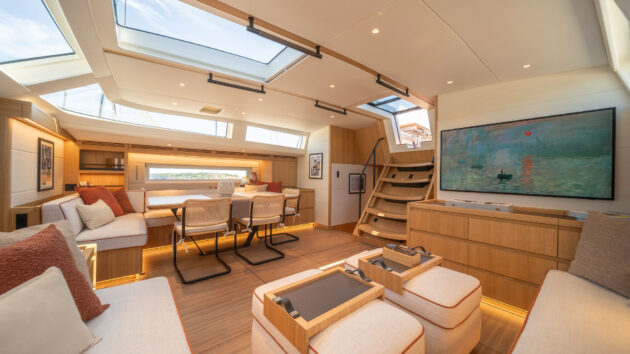
Nauta style: light oak trim with bold colour cushions, rattan-type locker doors and sumptuous linen bulkhead coverings. Photo: naphtalina.com
A 4.5m Williams tender is either towed or lashed on the foredeck.
The step between the aft deck and cockpit is the result of a typical battle between the naval architect and interior designers – to maintain a sleek aesthetic, while still guaranteeing the 1.9m headroom required for the interior passageway below.
Larger yachts of 90ft+ have the length to carry these lines better, but you can see how, with this step in the cockpit, Polli has tried to keep the lower transom look (his signature look is the ultra beamy yet low, rounded transom).
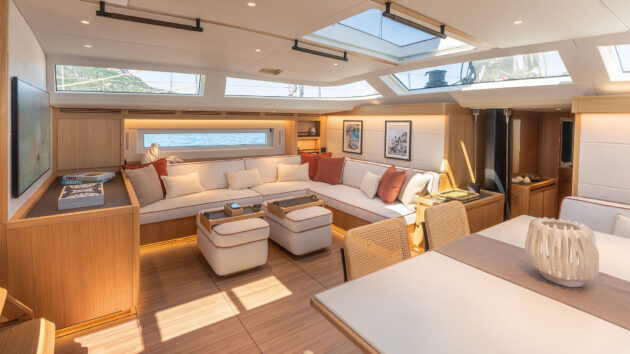
Natural light floods in from the large skylight in the saloon roof. Photo: naphtalina.com
Nauta’s Massimo Gino agrees that designing at this size is particularly demanding: “An 80ft yacht must encompass the qualities, functions and features typically found on yachts ranging from 95 to 100ft.”
Meanwhile, the naval architect has the task of incorporating the variety of systems which an owner might choose into the overall weight.
“We focused on keeping the centre of gravity as low as possible, optimising the placement of all major systems,” explains Polli.
“The hull was engineered to provide stability both at full load, with tanks and systems at maximum capacity, and in lighter configurations.”
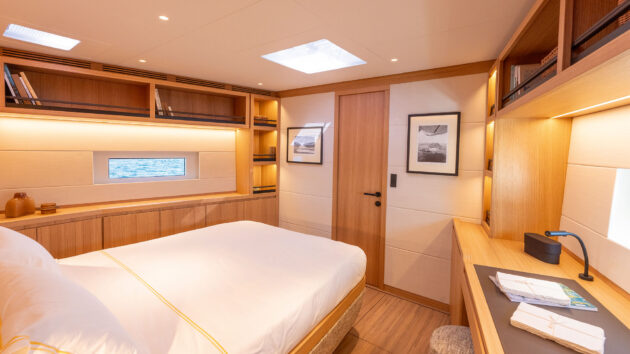
Master cabin features a private entrance way, offset berth and a long desk to starboard. Photo: naphtalina.com
Super-style
The interior shows the yard embracing the challenge of moving into ‘super’ territory and extending the growing theme of can-do customisation. The only thing you can’t really change is the bulkheads, I’m told – owners can even reverse the layout to have a galley forward, for example.
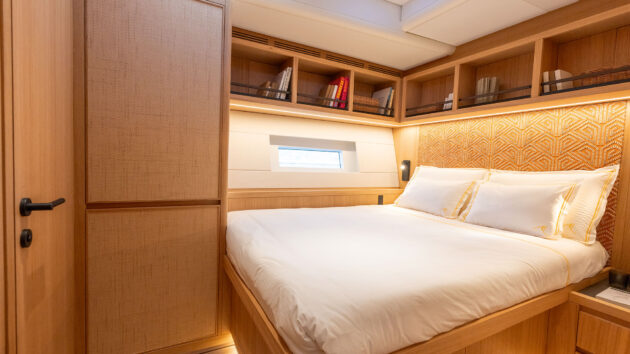
Guest cabins are generous. Photo: naphtalina.com
In this yacht’s case, it’s obviously designed around maximum guest and habitation capacity, including a crew cabin instead of a sail locker, and an extra (third) guest cabin forward of the saloon. A heads and shower just forward of the saloon both serve this and act as a practical day heads too.
The classy Nauta styling is executed with high quality, while the LC layout makes a telling difference in the extra light and space it offers. This raised saloon style brings additional views and uses the full beam, with an L-sofa to port and dining opposite.
There is so much natural light from the coachroof, hull ports and a large skylight on offer, so while there’s seating and space for multiple guests, it still feels spacious and premium class. (The freestanding chairs are perhaps a choice of style over practicality, as there is no means to secure them at heel.)
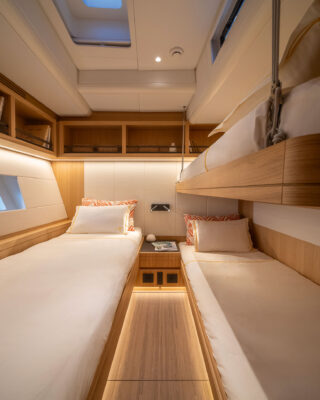
Guest cabins can be configured as doubles, twins or triples (using a fold-down bunk). Photo: naphtalina.com
Up forward, the master cabin entrance and layout are savvy, using a mirrored bulkhead to give this entrance privacy without needing to close the cabin door. It also means the headboard for the peninsular berth can be positioned slightly offset and aft, against a bulkhead and in an area of minimised pitching – the alternative layout is to have a central doorway with this headboard on the forward bulkhead.
Keeping the crew quarters and galley aft, with a dedicated companionway is, to my mind, undoubtedly the best format at this size. The practical U-shaped galley is a good size, but otherwise, there’s plenty packed in here. The navstation doubles as a mess table, for example, so it’s quite a compact area for three crew to share (in one cabin here and the other in the sail loft).
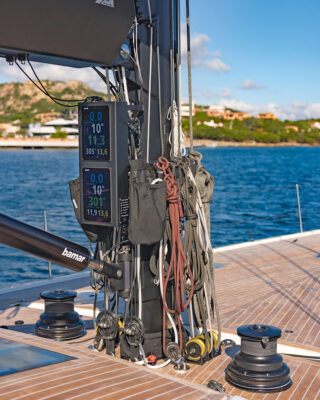
Race-spec instrumentation at the mast base. Photo: naphtalina.com
Packed with options
It helps illustrate just how much is contained within this 80ft. Another benefit a raised saloon brings is the additional space beneath to house tanks and machinery.
There is access to the keel under the forward saloon on Bianca II, as well as the two 40kWh lithium battery packs. The floorboards have to be lifted to service the 45kW generators or watermakers, but the filters for these can be flushed remotely, and the servicing is only done during charter turnarounds, the crew tells me.
The aft deck is stepped, dividing it from the guest cockpit. Photo: naphtalina.com
In many ways, this is the ideal new flagship for Grand Soleil to launch, as it showcases so much of what this yard can now offer. It’s packed with extra options to suit an uncommon programme of both racing and luxury cruises or charter.
The ability for owners to campaign it in a regatta off Porto Cervo one week, then to silently cruise it around these islands the next is quite special, and helps emphasise the Grand in this yard’s established name.
Grand Soleil 80 specifications
LOA: 26.20m 86ft 0in
LWL: 22.0m 72ft 2in
Beam: 6.6m 21ft 8in
Draught (std): 3.95m 13ft 0in
Displacement (lightship): 42,500kg (93,696lb)
Fuel: 2,000lt 440gal
Water: 1,300lt 286gal
Engine (std): Yanmar 250hp
Sail area: 400m² 4,306ft²
Price: For a fully equipped yacht from €5.7m
Design: Matteo Polli; Nauta; Cantiere del Pardo
 If you enjoyed this….

Yachting World is the world’s leading magazine for bluewater cruisers and offshore sailors. Every month we have inspirational adventures and practical features to help you realise your sailing dreams.Build your knowledge with a subscription delivered to your door. See our latest offers and save at least 30% off the cover price.
Note: We may earn a commission when you buy through links on our site, at no extra cost to you. This doesn’t affect our editorial independence.