



Is Outremer still the archetypal fast voyaging cat brand? Armed with questions, Toby Hodges spent a couple of days sailing the 48 two-up
Two days, one cat: Beyond the brief test drive with the new Outremer 48

Which yacht would you pick if you could choose any? I’m sure this is a game we all often play, and hopefully your answer wouldn’t automatically be the biggest or most expensive, but the one that might most suit your sailing, crew, aspirations and cruising area – now weave some practicality into the mix and your decision changes dramatically.
Try playing this with the Outremer range alone though, and you might still be at a loss. Choosing between them has become more challenging since the arrival of this new Outremer 48, which occupies a critical middle ground between the older, compact Outremer 45 and the more voluminous new Outremer 52.
Big impression
Over four decades, Outremer has built a reputation to become the preeminent multihull brand for fast voyaging, with over 400 of its cats plying the oceans.
Indeed, its name, ‘Overseas’ in French, encapsulates its bluewater aims. Its Spartan original Danson designs made the Outremer name, before the Barreau/Neuman 45 and 51 models cemented it. Since 2020, it has completely updated its range with VPLP, including the award-winning 55 and 52, from which this 48 closely follows suit.
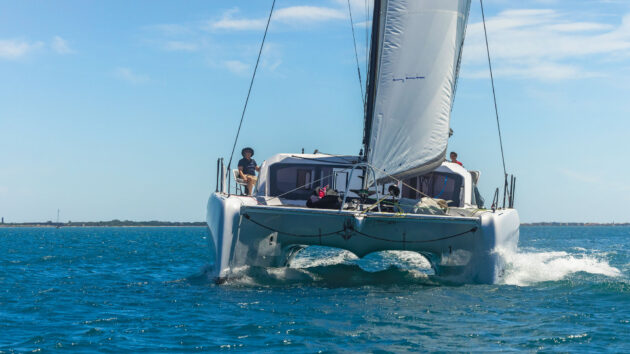
Photos: Thibault Desplats
So does this replace the 45, a model which achieved fame with Sailing La Vagabonde? Confusingly, that had already become a 48 by extending the transoms for increased waterline length. Also, how does it compare to that previous generation of designs, which were considered the best cruising cats for couples to handle? Intrigued, I travelled to Marseille to join the first new boat and spend some time living and sailing aboard.
As the 48 pulled into the fuel dock to collect me, it was immediately clear this is a large, high and somewhat bulky 48, very much a slightly smaller version of the 52 I had a memorable few days testing in 2023.
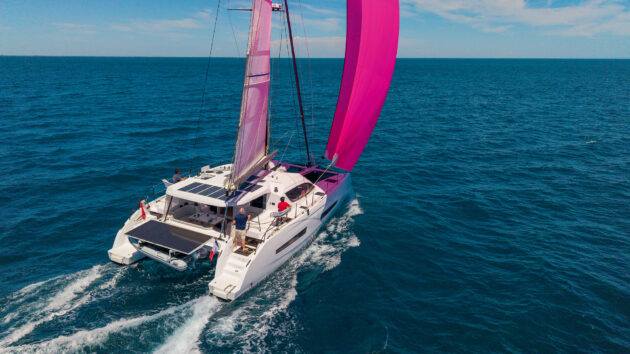
The new 48 aims to hit a sweet spot in their lineup. Photos: Thibault Desplats
The 48s are built at the ex Marsaudon Composites yard in Lorient, which Grand Large Yachting acquired a couple of years ago. The first hull was brought down to the main Outremer facility in La Grande Motte for the International Multihull Show debut in May, and following this Marseille shoot, veteran sales manager Matthieu Rougevin-Baville and I would sail it back there for de-snagging and prospective client trials.
During our overnight stay in the Frioul Islands, Rougevin-Baville explained how the previous generation of Outremer (45/51) was designed for “the sailor’s” experience, with a lower centre of gravity, narrow hulls for less drag and less hobby horsing.
But as charter style cats introduced ever increasing volume, the demand for space grew. Outremer’s current VPLP range was tasked with introducing more comfort without sacrificing that sailing experience. Its work with sister company Gunboat advanced its engineering know-how, introducing key modern weight-saving ideas.
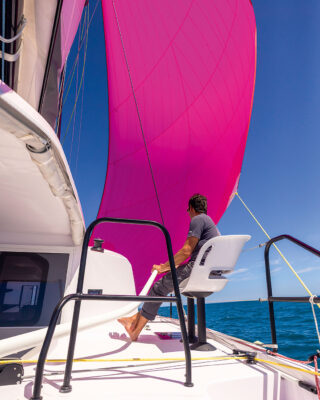
The tiller steering experience is still a delight. Photos: Thibault Desplats
“Improving quality of life and not increasing the pitching motion or decreasing speed is everything we have learned in the last 10 years,” Rougevin-Baville explains. This results in a more modern structure, he argues. Compared to the 45 then, the 48 brings more volume, headroom, glazing, stowage and payload capacity.
Outremer targeted a price within 15% of the 45, but once that figure doubled during development, the yard decided to retain the 45 in the range. It’s good news for those who still appreciate a ‘smaller’ (cheaper) cat, and also portrays this brand, with its dual construction sites, as a dominant force in the production boat scene today, with models every 3-4ft between 45-65ft.
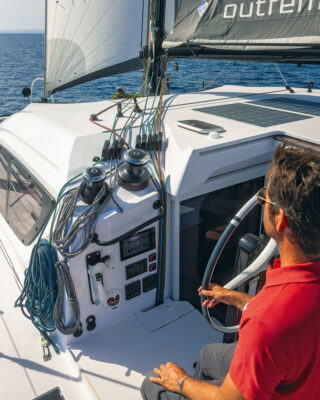
Most sail controls led to a single position. Photos: Thibault Desplats
Scenic sailing
With these design theories in mind it was time to experience the 48 under sail. The sensational Frioul archipelago, lying only a couple of miles off Marseille, is an ideal location for a photo shoot with historic clifftop forts and picturesque coves where deep blue seas lap onto white limestone shores.
With a light forecast all that week, we knew we’d not be repeating the spirited sailing we enjoyed on the 52 – rather, our return passage offered the chance to explore light wind performance benefits while sailing two-up.
Nosing out into the bay, we hoisted sail in 3-4 knots of wind, just enough to fill the powerful square-top main and genoa and start to make a little headway upwind. A self-tacking jib comes as standard, but this owner had chosen the larger headsail, as well as a staysail, Code 0 and a carbon mast.
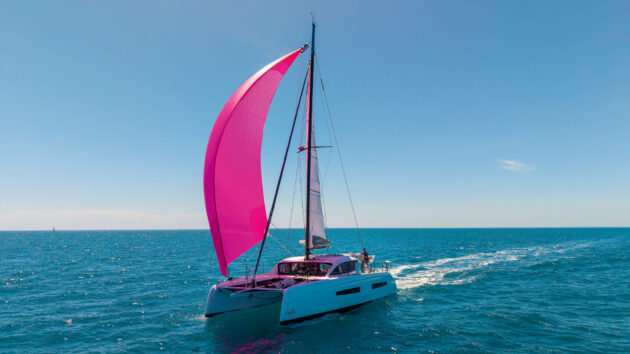
The 48 doesn’t replace the 45, more than 120 of which have been built, but offers a more premium and higher volume alternative. Photos: Thibault Desplats
The ease with which one person can set and trim sails is immediately apparent. The bulkhead winch set up in front of the port helm is well configured, complete with remote foot switches for the powered winch, which frees up your hands to work a sheet or halyard on the winch.
By late morning, the forecasted 8 knots had arrived, enough to encourage 5-5.5 knots boatspeed in 7.5-9 knots true wind, close-hauled at 30-35° to the apparent wind. That extra couple of knots is key to making meaningful speed – in 7 knots breeze we were down to under 4 knots boatspeed, the 11+ tonne laden displacement of the 48 telling.
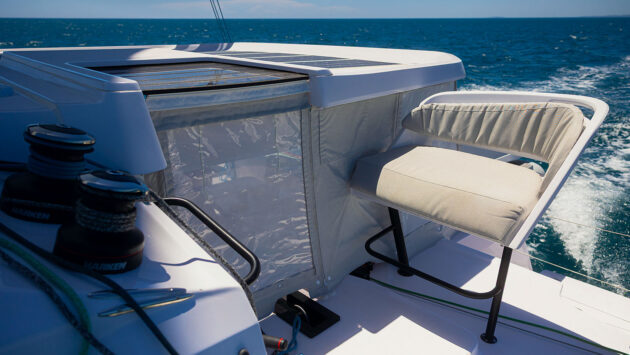
The canvas cockpit enclosures are neatly housed in the roof. Photos: Thibault Desplats
I settled in on the port helm seat to get the full Outremer experience. Yes, it still offers a tiller, but gone are the bucket seats of the 45/4X, in favour of comfortable and sociable dual helm seats. With this fore-and-aft style seat to starboard, you can put your feet up to lounge with tiller in hand.
It’s pure decadence. While a tiller is an option few will take or use, and perhaps more suits occasional/holiday sailors over liveaboards, I still think I’d choose it as it transformed the experience of hands-on helming in light wind/single figure conditions and proved surprisingly light and direct (plus it offers some posing potential!).
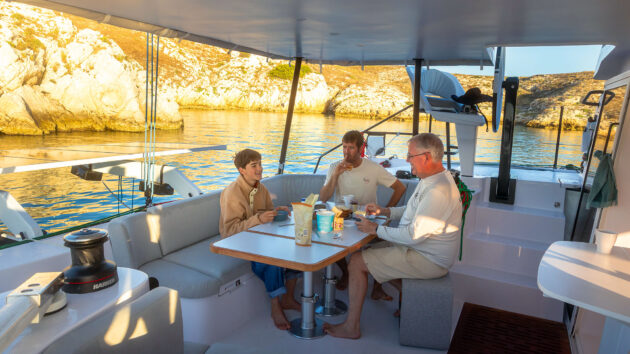
Sofas and well protected outdoor eating space in the cockpit, with good saloon connection. Photos: Thibault Desplats
As we headed offshore, a strange bank of fog arrived, at which point the wind backed to the south, allowing us to ease sheets onto more of a beam reach and set the Code 0. With plenty of length in the sail lockers to house furled sails, and a big trampoline to prepare the hoist, it proved an easy set of a sail which we carried for the rest of the afternoon and evening. These were easy, enjoyable miles, with the log averaging 6.5 knots in 8.5 knots at 85°T.
Decisions, decisions
Mid-afternoon brought the best breeze of the day, a steady 11-13 knots, which raised our average speeds to 8.5 at 105°T. Heat her up 10°, and the log instantly rose to over 9 knots, at which point the boat starts humming.
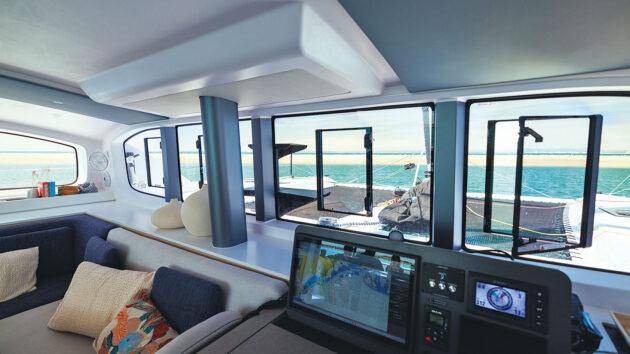
Ventilation and views from the navstation. Photos: Thibault Desplats
Then at 9.5 knots, the wake releases and sports mode is engaged (for which we needed over 13 knots true at 100°T with the Code 0). Admittedly, the asymmetric would have helped our speeds even more once the wind backed – according to the polars we could have been clocking 11 knots or more if so. But on a day where barely a white cap was to be seen, it was both pleasant and rewarding to be averaging 8.5 knots while flat water passagemaking.
The only stress was where best to relax a little on watch, such is the plethora of options.
First and foremost, the two-person helm seat is superb, a feature Outremer fine-tuned on the 55 and 52. Again, this includes throttle controls to hand inboard, while the swing pedestal allows you to sit comfortably, stand outboard for optimum visibility, or right inboard to helm in full protection looking through the vertical coachroof windows.
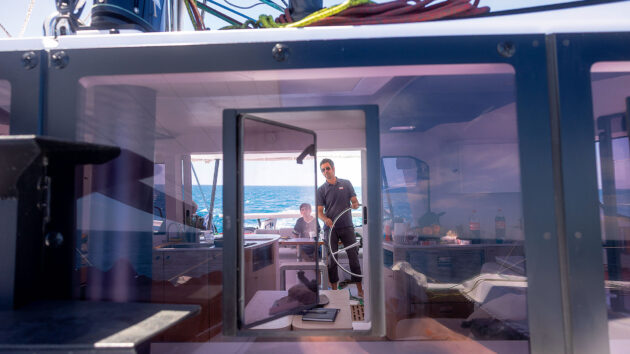
Sailing with wheel canted inboard. Photos: Thibault Desplats
This latter option was a position I relished on the 52, and the main difference here is that the 48 lacks the inboard cockpit winch setup for controlling sheets, too.
You soon notice how comfortable it is to be on watch while underway, to spend time aboard, living on one main deck area, transitioning between navstation and cockpit. The interior has excellent visibility and ventilation, allowing you to choose your spot to work, relax, or keep a lookout, while out of the sun. The ventilation is a significant deal, as it means no aircon or genset is needed.
As well as the superb forward-facing navstation, with its comfortable swing-out chair, I found sitting on the multipurpose stool at the breakfast bar a favoured position. Another top option is the portside saloon settee, as Outremer has given this a convertible backrest to create a chaise-style seat.
Meanwhile, the aft-facing double sofa in the cockpit is a new feature, a chaise-style lounger that is ideal for those feeling below par to relax in full protection.
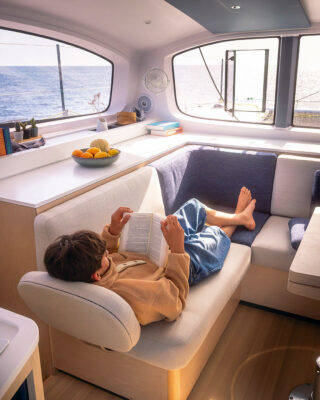
Chaise-style relaxation in the saloon. Photos: Thibault Desplats
This cockpit is a big upgrade over the 45. Its enlarged bimini roof supports more solar and integrates a rainwater collecting well that drains through the bimini supports, either for discharge or tank storage. Combined, the bimini and davits support 2,500W of solar, with the latter carrying a proper adventure-ready tender (a 3.5m RIB).
While the relaxing places are well-considered, the aesthetic is somewhat production boat utilitarian in places. The large roof offers plenty of protection and solar real estate, but it does create an expanse of white ceiling, with very limited views of the sails from beneath.
Natural light is abundant though, thanks to the large, vertical coachroof windows. And once you cross from cockpit to saloon, you enter a modern, bright interior, which uses its spaces intelligently.
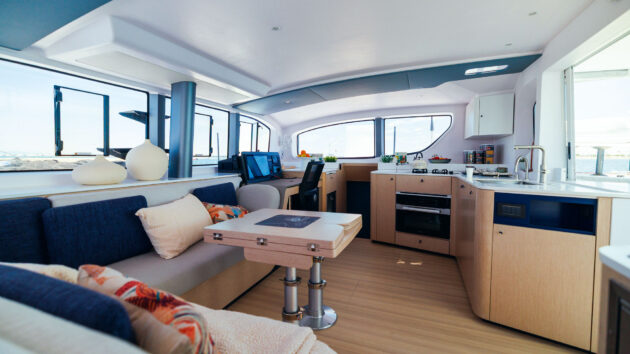
The 48’s airy saloon offers a crucial 10cm more headroom than the Outremer 45. Photos: Thibault Desplats
Outremer has increased stowage wherever possible, including below the saloon seats and soles. The main electrical boxes, including inverters and solar converters, have been relocated to a prime, accessible locker beside the galley, moving them away from their conventional position at the mast base bulkhead.
Heart of the yacht
The galley is, as it should be, the yacht’s heart and works well to integrate the social spaces, connecting saloon and cockpit. It’s arguably more practical than the 52, particularly the stovetop position. But it is perhaps a bit disparate, using lots of small lockers spread out on either side of the sliding door, and I wonder if you’d forever be trying to remember where items live. That said, there is stowage wherever possible, while lockers and shelves in corners slide out on rails for easy access.
The worksurface has a lip all around it to keep spills in, and I like Outremer’s use of drop shoots to feed the fish, or for waste into a bin.
The 48 is available in three or four cabins layouts, providing abundant volume for long-term living aboard. There’s certainly less of the poky feel of performance daggerboard cats in the hulls, without going too far the other way.
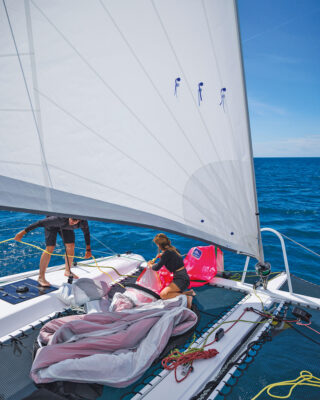
Sail changing from the tramp. Photos: Thibault Desplats
“People confuse comfort with space,” argues Rougevin-Baville. “Comfort is motion, noise, visibility. The cost of an island berth to be able to change your sheets without getting on to the bed, is huge! It kills the motion and performance of a cat.”
It’s a valid point, however this 48 will still feel capacious to many, including 45 owners. Where three cabins are standard, with the owner’s hull to starboard, the test boat had the optional fourth cabin, including a flexible, multipurpose one.
This ‘MyFreeSpace’ option is a versatile utility room, a cabin, office, or workshop. The test boat featured a smart combination, with a fold-down berth for when occasional guest capacity is required, yet without compromising the desk space and significant stowage capacity. The latter includes a laundry area and deep shelves aft, ideal for liveaboards.
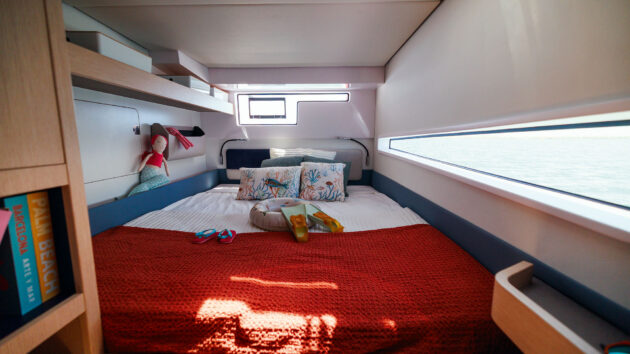
Aft cabins are spacious and well lit. Photos: Thibault Desplats
Which model suits?
The other forward cabin is well ventilated and bright, with good stowage, although the headboard forward berth arrangement could make it lively in a seaway. The aft cabins are spacious and well lit, with long hull windows and aft-facing portholes, and include vast stowage spaces below the berths (note that hanging allocation is reduced in the four-cabin format).
The daggerboard casings are integrated into the hulls with minimal impact on living space, and the inboard heads and showers compartments are shared by both cabins in each hull to efficiently use this volume. The separate shower stall in the guest hull lacks natural light and feels too enclosed compared to the owner’s version though.
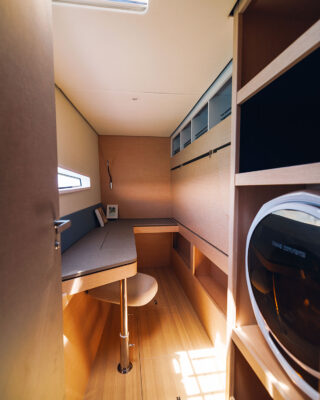
Flexible ‘MyFreeSpace’ cabin option. Photos: Thibault Desplats
Lift any panel or sole board, and you’re instantly reminded that this is a lightweight build. When Grand Large Yachting bought the Marsaudon Composites yard, where ORCs continue to be built, it inherited top composite knowledge.Outremer hulls and decks use vacuum-infused Vinylester; its furniture is all foam-cored recycled PET.
Addressing my opening questions, then, which model might you choose and does the 48 help the decision? It offers more space, light and volume over the 45, and particularly views and headroom in the saloon. Another consideration this modern generation brings is the comfort on the main deck for living aboard, and for cooking at sea, as it will move less than a smaller yacht such as the 45.
Compared with the 52 it is an equal in many regards, with a similar-sized saloon and only 15% less cockpit, so it may well end up stealing some of those potential clients – the slightly more compact size might better suit coastal sailing and Med berthing.
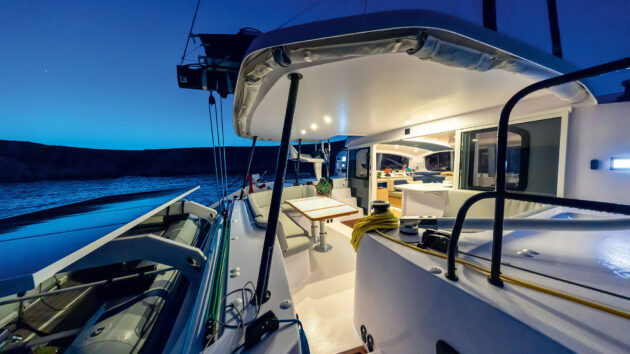
Inviting outdoor living zone for Mediterranean evenings. Photos: Thibault Desplats
The extra waterline length and payload of the 52 may be valued more for ocean sailing, but with a difference of €300,000-€600,000 between each model, depending on options, you have to really want that extra LWL, payload capacity and a tad more space. (I remember meeting a family who bought one of the first 55s, having completed a circumnavigation aboard an older 51. The prime reasons for their upgrade were additional waterline length for that extra average cruising speed, and the ability to sail in light breeze and therefore set off on passages in calm conditions.)
Outremer 48 specifications
LOA: 15.10m 49ft 7in
LWL: 14.63m 48ft 0in
Beam: 7.56m 24ft 10in
Draught (boards up/down): 1.25m/2.10m 4ft 1in/6ft 11in
Displacement (lightship): 10,500kg 23,148lb, (max payload) 15,000kg 33,069lb
Berths: 6-10
Engine: 2x 38hp saildrive
Water: 410lt 90gal
Fuel: 450lt 99gal
Sail area (100% foretriangle): 109.2m2 1,175ft2
Price (ex VAT): from €1.19m, boat as tested €1.56m
Design: VPLP, Patrick le Quement, Darnet
 If you enjoyed this….

Yachting World is the world’s leading magazine for bluewater cruisers and offshore sailors. Every month we have inspirational adventures and practical features to help you realise your sailing dreams.Build your knowledge with a subscription delivered to your door. See our latest offers and save at least 30% off the cover price.
Note: We may earn a commission when you buy through links on our site, at no extra cost to you. This doesn’t affect our editorial independence.
Verdict
Outremer has refined its recipe for distance voyaging in speed and comfort over several decades to become the benchmark for catamaran production yards. While we didn’t experience the pulsating sort of sail you’d wish for – we did on the 52, so do read/watch that – our more typical Med-style passage/delivery helped demonstrate how easily driven the 48 is. It just keeps sailing, clocking enviable average speeds, while being fun to helm. However, this trial was not about speed. The most telling aspect it highlighted is the comfort offered. This new generation Outremer maximises convenience, ventilation, visibility, headroom, and stowage, without overly impacting the sailing experience. Then consider the comfort of getting places at a low angle of heel, at good average speeds, while being able to make and prepare food or properly rest off watch; the ergonomics of multiple helming positions, combined with the horizon views from the autopilot positions. It all combines to help you arrive feeling rested. The price of all that comfort is a comparatively bulky-looking yacht compared to its ancestors – and of course, the price, which can’t be ignored. A choice, in this case between the 45, 48, and 52, is a nice one to have, but has been made no easier by this latest arrival.