


Dufour’s latest big cruiser, the Dufour 48, offers more than just volume and comfort, as Rupert Holmes discovered after sailing it in a good breeze
Dufour 48 review: How does this latest big cruiser perform in strong winds?

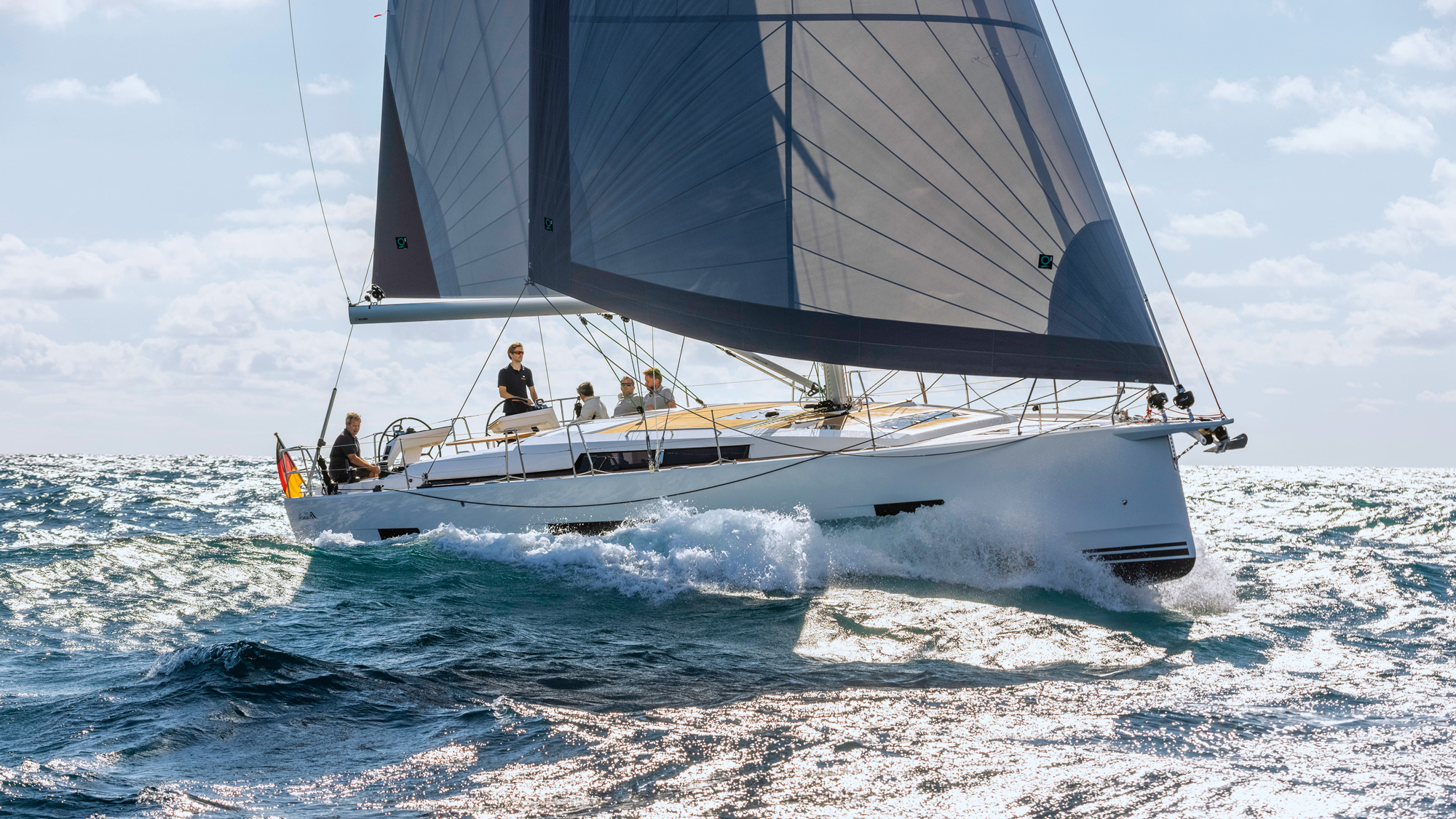
Today’s cruising monohulls tend to have full forward sections and rather bluff bows that markedly increase interior volumes forward. But how do these new hull shapes handle stronger winds? We had the opportunity to test the Dufour 48 in a gusty west-north-westerly of 15 to 26 knots during a blustery interlude between mid-summer heatwaves. It was a perfect chance to find out the answer to that question in testing conditions for any single-rudder monohull that offers a huge amount of accommodation for its length.
Close reaching with full sail at a 70° true wind angle we made an impressive 9.4 knots maximum speed in the gusts. The single rudder felt well loaded at this stage, but with no signs of losing grip.
After bearing away to a true wind angle of 110°, our speed hovered consistently between 8.5 and 9 knots with the boat feeling very comfortable, whether steering by hand or using the autopilot, and we were racking up the miles surprisingly quickly.
The additional beam in the Dufour 48’s forward sections boosts an already high level of form stability, which clearly helps resist excess heel, even in powerful gusts.
On the other hand, the sail plan of our test boat – a big mainsail paired with a small and very high aspect ratio self-tacking jib that depowers towards the head as soon as the sheet is cracked – would have quickly revealed the flaws of many older single rudder designs.
When I first sailed a twin rudder yacht back in the 1990s the level of control it offered, and the feel in the helm, was simply astounding.
I’ve since sailed more than 20,000 miles on dozens of different twin-rudder designs, from 20ft to more than 100ft, including transatlantic and beyond 60° north latitude, and have never been disappointed. However, much has changed in naval architecture over the past 30 years and today good single-rudder designs have far more grip than their forebears.
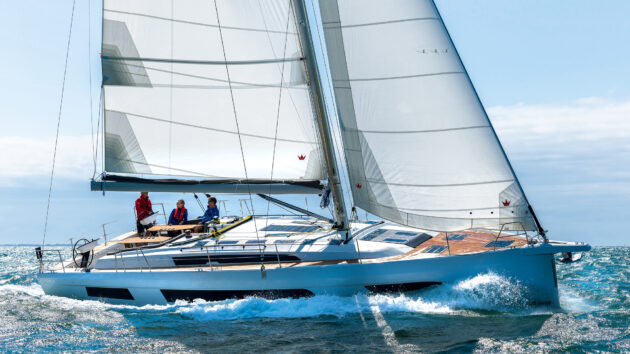
Felci’s modern, full design provides plenty of power and volume, while the single rudder proved capable and responsive in breeze. Photos: Jean-Marie Liot
Key factors behind this dramatic improvement in handling include moving the rudder further forward under the boat, where it’s clear of turbulence near the transom. It also helps that today’s designs tend to have proportionately more draught and a low centre of gravity bulb keel that improves stability. This also allows a deeper and more efficient rudder blade to be specified, without undue risk of the rudder grounding before the keel.
Today’s hull shapes also have massively high form stability once the chines start to dig in. Maximum heel angles are lower and even big gusts have less effect, which translates directly to reduced steering loads.
In addition, the Dufour 48’s full bow sections provide some balance for the broad transom and, when heeled, the boat tends to track in more of a straight line than older designs that paired a wide stern with a narrow bows. When well-heeled, these boats tend to dig the bows in, while the transom, along with the rudder, lifts out of the water. So the Dufour 48 is fundamentally different to wide stern, single-rudder designs of the 1980s and 1990s.
By the time we turned upwind the breeze was down to 16-19 knots, yet we consistently made 7.5 knots boat speed at a touch over 50° to the true wind. This was with the standard Dacron sails and the mainsail trimmed with a lot of twist to depower. With the higher specification laminate sails that come with the Performance pack, and the first reef in the main, we would have undoubtedly pointed a few degrees higher.
As we bore away onto a broad reach to return to La Rochelle, the breeze had dropped to 15 knots, yet we maintained 7 knots boat speed at 130° TWA. Bearing away further caused this figure to drop quickly and we had neither a Code 0 nor a spinnaker on board to check performance at deeper wind angles.
In any case, the breeze built again to 20-22 knots and we accelerated to 7.5–8.5 knots, even when sailing rather deeper at a 145° true wind angle. And when we luffed up to 125-130° TWA our speed jumped to 9 knots.
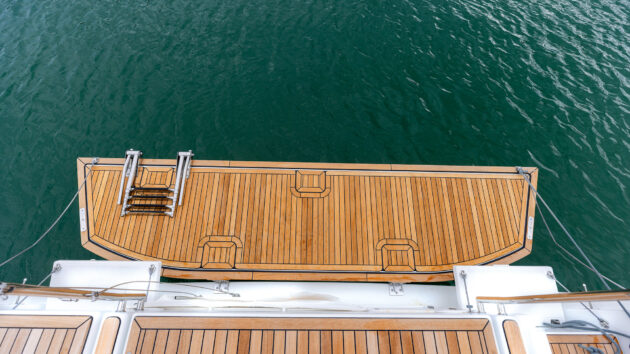
Beamy aft sections equate to significant space, particularly with the wide swim platform down. Photo: Jean-Marie Liot
Choices on deck
Our test boat was the low-spec easy version, with all lines, including sheets, handled at the companionway.
So it’s impossible to trimming sails from the helm, though in reality when short-handed sailing the pilot is likely to be steering almost all the time and it can be convenient to be able to carry out all key sail handling activities from the shelter of the sprayhood.
The top of the sprayhood would benefit from a window so that the mainsail can be seen easily when hoisting, reefing and trimming.
The ocean version has sail controls on the coamings just forward of the helm stations, where a pair of additional winches are located each side.
Artocle continues below…
14 of the most exciting boats to look out for at all the Boat Shows in 2025
Autumn 2025 is set to be a bumper season for new yacht launches. From Sweden to Genoa, and Southampton Boat…
Hanse 460 review: First in a new range
For some of us, sailing has always been about the functional and fundamental. We enjoy sailing for sailing’s sake. But…
£566,000.00
This model also adds a german mainsheet system, a larger jib sheeted via adjustable tracks on the edge of the coachroof, plus deck fittings to fly an asymmetric spinnaker and code 0.
The performance pack builds on this, adding a longer boom with bigger mainsail and a larger 108% headsail, plus up-rated deck gear including an adjustable backstay and cockpit-mounted mainsheet.
There’s an impressive amount of stowage on deck, including lockers each side of a central lazarette that has ample space for a deflated dinghy, fenders and plenty of other watersport toys. Equally, there are good rope bins ahead of the helm stations and at the companionway. There’s also a sail locker forward, with space for a couple of reaching/downwind sails, plus several additional fenders.
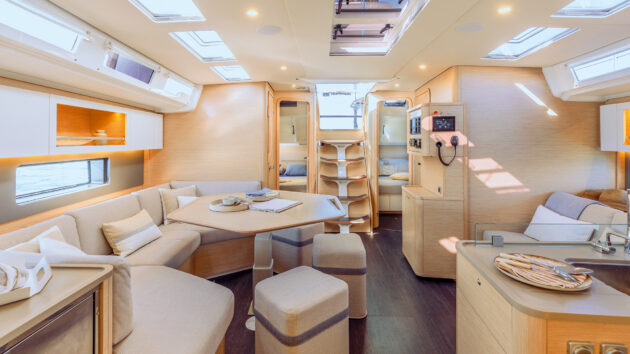
A particularly adaptable layout includes the choice of galley positions. Photo: Jean-Marie Liot
Big volume
In addition to increased form stability and better balance when heeled, the hull shape creates a lot more interior volume than earlier designs and the Dufour 48 has the feel of a particularly large 48-footer, both on deck and inside.
As well as increased space within the owner’s cabin, the extra beam forward allows the head of the generously proportioned peninsula berth to be moved forward, thereby creating more length for the remainder of the accommodation.
Two fundamentally different saloon and galley layouts are offered for the 48, and there’s an option of three, four or five cabins, along with two, three or four heads.
The test boat was the so-called long galley version, with a large and well-equipped linear galley to port, plus a very long saloon with a large dining table offset to starboard.
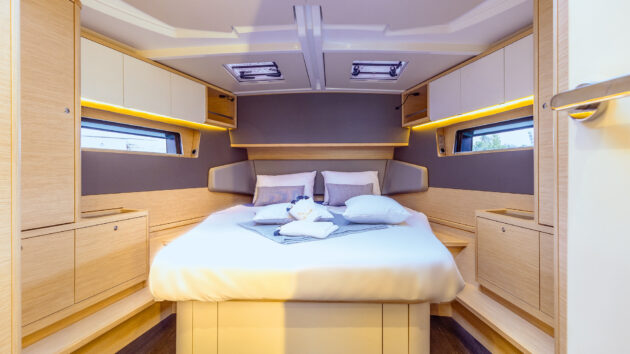
The Increased space is felt in the owner cabin. Photo: Jean-Marie Liot
Alternatively, owners can opt for a galley forward arrangement that spans the full width of the boat just aft of the main bulkhead, plus a short settee on the port side and smaller dining area to starboard.
Dufour says sales to date have been split roughly 50/50 between the two options, with experienced sailors from windier parts of the world, including the uk and france, tending to prefer the full-width forward galley, while those from italy and new england are more likely to choose the linear galley.
The concept of flexibility also extends to the two areas immediately ahead of each of the quarter cabins. Both can be fitted out as heads/shower compartments, with the larger one to port having a separate shower stall. Alternatively, the starboard area can become a small office space, with plenty of stowage, and the port one a pullman cabin with two single beds.
Aft cabins are impressively spacious, partly thanks to the high cockpit sole, though natural ventilation is poor as the only opening ports are to the cockpit well, and in the aft coachroof bulkhead. By contrast, the owner’s cabin forward has excellent natural ventilation thanks to opening hatches above the head of the bed on both sides.
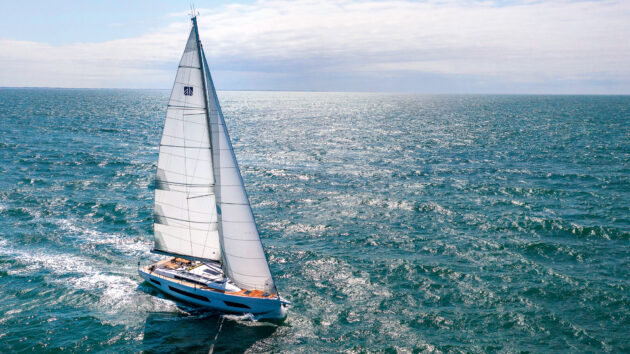
A tall, manageable sailplan: large main and high-aspect self-tacker. Photo: Jean-Marie Liot
This area can also be fitted out as two separate en suite cabins for the charter market.
Dufour has ensured key systems are easy to service marine engine and the electric panels particularly deserve mention for their logical layout and ease of getting to the wiring behind. These are also set up to facilitate neat retrofitting of additional equipment.
As with all models now in the Dufour and Fountaine Pajot ranges, the ODSea+ hybrid propulsion rudder system is available as an option. Owners can also specify a hardtop with solar power over the cockpit area.
This wasn’t fitted to the test boat, but assuming there’s appropriate provision to see the mainsail, the idea is appealing for a pure cruiser, adding excellent shelter and a big advantage in terms of autonomy with ample electrical power.
Dufour 48 specifications
LOA: 15.29m 50ft 2in
Hull length: 14.32m 46ft 1in
LWL: 12.23m 43ft 1in
Beam: 4.85m 15ft 1in
Draught (standard keel): 2.35m 8ft 0in
Draught (shoal keel): 1.75m 5ft 11in
Displacement: 13,900kg 30,644lb
Ballast: 3,850kg 8,487lb
Mainsail: 64m2 688ft2
Genoa: 53m2 570ft2
Fuel: 250lt
Water: 530lt
Price as tested: €522,000 including teak deck, electronics, adventure pack and office/heads option
Contact: dufour-yachts.com
 If you enjoyed this….
Yachting World is the world’s leading magazine for bluewater cruisers and offshore sailors. Every month we have inspirational adventures and practical features to help you realise your sailing dreams.Build your knowledge with a subscription delivered to your door. See our latest offers and save at least 30% off the cover price.
Note: We may earn a commission when you buy through links on our site, at no extra cost to you. This doesn’t affect our editorial independence.
Verdict
Naval architect umberto felci has created a big 48-footer by any standards, yet the handling is surprisingly vice free and the boat offers a good turn of speed. It was responsive to the helm, even when pressed, and also steered reliably under autopilot. But it’s a heavy boat with displacement 25% greater than Beneteau’s new oceanis 47, for instance, and our experience with other Dufour models of this generation show them to be a bit sticky in light airs and need true wind above 10 knots to come alive. The boat’s stable motion felt very comfortable and the high freeboard lifted us well above flying spray, though the sea state still hadn’t built to its full extent. The flexibility of accommodation layouts will broaden the appeal of this model for those who need a supremely spacious boat. The ODSea+ option would be tempting, but adds a big chunk to the price.